Clear Sky Science · en
Towards resilient renewable energy deployment in Africa through a weather-aware optimization framework
Powering a Growing Continent
Africa’s demand for electricity is expected to triple in the coming decades, and much of that power will need to come from the sun and wind. But sunshine and wind are anything but constant. This study asks a simple but crucial question: if African countries are going to bet their future on renewables, how can they choose locations that keep the lights on even when the weather misbehaves?
Looking Beyond the Sunniest and Windiest Spots
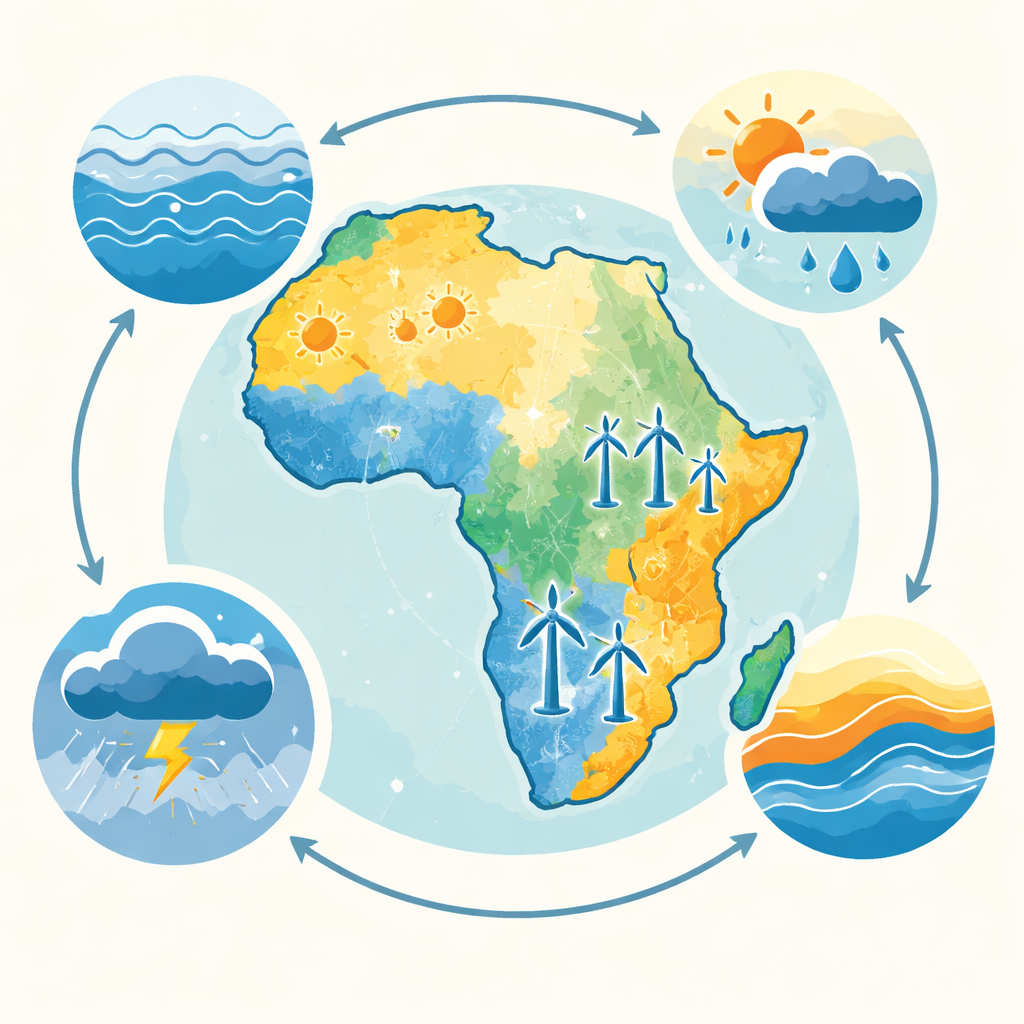
Traditional energy planning often focuses on where average solar radiation and wind speeds are highest. The authors argue that this is not enough. They rebuild a continent-wide map of promising areas for solar panels and wind farms, called model supply regions, by combining long-term satellite-based weather data with practical constraints like population density, protected areas, terrain, roads, and power lines. Crucially, they add a new ingredient: how much the energy output at a site tends to swing up and down over time. This means a place with slightly lower average wind, but more stable conditions, may be preferable to a more turbulent hotspot.
Weather Patterns that Shape Power Output
Africa’s climate is influenced by giant, slowly shifting patterns in the atmosphere and oceans. Two of the most important are the Madden–Julian Oscillation, a pulse of tropical storms that marches eastward every 30–60 days, and El Niño–Southern Oscillation, which warms or cools the tropical Pacific every few years. These patterns alter cloud cover, rainfall, and wind across the continent, and therefore the output of solar and wind farms. The researchers examine how different combinations of these oscillations line up with periods of stronger or weaker renewable generation, finding that some phases consistently boost output in certain regions while others cause noticeable drops.
Discovering Africa’s Own Weather Regimes
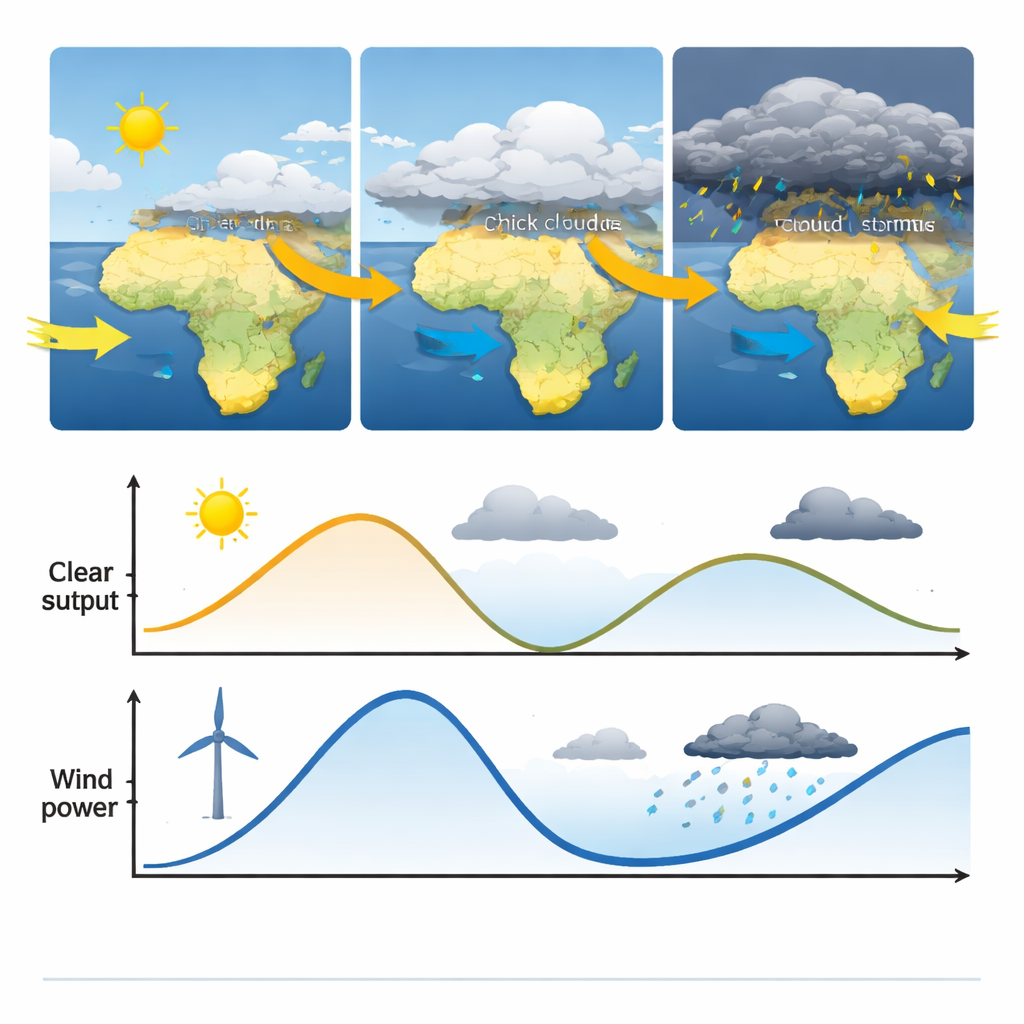
Because global climate patterns do not explain all of Africa’s energy swings, the team develops a set of nine “African OLR regimes,” based on satellite measurements of outgoing heat from the Earth’s surface and clouds. Using a type of machine learning called a self-organizing map, they cluster days with similar cloud and convection patterns over tropical Africa. These regimes capture powerful contrasts—such as clear-sky versus stormy configurations—that more directly track how much sunlight reaches solar panels and how winds behave over key regions. In many cases, these local regimes explain larger ups and downs in electricity yield than the better-known global oscillations.
Country-by-Country Insights and Hotspots
Applying this weather-aware framework to 45 years of data, the authors estimate how much solar and wind each African country could generate from its optimal supply regions and how sensitive that output is to different weather regimes. Some countries, such as Kenya and parts of East Africa, show excellent average potential for both solar and wind but also sizeable variability, especially in wind. Uganda stands out with particularly large swings in wind power between favorable and unfavorable regimes. In contrast, North Africa tends to have steadier conditions, with relatively modest variability, especially for solar. These differences matter for planning grid upgrades, storage, and backup capacity.
Planning for a Weather‑Wise Energy Future
For non-specialists, the takeaway is that building a resilient renewable system in Africa is not just about finding the sunniest desert or the windiest coast. It is about understanding how repeating weather patterns and distant ocean changes can cut or boost electricity for days to weeks at a time. By pinpointing which patterns cause the biggest swings in each country, and how often they occur, this framework helps planners choose sites and design power systems that can ride out natural ups and downs. With better forecasts of these regimes, African nations can move toward clean energy systems that are not only cheap and abundant, but also reliably there when people need them.
Citation: Kurup, R.S., Bloomfield, H.C., Tiwari, P.R. et al. Towards resilient renewable energy deployment in Africa through a weather-aware optimization framework. npj Clean Energy 2, 3 (2026). https://doi.org/10.1038/s44406-026-00019-7
Keywords: renewable energy Africa, solar and wind variability, weather regimes, climate-sensitive planning, energy system resilience