Clear Sky Science · en
APP E590D mutation increases generation of Aβ and Aη peptides and exacerbates tauopathy
Why this rare mutation matters
Alzheimer’s disease is usually thought of as the slow buildup of two harmful proteins, amyloid and tau, in the brain. Most people develop Alzheimer’s without a single clear cause, but a few families carry rare gene changes that can tip the balance dramatically. This paper examines one such uncommon change in the gene for amyloid precursor protein (APP) and shows how it can supercharge the production of toxic protein fragments and worsen the brain-tangling process known as tauopathy. Understanding this rare case offers clues that may apply much more broadly to how Alzheimer’s gets started and then accelerates.
A small genetic change with big effects
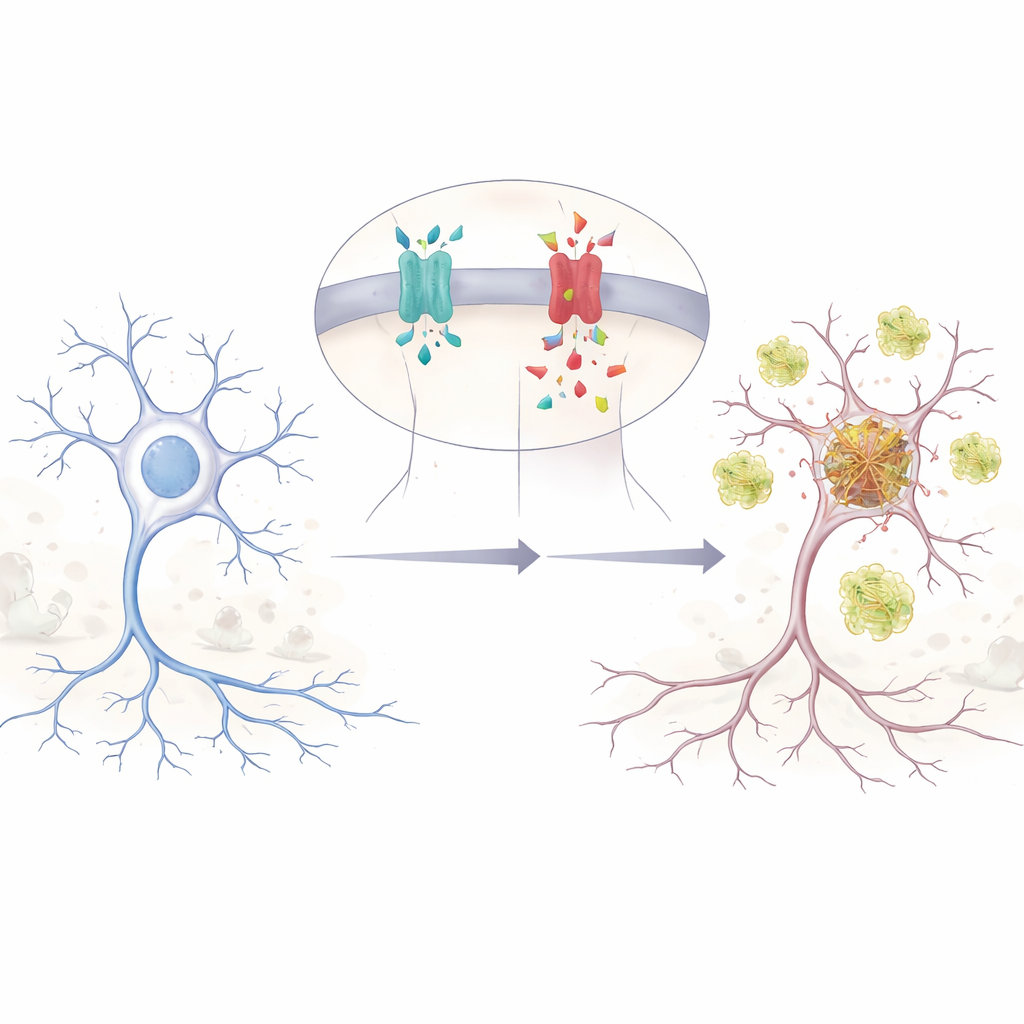
The authors focus on a single-letter change in the APP gene, called E590D in the main brain form of APP. This mutation has been reported in only two people, both with confirmed Alzheimer’s disease at relatively young ages and with unusual, very early memory and behavioral problems. Because it is so rare, scientists were not sure if it truly causes disease or is just an innocent bystander. To find out, the team recreated the mutation in human cells and in mouse neurons, then tracked how APP was chopped up into its many fragments. They discovered that the mutant APP produces much more amyloid beta (Aβ), the sticky peptide long linked to Alzheimer’s, than normal APP does when levels are compared fairly.
Two toxic peptides instead of one
APP can be cut in several ways, like a log being sliced at different points. The classic Alzheimer’s pathway generates Aβ, but another cut produces a lesser-known fragment called Aη. Earlier work showed that Aη can damage the connections between nerve cells and weaken the brain’s ability to strengthen memories. In their experiments, the researchers found that the E590D mutation does not just boost Aβ; it also strongly increases Aη and an upstream fragment that feeds into both pathways. This means the mutation shifts APP processing toward a double hit of harmful peptides, potentially disturbing brain circuits even before classic amyloid plaques would be expected to appear.
How the mutation speeds up cellular traffic
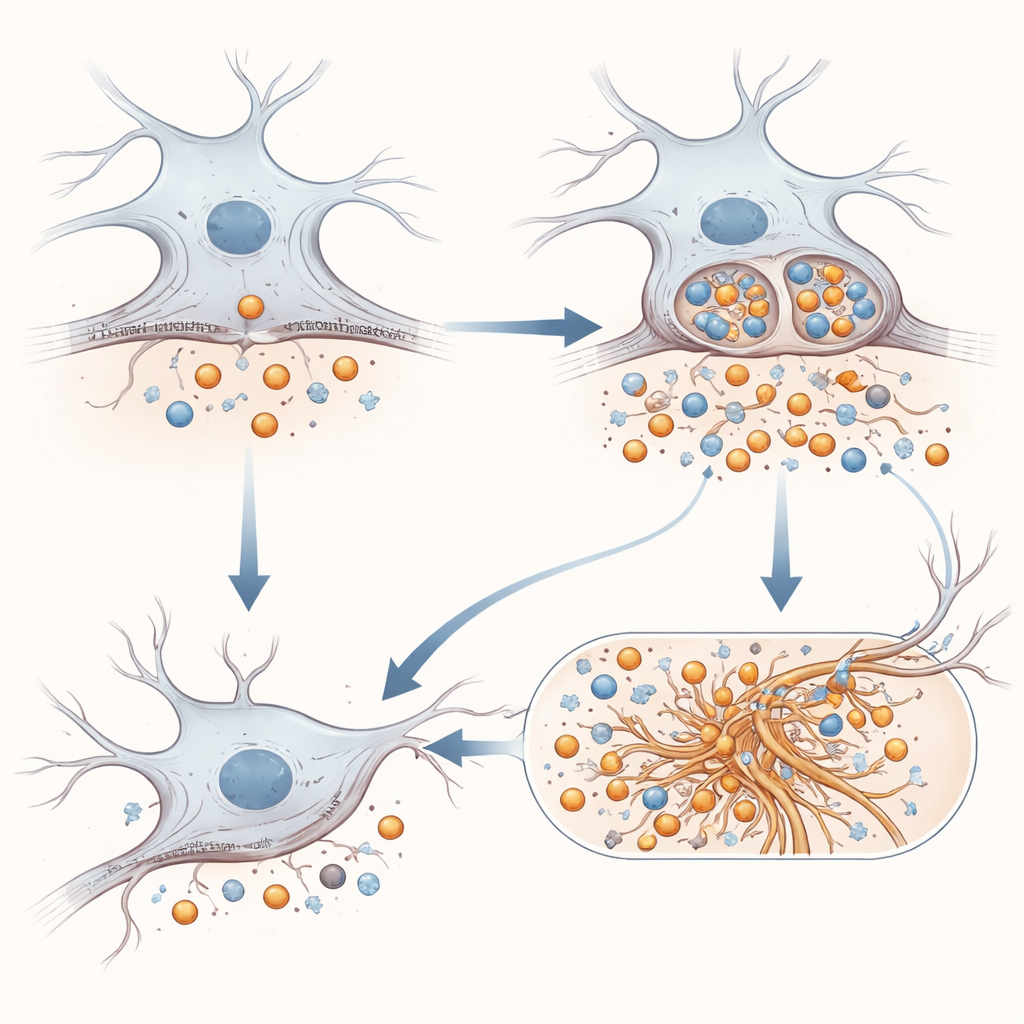
To understand why more toxic fragments are made, the team studied where APP sits and moves on the cell surface. Many of the cuts that create Aβ occur only after APP has been pulled inside the cell through a process called endocytosis. Using imaging and biochemical tricks that label proteins at the surface and then track their internalization, the scientists showed that mutant APP is less abundant on the outside of cells and is taken up more rapidly into internal compartments than normal APP. Once inside these early endosomes, APP meets the enzymes that generate Aβ, and the altered trafficking appears to give those enzymes more opportunity to act. At the same time, cutting at the η site on the surface is also increased, explaining the rise in Aη.
From protein fragments to tangled tau and brain inflammation
The story does not stop with amyloid-related fragments. The researchers tested whether mutant APP would influence tau, the structural protein that forms twisted fibers in many dementias. In cell models that light up when tau seeds cause new tau clumps to form, the presence of E590D APP led to stronger aggregation than either normal APP or no APP. In a mouse model already prone to tau problems, injecting a virus that makes the mutant APP into the hippocampus made tau tangles worse and triggered stronger activation of astrocytes and microglia, the brain’s support and immune cells. Interestingly, standard soluble amyloid pieces were hard to detect in these mouse brains, but a distinct APP-derived fragment appeared only when the mutation was present, suggesting altered processing in living tissue.
What this means for understanding Alzheimer’s
Put together, the findings show that this rare APP mutation is not benign. It pushes APP toward generating more than one toxic peptide, speeds up the internalization steps that favor harmful cuts, and amplifies tau tangling and inflammation in the brain. For non-specialists, the key message is that Alzheimer’s biology is not driven by a single bad actor but by a network of interacting protein fragments and cell responses. Studying such powerful but unusual genetic variants provides a magnified view of that network. In this case, it suggests that therapies may need to consider both amyloid and alternative APP-derived peptides like Aη, as well as their combined impact on tau, rather than targeting one pathway in isolation.
Citation: Liu, T., Wetzel, L., Roy, D. et al. APP E590D mutation increases generation of Aβ and Aη peptides and exacerbates tauopathy. npj Dement. 2, 21 (2026). https://doi.org/10.1038/s44400-026-00069-9
Keywords: Alzheimer’s disease, amyloid precursor protein, tau tangles, neuroinflammation, genetic mutation