Clear Sky Science · en
The global landscape of online dementia resources
Why this matters for families everywhere
Dementia already affects tens of millions of people worldwide, and most day‑to‑day care is provided not by professionals but by family and friends. When a loved one is diagnosed, relatives often turn to the internet in search of clear, trustworthy guidance. This study asks a simple but vital question: what kind of online help is actually available around the globe for these care partners, and who is being left behind?
A global check‑up on dementia websites
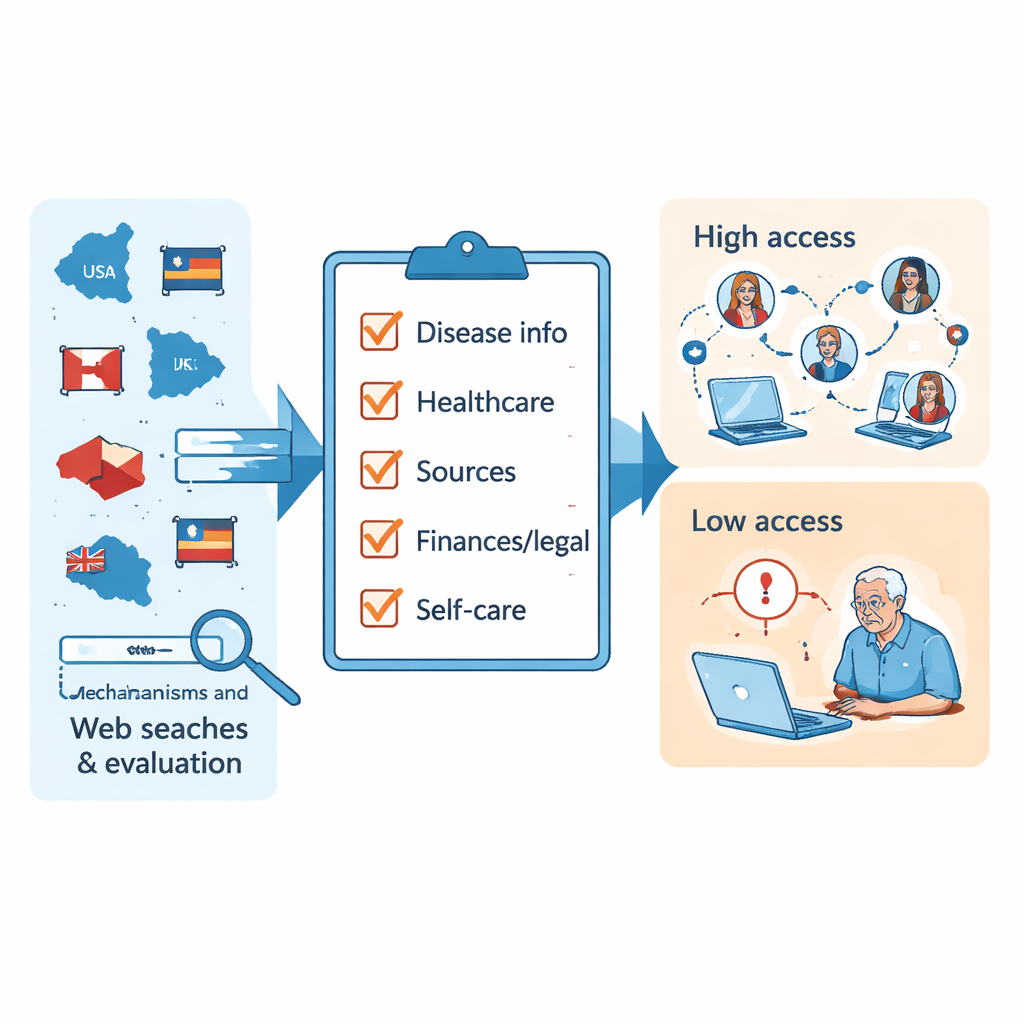
The researchers examined 124 publicly available dementia websites across 17 countries on five continents, from Australia and Belgium to India, Brazil, Kenya and beyond. They focused on sites run by governments, charities, and other organizations that a worried family member might realistically find through a web search. Using a common checklist, they looked at what topics each site covered, how easy it was to find and understand information, and whether the pages were technically accessible to people using phones, slow internet, or assistive tools such as screen readers.
What caregivers most need to know
To judge usefulness, the team relied on an evidence‑based list of what dementia care partners say they need most. This includes plain‑language explanations of the disease, guidance on navigating health services, pointers to trustworthy information sources, advice on their own wellbeing and stress, and practical details about money and legal rights. Each website was scored for how fully it addressed these five areas and how well it met international accessibility standards that aim to make web pages usable for people with different abilities and levels of connectivity.
Strong help in some places, gaps in others
The online help families receive depends heavily on where they live. Countries with high internet access and stronger health spending, such as Australia, France, and Scotland, tended to offer more and better websites, often run by national charities working alongside public services. These sites usually provided rich information on symptoms, everyday care, where to find services, and how caregivers can look after their own health. In contrast, in countries with limited internet infrastructure, including Cuba and the Democratic Republic of Congo, the researchers could not identify any eligible national dementia websites at the time of the search, highlighting a double burden: high need but little online support.
The missing money and legal answers
One of the clearest global gaps was information on finances and legal matters, such as benefits, care costs, powers of attorney, or guardianship. On average, this was the weakest area across all sites, even in wealthier nations. The authors suggest several reasons: rules and entitlements vary by region, are often complex, and may be seen as less urgent than medical advice. Yet for many families, understanding how to pay for care and protect a loved one’s rights is just as critical as knowing the difference between memory loss and normal ageing. The study argues that neglecting these topics leaves caregivers without guidance on some of their hardest real‑world decisions.
Local ideas that could be shared
Despite the gaps, the survey uncovered many creative approaches that could inspire other countries. Examples include virtual dementia hubs that combine online information with live chat, podcasts and WhatsApp groups for carers in Brazil, folklore‑based storybooks for children in Russia, and partnerships with religious institutions in Kenya. Memory Cafés and dementia‑friendly community projects, found in both rich and poorer settings, show how online material can be tied to local, in‑person support. These diverse models suggest that innovation is not limited to high‑income countries; instead, different places adapt to their own cultures, languages, and technologies.
What this means for families and policy makers
For families, the study’s message is both reassuring and cautionary. Helpful online dementia resources do exist, and some countries already offer thorough, easy‑to‑use portals. But quality is uneven, crucial financial and legal guidance is often missing, and people in low‑connectivity regions may find little or nothing online. The authors call for national, well‑governed websites that meet minimum content and accessibility standards, link directly to health and social services, and are backed up by offline options such as helplines, radio programmes, and printed guides. Put simply, as dementia becomes more common, fair access to clear, trustworthy information should be treated as a basic part of care, not a luxury reserved for those with fast internet and strong health systems.
Citation: Kinchin, I., Dupont, C., Mayan, I. et al. The global landscape of online dementia resources. npj Dement. 2, 17 (2026). https://doi.org/10.1038/s44400-026-00063-1
Keywords: dementia caregiving, online health information, global health equity, digital accessibility, caregiver support