Clear Sky Science · en
Telomere shortening in the association between accumulation of affective symptoms and later-life cognition
Why Your Mood Might Matter for Your Future Mind
Many people worry that feeling anxious or low over the years might set them up for memory problems or even dementia later in life. At the same time, we often hear that the tiny caps on our chromosomes—called telomeres—act as a kind of biological clock for aging. This study brings those two ideas together, asking a simple but important question: do these cellular “caps” help explain why lifelong emotional difficulties are linked to how well we think in our later years?
Following One Generation Across a Lifetime
To explore this, researchers turned to a unique British study that has followed thousands of people born in one week in 1946 for nearly seven decades. Throughout their lives, these participants regularly answered questions about their emotional health, including symptoms of anxiety and depression, and took tests of memory and thinking speed in midlife and again at age 69. At ages 53 and again at 60–64, many also gave blood samples so scientists could measure the length of their telomeres and how quickly those telomeres shortened over ten years. This rare combination of long-term mental health records, thinking tests, and biological measures allowed the team to test whether telomeres were a missing link between mood and later-life thinking ability. 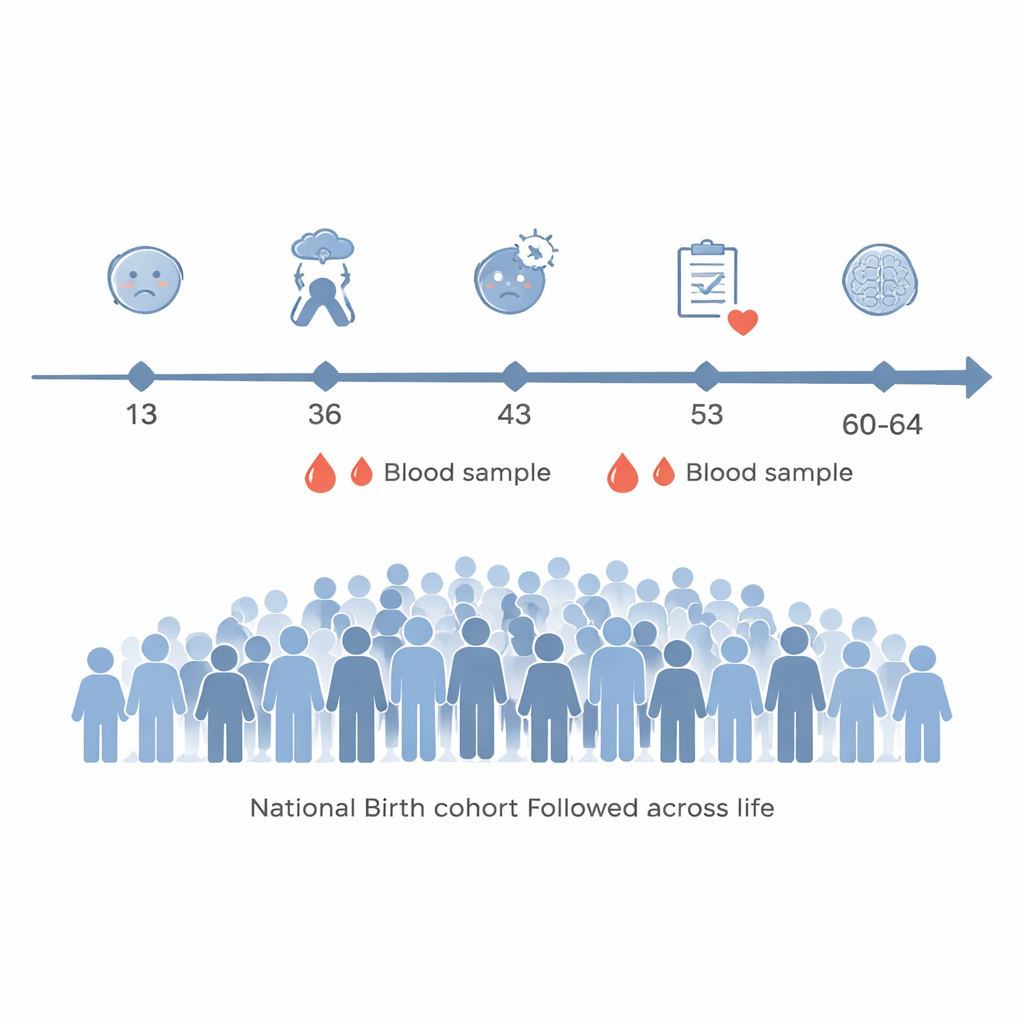
Testing How Feelings, Cells, and Thinking Interact
The researchers focused on two big ideas. First, telomeres might act as a middle step: repeated bouts of anxiety or depression across adulthood could speed up telomere shortening, which in turn might lead to memory loss or slower thinking. Second, telomeres might be a common cause: people born with shorter telomeres, or whose telomeres shrink faster, might be more likely to develop both emotional problems and cognitive decline as they age. Using statistical models, the team examined links between the accumulation of affective symptoms from adolescence to early old age, telomere length and shortening, and three ways of measuring thinking at 69: a broad cognitive exam, a verbal memory test, and a test of how quickly people could search for letters on a page.
What the Study Actually Found
Lifetime emotional symptoms did show some connection to how quickly people could search for letters at age 69: those with more repeated symptoms tended to be a little slower on this task, even after taking account of education, early-life thinking ability, social class, and other factors. However, emotional symptoms were not clearly linked to performance on the broader cognitive exam or the memory test once these other influences were considered. Crucially, there was no sign that telomere length or the rate at which telomeres shortened over ten years acted as the bridge between mood and thinking. Telomeres were not tied to emotional symptoms in later life, nor did they help explain the impact of long-term affective problems on any of the cognitive measures.
A Small Signal, but No Smoking Gun
There was one modest exception: people with longer telomeres at around age 60–64 tended to perform slightly better on the thinking-speed task at 69, even after adjusting for many background factors. But this link was small, and the rate of telomere shortening itself did not remain related to thinking speed once those same factors were considered. The results suggest that, at least in this relatively healthy group of 69-year-olds, telomeres are not a major driver of the connection between mood and cognition. The authors note that stronger links might emerge at older ages, in people with more severe depression, or in those already experiencing dementia, where earlier work has found clearer ties between short telomeres and disease. 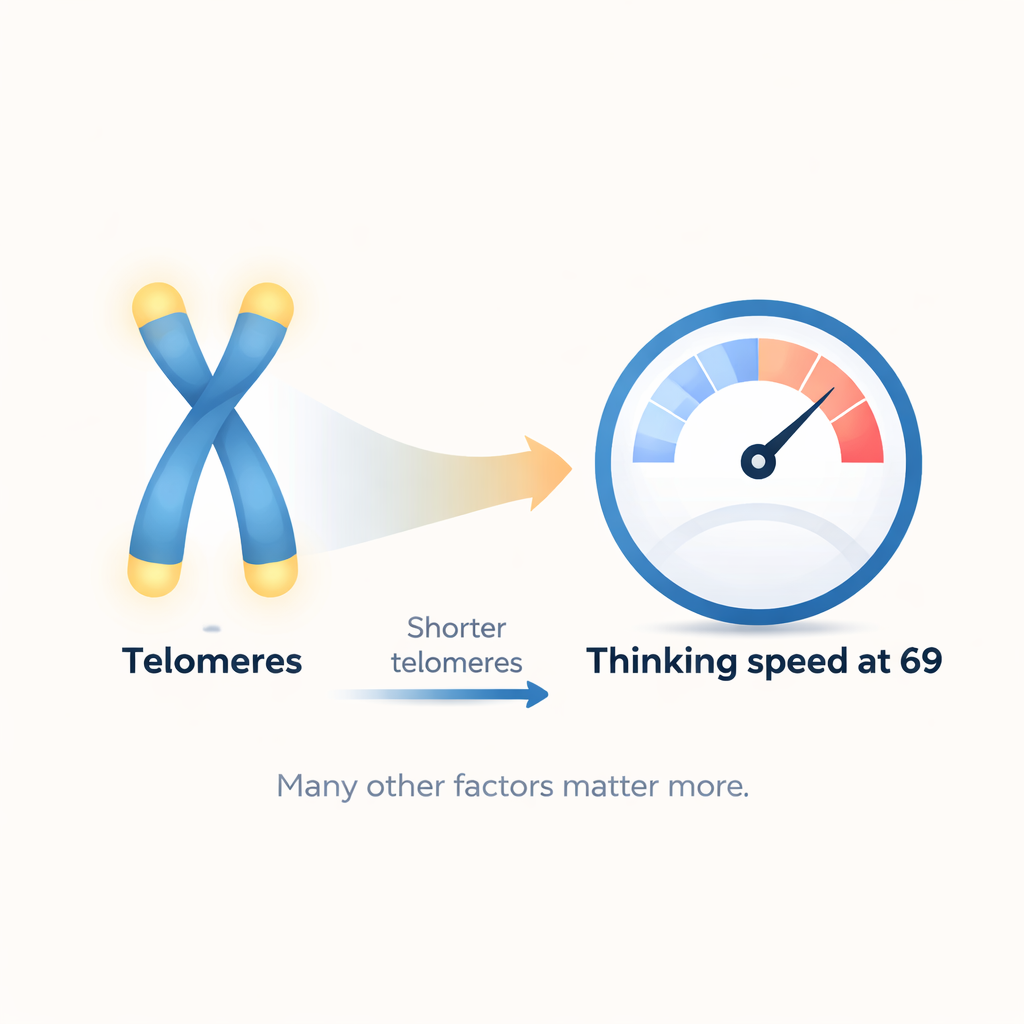
What This Means for Healthy Aging
For non-specialists, the take-home message is reassuring but nuanced. This study confirms that emotional health across adulthood can matter for certain aspects of thinking in later life, such as mental speed. But it also shows that one popular biological explanation—shortening of telomeres in blood cells—does not appear to be the key reason for that link in generally healthy older adults. Instead, other factors, including heart and metabolic health, inflammation, lifestyle, and social circumstances, may play larger roles. Rather than looking for a single “aging switch” in our cells, the findings point toward a more complex picture in which many pathways shape how our brains age—and in which looking after our mood remains important, even if telomeres are not the whole story.
Citation: Melville, M., Desai, R., Singham, T. et al. Telomere shortening in the association between accumulation of affective symptoms and later-life cognition. npj Dement. 2, 14 (2026). https://doi.org/10.1038/s44400-026-00061-3
Keywords: telomeres, cognitive decline, depression and anxiety, healthy aging, dementia risk