Clear Sky Science · en
Proper name anomia in people with Alzheimer’s disease: implications for diagnosis and treatment—a systematic review
Why Remembering Names Matters
Most people know the awkward feeling of seeing a familiar face but blanking on their name. For people with Alzheimer’s disease, this problem—called proper name anomia—can be constant and deeply upsetting. This review article pulls together what scientists know about why names are so easy to lose, how this relates to Alzheimer’s, and what kinds of training can actually help people hold on to the names that matter most to them.
The Special Challenge of People’s Names
Names are not like other words. Common words, such as “apple” or “chair,” link to rich networks of meaning: color, shape, how they are used, and so on. People’s names, by contrast, are mostly arbitrary labels. Many unrelated people can be called “John,” and knowing the name tells you almost nothing about the person. As we age, this weak link between the name and the person makes proper names especially fragile, even in healthy adults. The review explains that this fragility is magnified in Alzheimer’s disease, where brain areas that support memory and language are already under strain.
Three Steps From Face to Name
According to modern cognitive models, naming a familiar person involves three key steps. First, we recognize the face or the voice and realize that this is someone we have met before. Second, we access person-specific knowledge, such as what they do, where we know them from, or important events we share with them. Third, we retrieve and say the person’s name. Using data from 22 studies, the authors estimate that in Alzheimer’s disease, name failures stem from problems with face recognition in about one fifth of cases, from weakened person knowledge in about one third, and from breakdown at the final “say the name” step in about two fifths of cases. 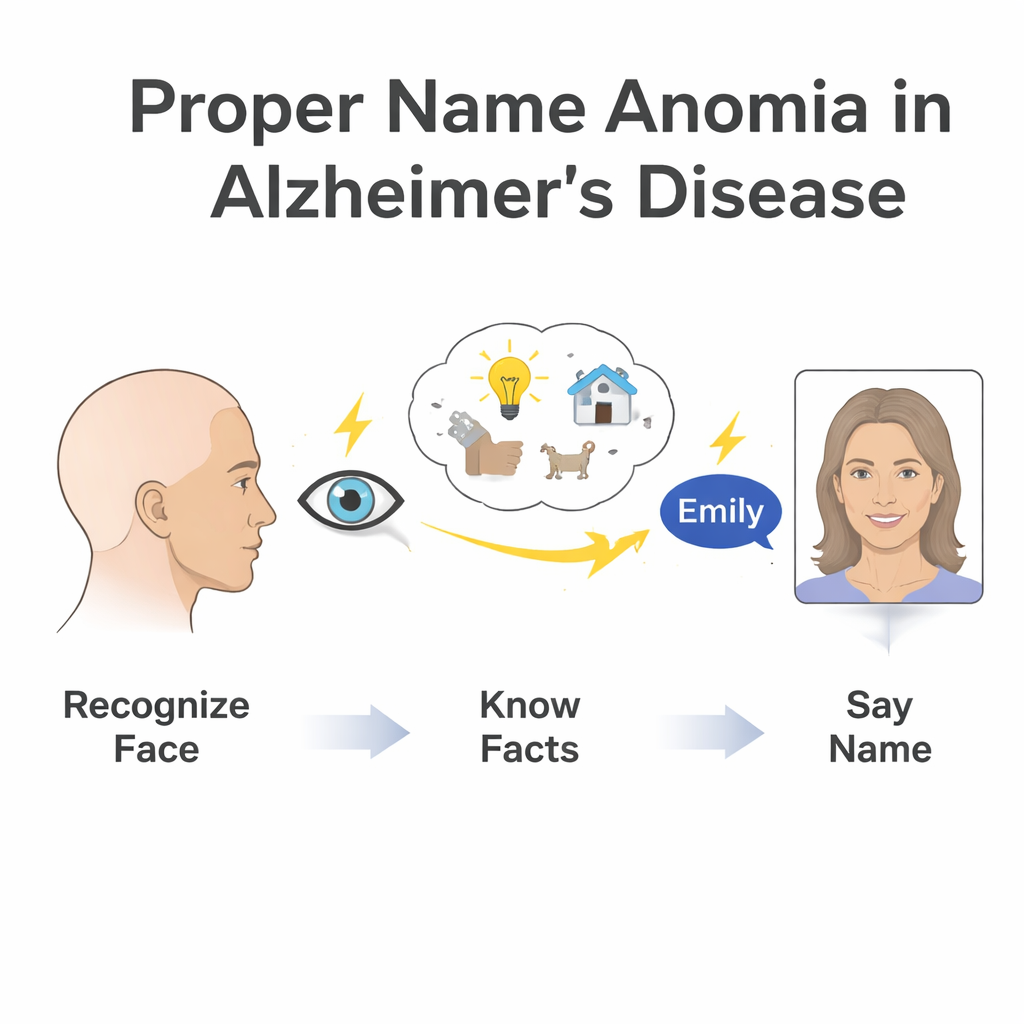
Early Warning Sign of Memory Trouble
Several of the studies reviewed asked whether trouble with people’s names might be an early warning sign of Alzheimer’s. Researchers used “famous faces” or “famous names” tests, which ask people to identify well-known public figures from different eras. Even individuals with only very mild symptoms, who scored near-normal on standard dementia tests, often performed poorly on these name tasks. People with mild cognitive problems who later went on to develop Alzheimer’s tended to do worse on naming famous individuals than those who did not progress. Although no study has yet provided the large-scale data needed to calculate how accurate this sign is on its own, the pattern suggests that name-finding problems could help clinicians spot Alzheimer’s earlier when combined with other tests.
Can Practice Really Help?
Encouragingly, almost half of the studies in the review looked at ways to improve name recall. Many used structured memory exercises to help people with Alzheimer’s either learn new face–name pairs or relearn the names of people they already knew. Techniques included spaced retrieval (practising the name at gradually increasing intervals), errorless learning (designing tasks so that the person is guided to the right answer rather than guessing), and “vanishing cues,” where more of the name is shown at first and then slowly removed as recall improves. Across these studies, people with Alzheimer’s were able to learn or relearn names, especially when the faces were already familiar, and some gains lasted for months. Training that combined helpful cues with spaced practice tended to work best. 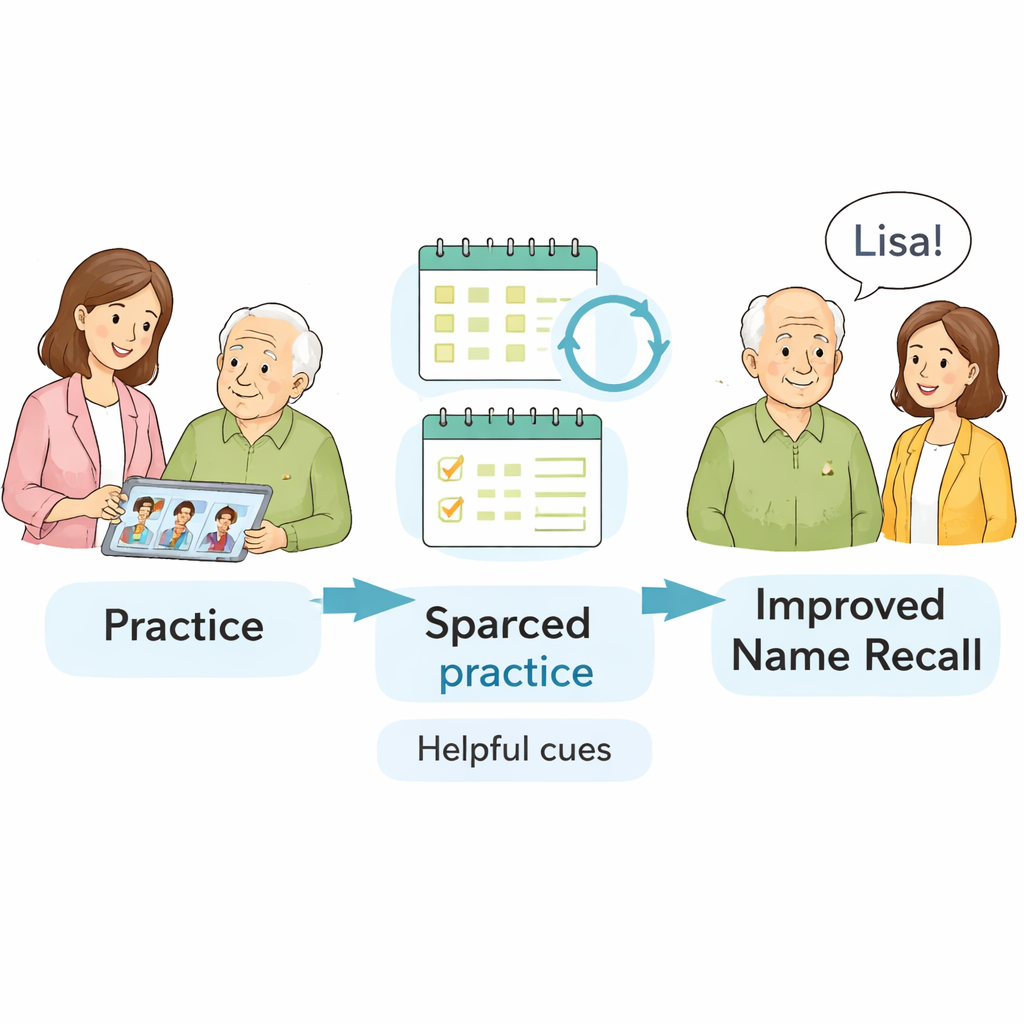
What This Means for Families and Care
The review concludes that difficulty recalling names is not just a social annoyance—it is a central and often early feature of Alzheimer’s disease, with clear emotional and practical consequences. While scientists still need larger, longer-term studies, current evidence shows that simple, well-structured exercises can help many people with Alzheimer’s keep important names accessible for longer. Families and caregivers can build on these ideas by regularly reviewing labeled photos, practising names little and often, and using prompts such as the first sound of a name rather than simply repeating, “Don’t you remember?” In everyday terms, this work suggests that with patience, repetition, and smart use of cues, it is possible to shore up one of the most personal parts of memory: knowing who the people around you are, and what to call them.
Citation: Badalova, A., Stott, J. & Leff, A.P. Proper name anomia in people with Alzheimer’s disease: implications for diagnosis and treatment—a systematic review. npj Dement. 2, 11 (2026). https://doi.org/10.1038/s44400-026-00058-y
Keywords: Alzheimer’s disease, name-finding, memory training, famous faces, dementia