Clear Sky Science · en
SENSE-Cog Residential Care: piloting hearing and vision support for dementia in long-term care
Why Senses Matter in Dementia Care Homes
For many people living with dementia in nursing homes, the world can quietly fade out of focus and sound. Hearing loss and poor eyesight are extremely common in this group, yet are often overlooked. This study asks a simple but powerful question: if we systematically check residents’ hearing and vision, improve their glasses and hearing aids, train staff, and adjust the environment, can daily life in long-term care feel clearer, calmer, and more connected?
Hidden Hearing and Sight Problems
In Ireland and many other countries, a large share of people with dementia live in long-term care facilities. Research shows that up to nine out of ten have significant hearing loss, and more than four in ten have serious vision problems—rates far higher than among people with dementia who remain at home. When hearing and sight are poor, conversations become harder to follow, activities are less enjoyable, and people may appear more confused or withdrawn. These changes can easily be blamed on dementia alone, meaning treatable sensory problems remain undiscovered and unmanaged.
Why Usual Care Falls Short
Although staff in care homes are generally aware that residents struggle with hearing and vision, support is patchy. Glasses and hearing aids may not be checked regularly, repairs and replacements can be slow, and care homes often lack clear systems for arranging specialist visits. Environments can also be “sensory unfriendly”: noisy dining rooms, echoing corridors, or dim lighting that make it harder to see and hear. Staff frequently report that they want to do better but lack training, time, and straightforward guidance on what to change.
A New Multi-Level Support Program
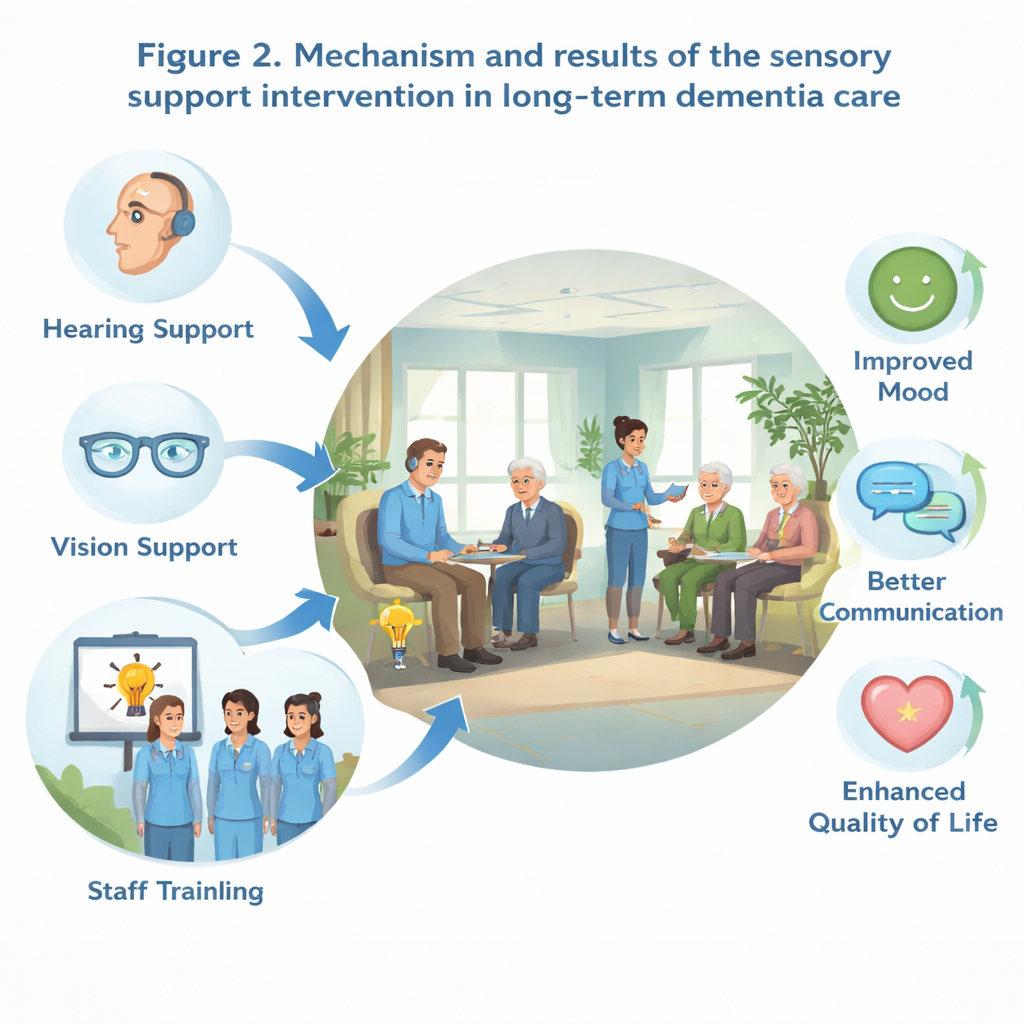
To tackle these gaps, the researchers adapted an existing home-based program, called SENSE-Cog, for use in residential care. The new version, SENSE-Cog Residential Care, focused less on residents managing their own devices and more on the care home as a whole. In a pilot trial across nine Irish facilities, homes were randomly assigned either to continue with usual care or to receive a four-part intervention: personalised hearing and vision assessments for residents, staff training led by a “sensory champion” in each home, an audit and improvement plan for the physical environment, and a review of how the home connects with outside hearing and vision services.
What Happened in the Pilot Trial
The team recruited 27 residents with dementia and sensory problems and followed them for three months. Twelve residents in the intervention homes received on-site hearing and vision checks, which led to new or updated glasses for all, four hearing aids, and six listening devices such as personal amplifiers. Staff training reached 42 staff members, and sensory champions stayed in close contact with the research therapist. By follow-up, about two-thirds of residents were wearing their glasses daily and three-quarters of those given hearing aids were still using them. Only a minority continued with listening devices, suggesting these may be harder to integrate into everyday routines. An environmental audit was completed in all intervention homes, but only one facility managed to implement noticeable changes, such as reducing group noise levels.
Early Signs of Benefit and Lessons Learned
Because this was a small feasibility study, it was not designed to prove effectiveness. Even so, residents in the intervention group showed promising improvements in several aspects of quality of life, particularly feelings, memory-related experiences, and day-to-day activities, compared with those receiving usual care. There were no serious harms linked to the program. The trial also revealed practical issues: it often took two to three months for hearing aids and listening devices to be delivered, leaving little time for residents to adjust before follow-up, and publicly run homes sometimes faced building restrictions that limited environmental changes. These insights will help shape a larger, more robust trial.
What This Means for Families and Care Homes
The study shows that it is both possible and acceptable to bring structured hearing and vision support into dementia care homes, and that doing so may improve residents’ mood, comfort, and engagement. Families and staff should not assume that all changes in behaviour are “just dementia” when untreated hearing or sight problems could be playing a role. The authors conclude that a full-scale trial, with longer follow-up and more flexible environmental adjustments, is justified. If future research confirms these early gains, routine hearing and vision support could become a standard part of high-quality dementia care, helping residents stay more connected to the people and places around them.
Citation: Leroi, I., Aijala, M., Boland, E. et al. SENSE-Cog Residential Care: piloting hearing and vision support for dementia in long-term care. npj Dement. 2, 12 (2026). https://doi.org/10.1038/s44400-025-00046-8
Keywords: dementia care, hearing loss, vision impairment, nursing homes, sensory support