Clear Sky Science · en
Classroom AI: large language models as grade-specific teachers
Teaching Help from a Digital Partner
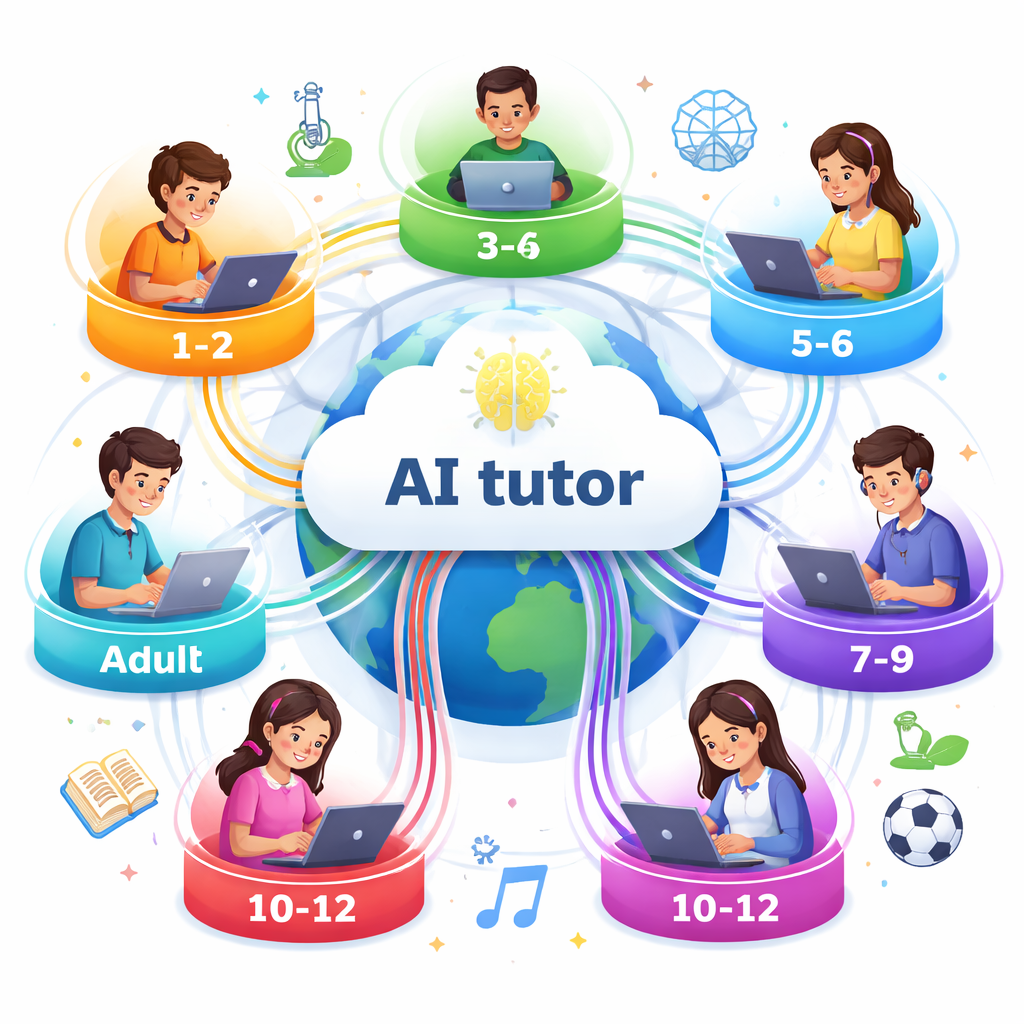
Across the world, millions of children go to school without enough qualified teachers, and even in well‑resourced classrooms, it is hard to give every student explanations that truly match their age and reading level. This study explores whether modern artificial intelligence, specifically large language models, can be turned into “grade‑specific teachers” that talk very differently to a first‑grader than to a college student, while still getting the facts right.
Why Matching Words to Ages Matters
Good teaching is not only about knowing the right answer, but about saying it in a way a student can understand. Today’s AI chatbots can solve many problems, yet they often reply in language that is too advanced, even when asked to “explain for a 3rd grader.” Earlier research mostly tested simple prompting tricks and found they fell short, especially for younger readers. The authors argue that if AI is to support learning fairly around the globe, it must reliably produce clear, age‑appropriate explanations across a wide range of subjects and questions, not just rewrite or shorten existing texts.
Building a Scale for Easy and Hard Text
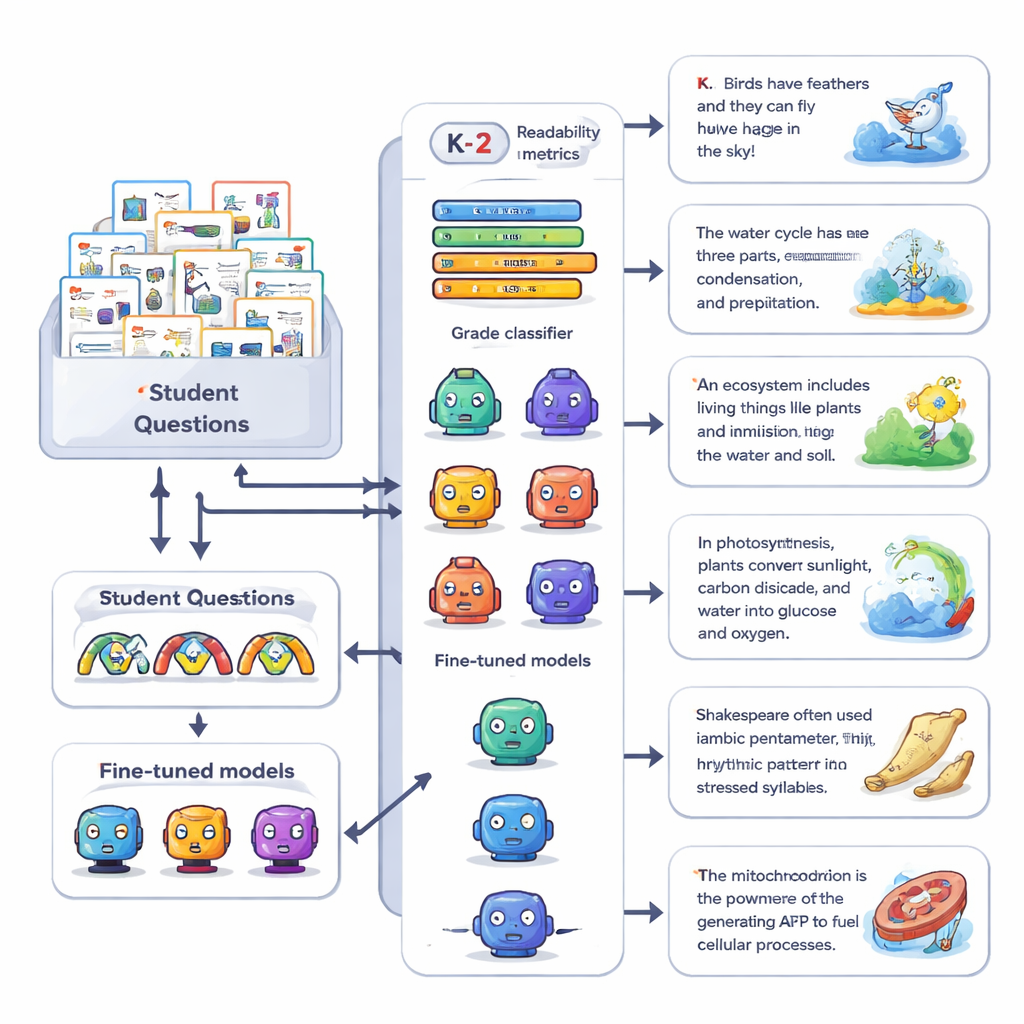
To tackle this, the researchers first needed a trustworthy way to judge how hard a piece of writing is to read. Instead of relying on a single yardstick, they combined seven classic readability formulas that measure things like sentence length, word length, and how many “hard” words are used. They grouped these formulas by what they focus on and then created an integrated voting scheme that assigns each answer to one of six bands: lower elementary, middle elementary, upper elementary, middle school, high school, and college or adult. This richer scoring system can pick up subtle differences in complexity that a lone metric might miss.
Training AI to Speak Six Different Ways
Armed with this reading‑level scale, the team generated a large synthetic dataset. Using several state‑of‑the‑art language models, they wrote thousands of open‑ended questions across 54 school subjects, from science and health to literature and social studies. For each question, they prompted an AI model to produce many different answers, varying the intended grade and sentence length. Their integrated readability tool then labeled each answer with an actual grade band. These labeled question‑answer pairs became training material to fine‑tune six separate versions of an AI model, each aimed at one grade group, so that the “lower elementary” model naturally uses short sentences and simple words, while the “adult” model offers longer, more detailed explanations.
How Well the Grade‑Specific Teachers Performed
The authors tested their models on several real and synthetic question sets. They measured “compatibility,” meaning how often an answer truly landed at the target grade level, and “accuracy,” meaning whether the answer was factually correct and relevant. Compared with simple prompt‑only approaches, the fine‑tuned models boosted grade‑level success by about 36 percentage points on average, especially for the hardest group to reach: elementary school students. Importantly, this tailoring did not substantially harm accuracy on science questions. Surveys with 208 human participants, plus checks with another AI judge, showed strong agreement that the answers from different grade‑specific models really did grow more complex and sophisticated as the grade level increased.
What This Means for Classrooms and Students
The study concludes that large language models can be reshaped into reliable, grade‑aware helpers that adjust their wording to students’ reading abilities while keeping explanations correct. This does not yet solve the deeper problem of whether a young child can grasp very abstract ideas, but it is a major step toward AI tools that meet learners where they are. If developed and deployed carefully, such grade‑specific AI tutors could extend the reach of skilled teaching, support overburdened educators, and bring clearer explanations to students who currently lack access to quality instruction.
Citation: Oh, J., Whang, S.E., Evans, J. et al. Classroom AI: large language models as grade-specific teachers. npj Artif. Intell. 2, 28 (2026). https://doi.org/10.1038/s44387-026-00081-7
Keywords: AI tutoring, grade-level readability, educational technology, large language models, personalized learning