Clear Sky Science · en
Designing band gaps with randomly distributed sub-wavelength Helmholtz resonators
Turning Noise into Quiet with Smart Randomness
Imagine a thin panel that can block or reroute annoying sounds, not by precise, delicate patterns, but by embracing randomness. This paper shows how to design such sound‑controlling materials using many tiny acoustic "bottles" called Helmholtz resonators, scattered at random. Remarkably, the authors derive simple formulas that let engineers predict how these messy‑looking materials behave, opening the door to cheaper, more robust sound barriers and filters.
Little Bottles that Tame Sound
Helmholtz resonators are everyday physics in disguise: a classic example is the tone you hear when you blow across the mouth of a bottle. Each resonator responds strongly at a particular pitch, soaking up or reflecting that part of the sound. Traditional acoustic metamaterials—artificial structures that bend and block waves in unusual ways—line up many identical resonators in neat, repeating patterns. This regularity creates "band gaps": frequency ranges where sound cannot travel. But packing several different gaps into one material usually demands complex, multi‑scale patterns that are hard to design and even harder to manufacture.
Order without Order: Random Metamaterials
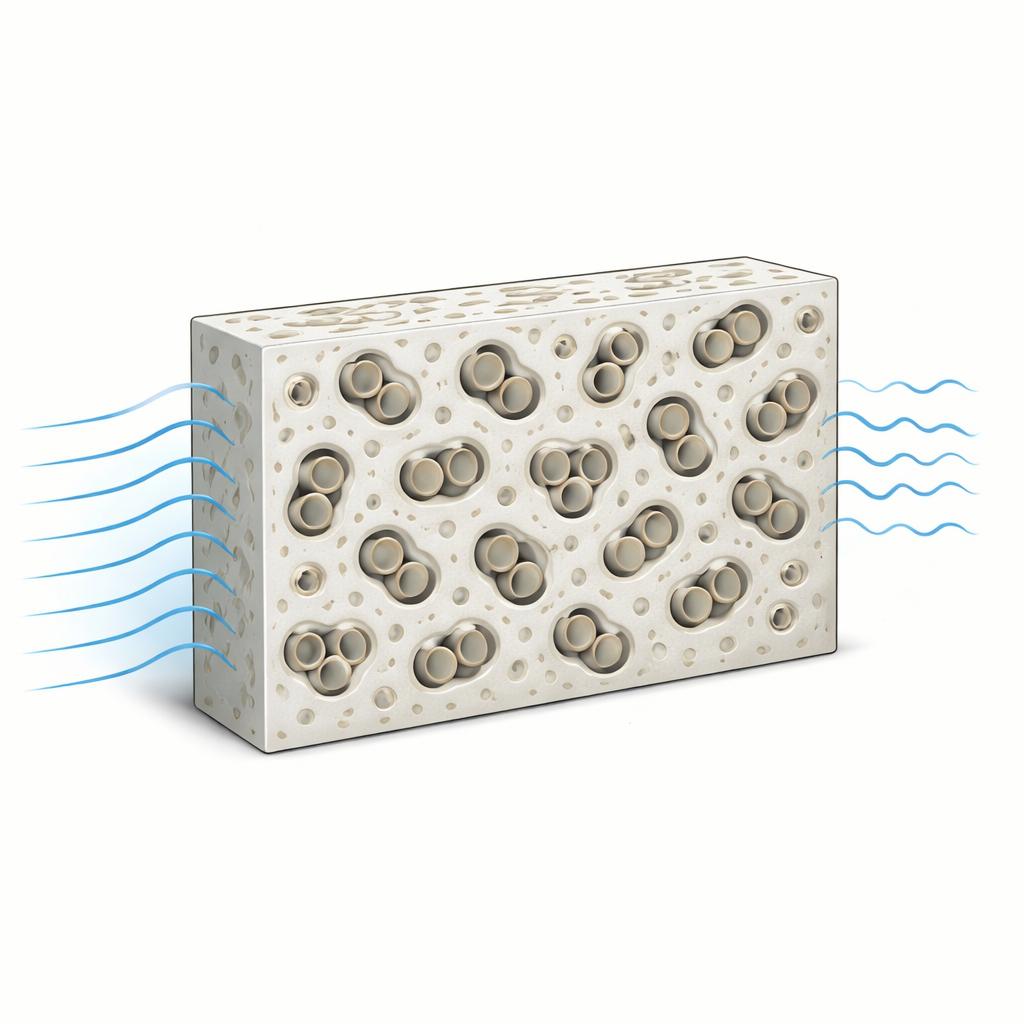
Instead of relying on strict periodic patterns, the authors design materials made from many different kinds of sub‑wavelength Helmholtz resonators, all tossed randomly into a background medium such as air. Each resonator has its own preferred frequency, set by its size and the width of its opening. By mixing species with different geometries, the material as a whole can block several frequency ranges that overlap or merge into a broad quiet zone. The key is to replace the messy details of individual resonators with effective bulk properties—an overall density and compressibility—that describe how the average wave moves through the mixture.
Simple Formulas from Complex Physics
Using advanced wave‑scattering theory and a mathematical technique called homogenization, the authors derive compact formulas for the material’s effective density and bulk modulus. In plain terms, these formulas tell you how fast sound travels in the composite and how easily it can be squeezed. The effective density turns out to depend mainly on how much of the material’s volume is filled by resonators, and not on frequency. By contrast, the effective bulk modulus changes sharply with frequency and with the internal geometry of each resonator type. Where this modulus takes on certain values, the material develops a band gap: the average sound wave cannot propagate, although a faint, mottled “speckle” pattern of scattered energy may still sneak through.
Designing Quiet Zones and Smart Filters
To demonstrate how their formulas work, the authors explore several design examples. With just one kind of thin‑walled resonator, they show that modest filling fractions—only a few percent of the volume—can open a strong band gap, turning a slim layer into an effective acoustic shield. Adjusting how many resonators are present broadens the blocked range and shifts it in frequency. Adding a second species of resonator with a different opening size produces either a single broad gap or two separate gaps, depending on how far apart the individual resonances lie. With three species, they reveal a subtle effect: thickening the walls of the resonators first lowers the resonance frequency and then, past a point, raises it again and weakens the effect, behavior that would be hard to guess without the theory.
From Theory to Practical Devices
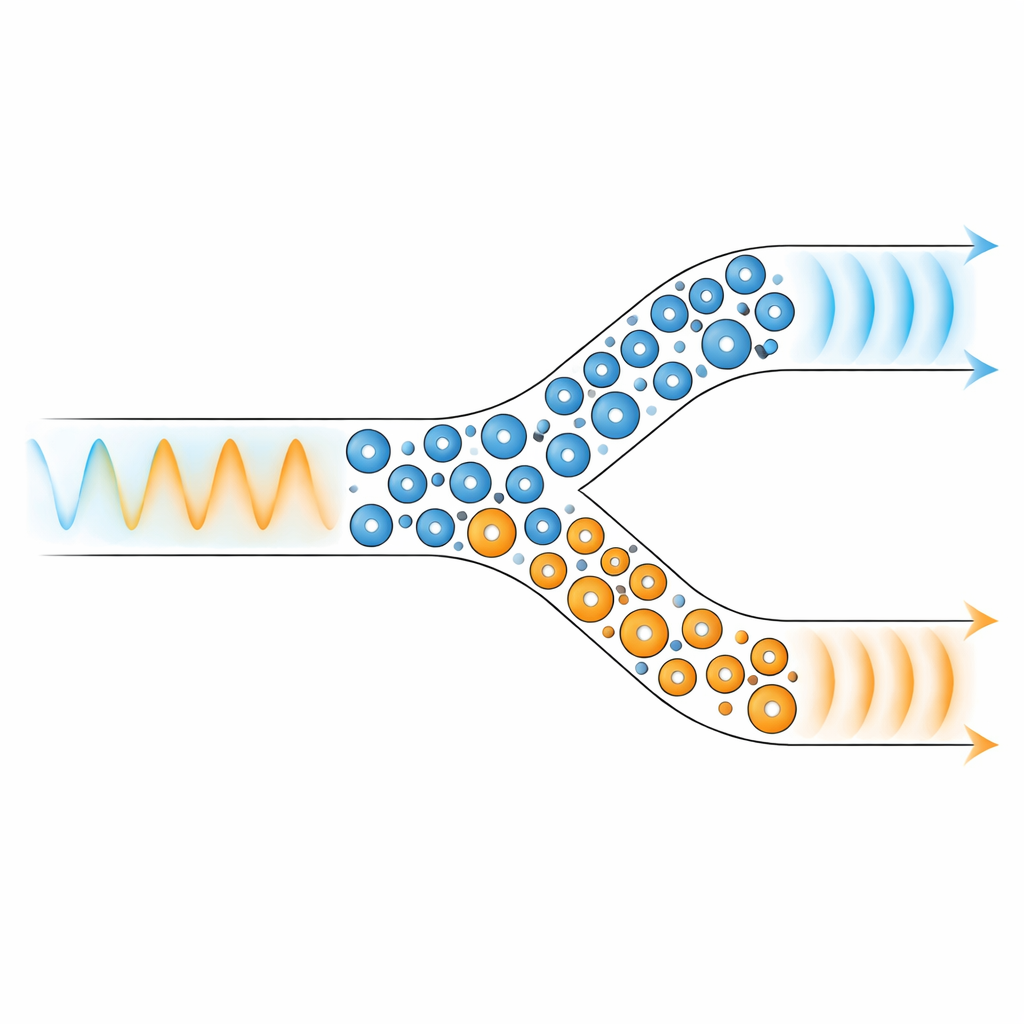
The team then stress‑tests their formulas against heavy‑duty computer simulations. They perform thousands of Monte‑Carlo runs, each with a different random placement and orientation of resonators, to compute how much sound is transmitted or scattered. Over the low‑frequency range where the resonators are smaller than the wavelength, the simple effective‑property formulas closely match the simulated average response, both for a flat layer and for a circular cluster. Building on this, the authors design a “frequency demultiplexer”: a waveguide that splits into two branches, each filled with a different resonator mix. Incoming sound is automatically steered so that one band of wavelengths exits mainly through the upper branch and another band through the lower one, all using randomly arranged elements rather than carefully optimized layouts.
Why This Matters for Real‑World Sound Control
The main takeaway is that useful acoustic devices do not need perfect order. By understanding how many and what kinds of tiny resonators to mix into a host material, designers can quickly sketch out walls and components that block, absorb, or route selected frequencies—even in the face of manufacturing imperfections. These random metamaterials trade the need for fine spatial control for a powerful set of design rules: simple formulas that link desired frequency bands to resonator geometry and concentration. That shift could make advanced sound control more accessible in applications ranging from quieter buildings and machinery to compact filters and sensors in communications hardware.
Citation: Piva, P.S., Gower, A.L. & Abrahams, I.D. Designing band gaps with randomly distributed sub-wavelength Helmholtz resonators. npj Acoust. 2, 10 (2026). https://doi.org/10.1038/s44384-026-00045-w
Keywords: acoustic metamaterials, Helmholtz resonators, sound band gaps, random composites, frequency filters