Clear Sky Science · en
Topological transfer of multidimensional states in phononic crystals
Sound That Knows Where to Go
Imagine being able to send sound from one tiny spot of a device to another, even around defects and imperfections, with almost no loss or distortion. This is the promise of new “topological” sound structures called phononic crystals. In this work, researchers show how to guide sound in a remarkably controlled way so that it travels from one corner of a structure, along its edges, through its interior, and out at another corner—almost as if the sound wave were following a pre-drawn route on a map.
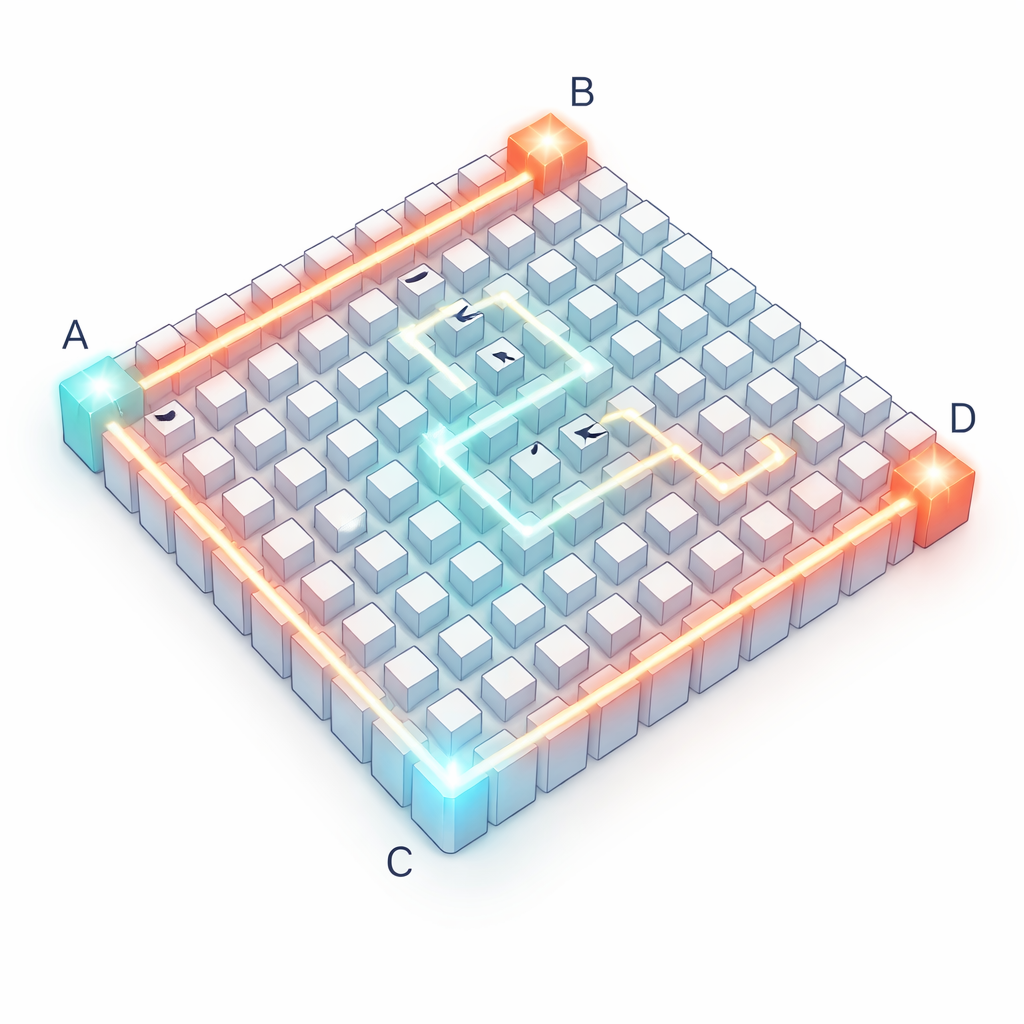
Guiding Waves Like Slot Cars on a Track
Conventional waveguides try to steer sound or light using carefully shaped paths, but small flaws can scatter energy and ruin the signal. Topological materials take a different approach: their overall “shape” in a hidden mathematical sense forces waves to cling to special boundary states—such as edges or corners—that are unusually resistant to disorder. Earlier research showed how to pump waves along edges (first-order topological pumps) or between corners (higher-order topological pumps). The present study tackles a more ambitious goal: combining these behaviors so that energy can move smoothly among corner, edge, and bulk (interior) regions in a single continuous process.
A New Kind of Topological Conveyor Belt
The authors design a theoretical model in which sound energy is confined to an array of coupled “sites,” arranged in a square grid. By slowly varying a control parameter—much like turning a knob over time—they cause the system’s hidden topological properties to evolve in a loop. In this loop, special states appear at the corners and along the edges of the grid and then merge into states spread throughout the interior. As the parameter sweeps from one value to another, a state initially localized at a bottom-left corner gradually shifts along the bottom edge, passes through the interior, climbs up to the top edge, and finally arrives at the top-left corner. This seamless corner–edge–bulk–edge–corner journey is what the authors call a “hybrid-order” topological pump, because it unites first-order (edge) and higher-order (corner) transport in one cycle.
Turning Theory into a 3D Sound Device
To bring this idea into the lab, the team builds an acoustic analog using phononic crystals—rigid structures containing air-filled cavities connected by narrow tubes. Each cavity acts like a tiny resonator, and the widths and lengths of the tubes control how sound can hop from one cavity to another, mirroring the couplings in their theoretical model. By carefully shaping these geometric details, they reproduce the required topological behavior for many different values of the control parameter. They then stack multiple two-dimensional layers with slightly different settings into a three-dimensional tower, so that moving upward through the device corresponds to sweeping the parameter along its loop. A sound source placed at the lower corner launches a wave that automatically follows the programmed path through edges and bulk as it climbs the structure.
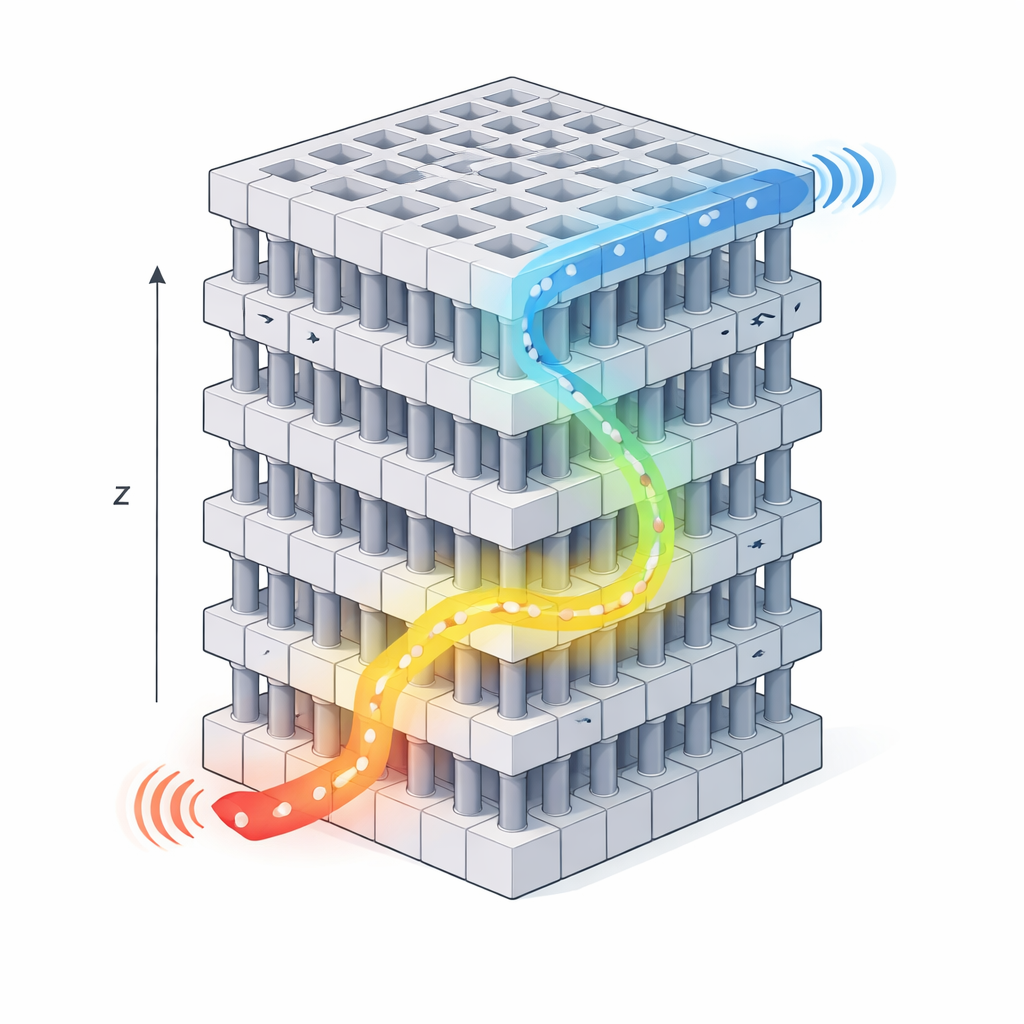
Robust Travel, Even Through Obstacles
A key test of any topological effect is robustness: does the desired behavior survive when the device is imperfect? The researchers deliberately add small solid blocks—defects—near the center of the structure and measure the pressure field layer by layer using a tiny microphone. They find that the sound still performs the same corner–edge–bulk–edge–corner transfer, with only minor distortions. In another experiment, they speed up the effective pumping so that the process is no longer perfectly gentle (non-adiabatic). In this regime, something even more surprising happens: energy started at a single corner splits and ends up simultaneously at two diagonally separated corners, offering a built-in way to redistribute acoustic energy between different output ports.
Why This Matters for Future Technologies
For a non-specialist, the takeaway is that the researchers have built an acoustic structure where sound can be routed between tiny, well-defined regions in a way that is both programmable and unusually resistant to flaws. Their design supports several kinds of topological pumps—edge-only, corner-only, and hybrid—within the same platform, and it is straightforward to switch between them by adjusting how the structure is modulated. Such robust, multidimensional control of waves could be valuable for future communication devices, sensors, and signal-processing technologies, and the same ideas may eventually be adapted beyond acoustics to control light, mechanical vibrations, or even electronic signals with similar reliability.
Citation: Wang, Z., Fu, Z., He, H. et al. Topological transfer of multidimensional states in phononic crystals. npj Acoust. 2, 8 (2026). https://doi.org/10.1038/s44384-026-00043-y
Keywords: topological acoustics, phononic crystals, sound waveguides, higher-order topology, robust state transfer