Clear Sky Science · en
Tomato aspartic proteinases harbouring PSI domains reveal stress responsiveness, organ specificity, and conserved features
Why tomato stress biology matters
Tomatoes don’t just sit passively in the garden; their cells are constantly sensing and responding to the world around them. Drought and salty soils, which are becoming more common with climate change and intensive farming, threaten yields of this globally important crop. This study looks inside tomato cells at a special group of protein-cutting enzymes and shows how they are wired into growth, reproduction, and stress protection—knowledge that could ultimately help breeders and biotechnologists create tougher tomato plants.
Hidden helpers inside tomato cells
Plants routinely recycle and reshape their own proteins to grow, defend themselves and adapt to harsh conditions. A major part of this clean‑up and remodeling crew are enzymes called aspartic proteinases, which chop other proteins into pieces. Many of these enzymes live in internal storage and recycling chambers known as vacuoles. The authors focused on a particular subset that carry a short add‑on segment called the plant specific insert, or PSI. This extra piece acts both as a postal code, helping ship the enzyme to the right compartment, and as a tiny defense module with antimicrobial properties. In tomato, these PSI‑bearing enzymes had not been fully charted before.
Finding the key enzymes in tomato
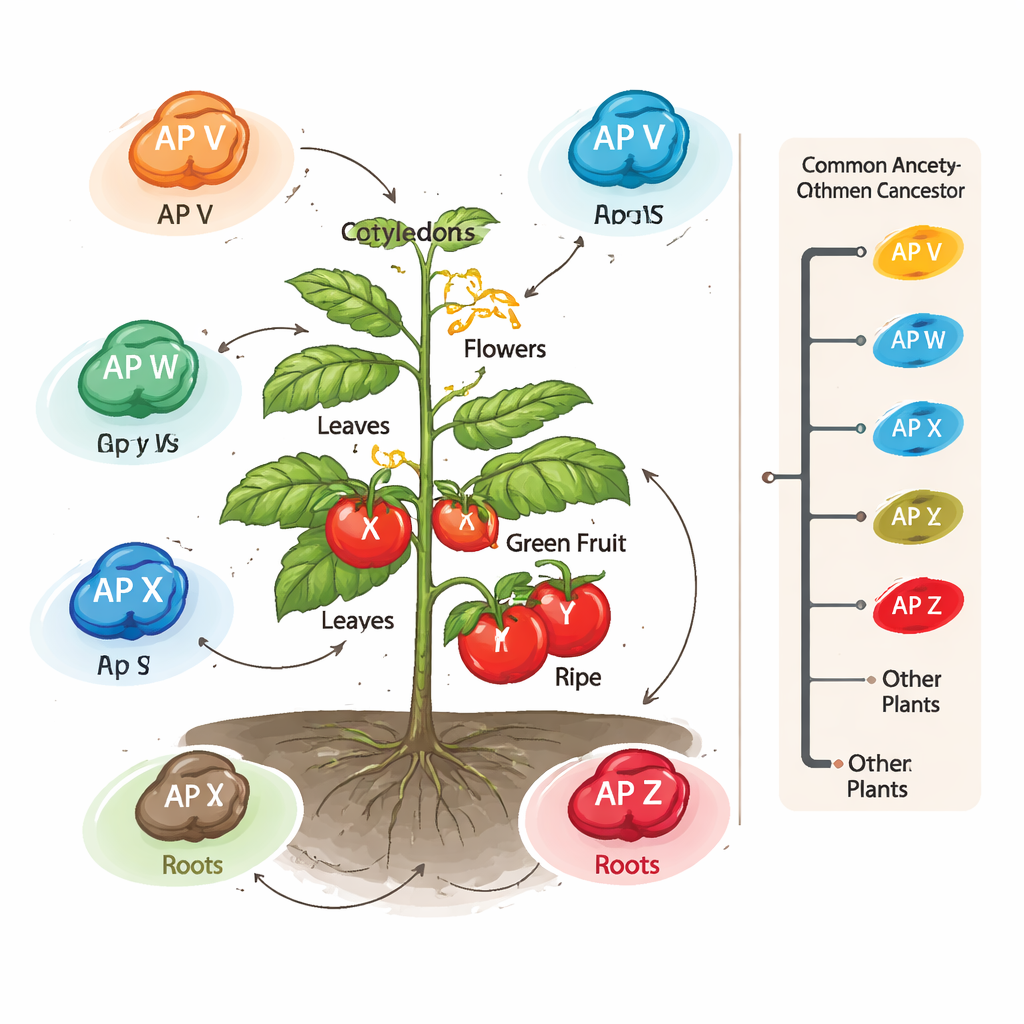
Using genome databases, the team catalogued 58 aspartic proteinases in cultivated tomato. Only five carried both a PSI segment and a second vacuole‑targeting “tail” at the end of the protein. These five were named AP V, AP W, AP X, AP Y and AP Z. By comparing their amino acid sequences with counterparts from other plants, including Arabidopsis, soybean, barley, potato and even green algae, the researchers built an evolutionary tree. The tomato enzymes grouped closely with known PSI‑containing proteinases involved in seed protein mobilization, defense and vacuole traffic in other species. This tight clustering suggests that, across very different plants, these enzymes share ancient and conserved roles.
Where in the plant each enzyme works
The authors then asked which parts of the tomato plant rely most on each of the five PSI enzymes. Measuring gene activity in young seedlings, roots, stems, leaves, flowers and fruits, they found a clear pattern. Four enzymes—AP V, AP W, AP X and AP Z—were most strongly switched on in cotyledons, the first seedling leaves, and often in roots, pointing to roles in early growth and nutrient use as the plant emerges from the seed. AP Z also showed a more even presence across tissues, hinting at a general housekeeping function. AP Y stood out: instead of seedlings, it peaked in flowers and green (developing) fruits, matching a likely role in shaping reproductive tissues as they form and mature.
How the enzymes react to drought and salt
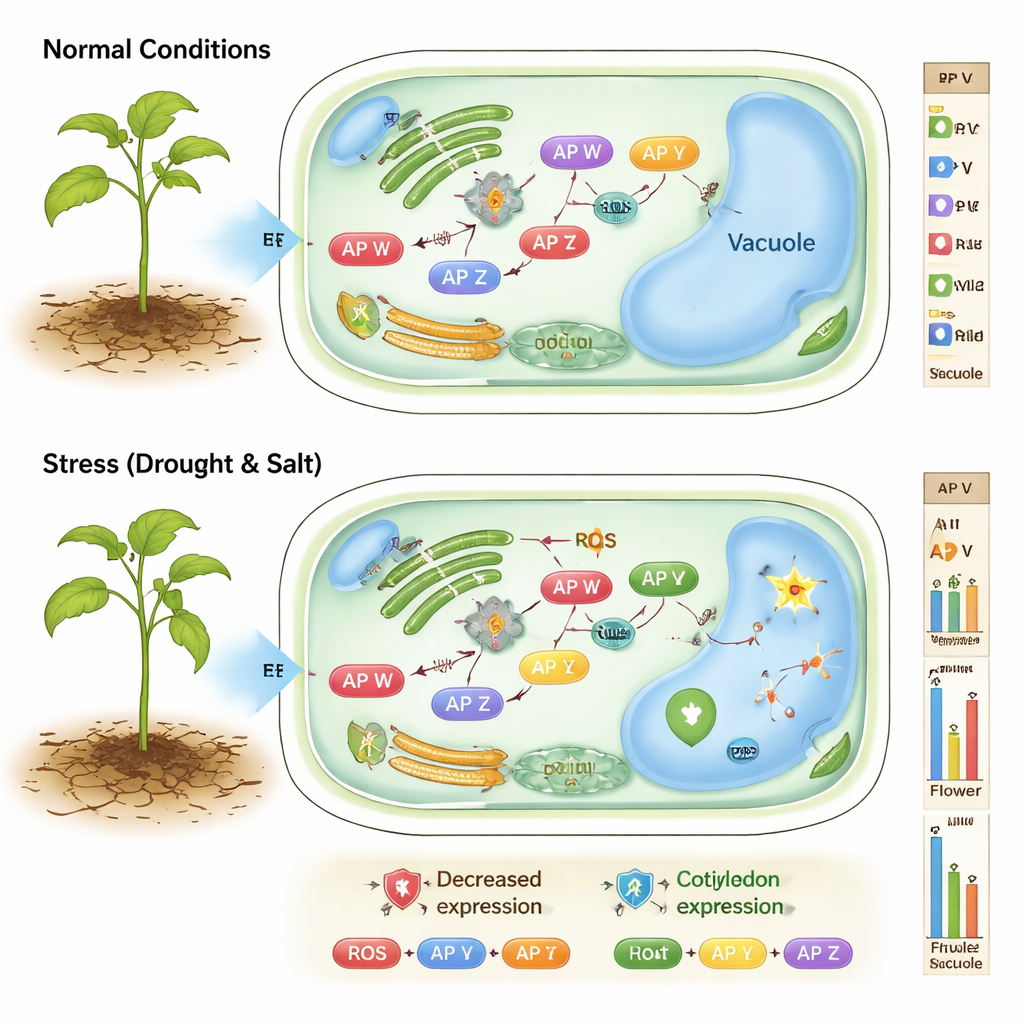
To mimic real‑world stress, tomato seedlings were grown in culture bottles with extra salt or sugar alcohol to create salty or drought‑like conditions. Plants under the harshest treatment were smaller and showed biochemical signs of oxidative stress, including higher levels of hydrogen peroxide, damaged membrane lipids and boosted antioxidants. When the researchers tracked the five PSI enzymes over time, they saw that young seedlings tended to dial several of them down under stress, particularly AP V, AP X and AP Z in salty conditions and AP W and AP Z in strong drought‑like conditions. In older, 25‑day plants, the picture shifted: AP V, for example, was now turned up under drought‑like stress, suggesting that the same enzyme can play different roles as the plant develops. Overall, AP Z proved the most broadly sensitive across treatments, while AP Y stayed relatively stable, consistent with its core function in reproductive organs.
Following the enzymes’ postal codes
Because PSIs are thought to help steer proteins to vacuoles, the team tested whether tomato PSIs behave this way inside living leaf cells of tobacco, a standard lab plant. They fused three PSI segments (from AP W, AP X and AP Z) to a red fluorescent tag and a signal that sends proteins into the cell’s shipping system. Under a microscope, the glowing fusion proteins accumulated mainly in vacuoles, confirming that tomato PSIs can act as sorting tags. When the normal route from the endoplasmic reticulum to the Golgi apparatus was partially blocked with a genetic trick, all three PSIs got stuck early in the pathway. This was surprising because earlier work in other species hinted that some PSIs could bypass the Golgi under certain conditions. The new results imply that tomato PSIs may all depend, at least in this test system, on the conventional route, and that factors beyond a simple sugar attachment on the PSI control which path is taken.
What this means for future tomatoes
Put together, the study shows that tomato cells use a small, specialized set of PSI‑bearing enzymes in finely tuned ways: some dedicated to seedlings and roots, one focused on flowers and young fruits, and several that adjust their activity as the plant faces drought or salt. These enzymes not only cut proteins but also rely on flexible postal codes to reach the vacuole, where they help recycle and remodel cell contents during stress. Understanding who these enzymes are, where they act and how they travel offers new entry points for breeding or engineering tomatoes that keep growing and setting fruit even when water is scarce or soils are salty.
Citation: Sampaio, M., Neves, J., Monteiro, J. et al. Tomato aspartic proteinases harbouring PSI domains reveal stress responsiveness, organ specificity, and conserved features. npj Sci. Plants 2, 8 (2026). https://doi.org/10.1038/s44383-026-00023-x
Keywords: tomato stress, plant proteases, vacuole trafficking, drought tolerance, salinity tolerance