Clear Sky Science · en
Fundamental and applied insights into peptide hormones linking nitrogen and phosphate sensing to microbial interactions
How Plants Talk to Their Underground Allies
Plants don’t passively sit in the soil waiting for food; they actively bargain with microbes to get hard-to-find nutrients like nitrogen and phosphorus. This paper explains how plants use tiny protein fragments called peptide hormones as messages to decide when to welcome helpful microbes such as fungi and bacteria—and when to hold them at arm’s length. Understanding this underground conversation could help farmers grow crops with less fertilizer, cutting costs and pollution.
Roots in a Crowded Underground Neighborhood
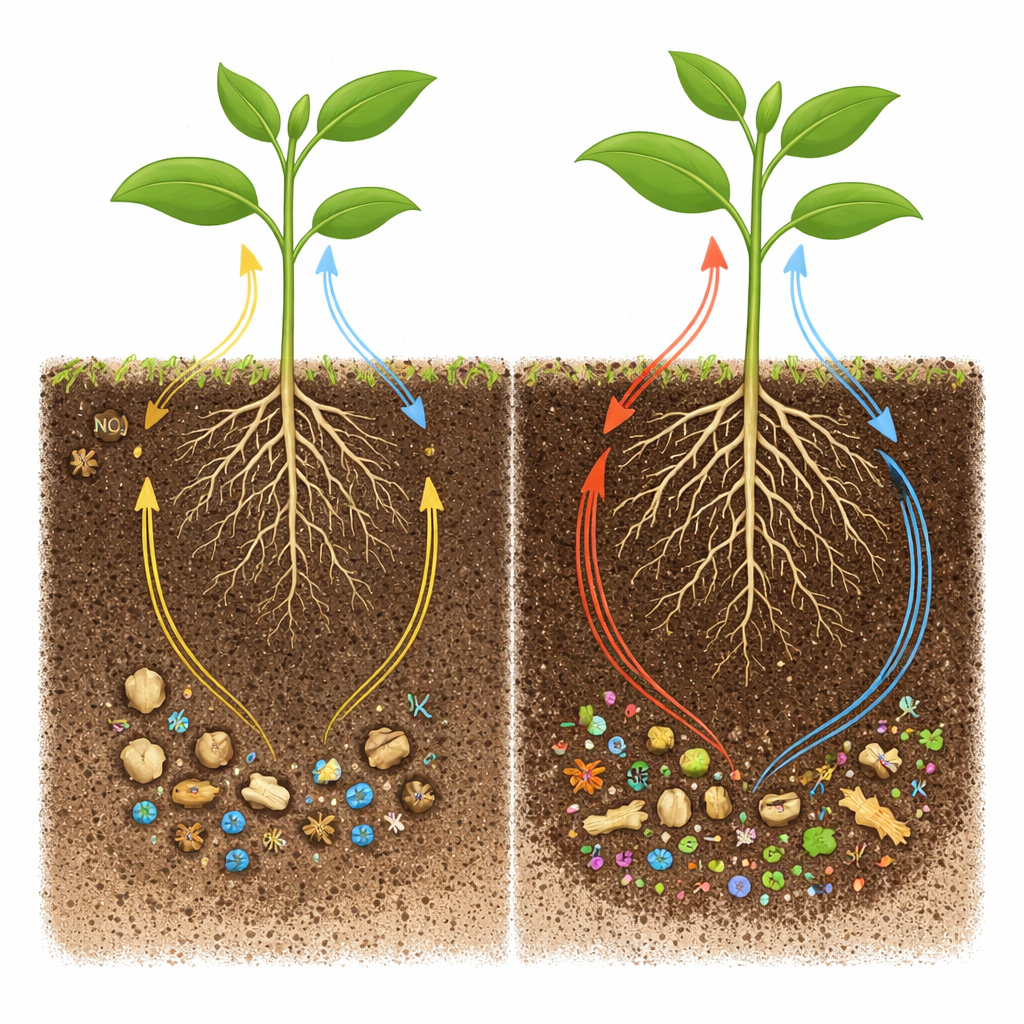
Plant roots live in busy communities packed with bacteria and fungi. Some of these partners help plants tap into nitrogen in the air or locked-up phosphorus in the soil, but they demand payment in the form of sugars from the plant. Because feeding partners is expensive, plants constantly measure how much nitrogen and phosphorus they already have. When nutrients are scarce, it often makes sense to invest in these helpers; when nutrients are plentiful, the same partnerships can slow growth. The review describes how plants sense nutrient levels and then use peptide signals to tune how strongly they engage with their microbial neighbors.
From Nutrient Sensors to Chemical Messages
Inside plant cells, specialized molecular sensors track phosphate and nitrate, the main forms of phosphorus and nitrogen that roots absorb. When phosphate is abundant, one set of signals shuts down genes that promote partnerships with phosphate-gathering fungi. When nitrate is plentiful, a different set of sensors alters the activity of key regulators that control genes involved in nitrogen uptake and root nodules that house nitrogen-fixing bacteria. The crucial step highlighted in this paper is that both nutrient-sensing systems feed into families of mobile peptides—short, hormone-like molecules—that move between roots and shoots and act as long-distance messengers about nutrient status.
Green Lights and Red Lights for Microbes
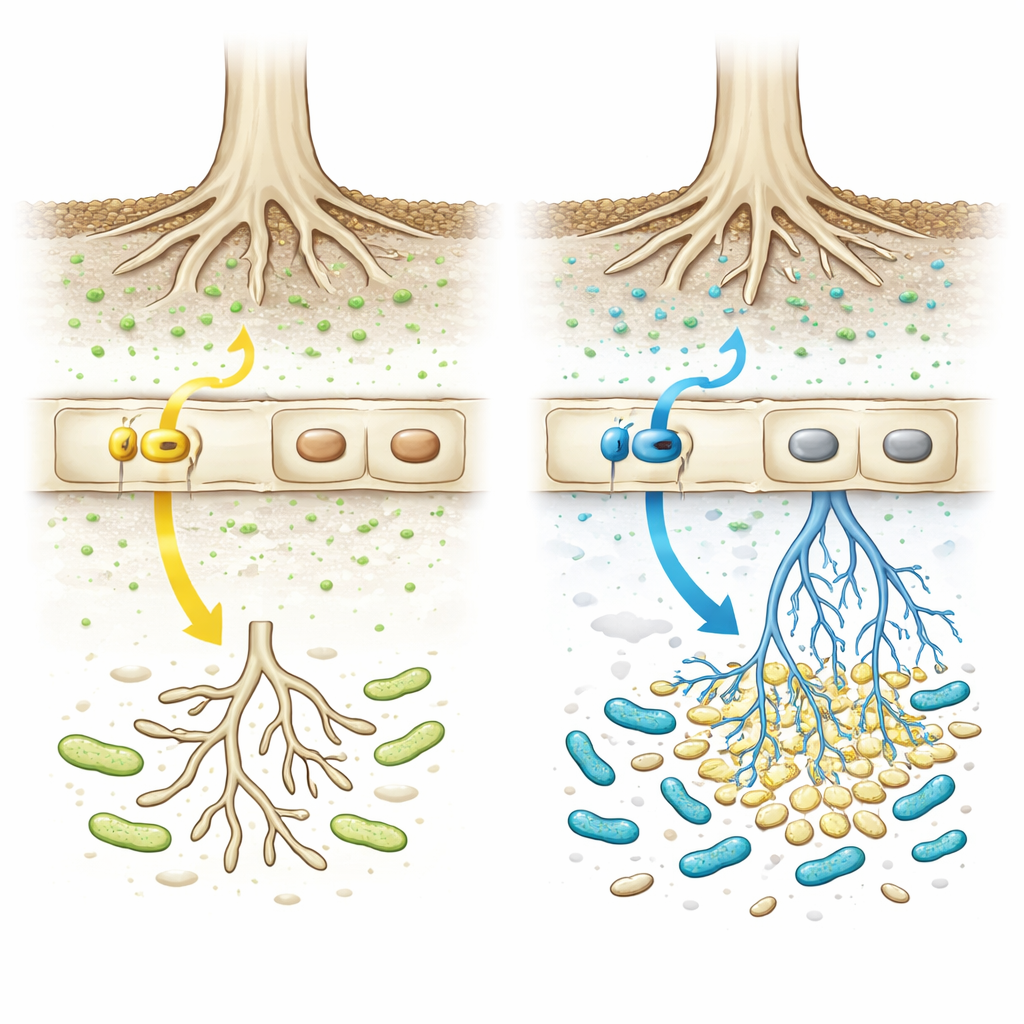
The authors focus on three peptide families—CLE, CEP, and RALF—that act like traffic signals for microbial partners. Certain CLE peptides serve as red lights: under high phosphate or high nitrate, they travel through the plant and tell it to limit fungal colonization or to stop making new nitrogen-fixing nodules, preventing wasteful carbon spending. By contrast, CEP peptides often act as green lights. When phosphate or nitrate is low, CEPs promote the formation of arbuscular mycorrhizal structures inside roots, increase the number of nodules that host helpful bacteria, and even boost the activity of nutrient transporters in roots growing in richer soil patches. RALF peptides play a subtler role, helping plants reshape the mix of bacteria around their roots under phosphate starvation so that communities form that are better at helping plants cope with low phosphorus.
Balancing Food Supply and Disease Defense
Because many microbes are potential enemies, the same peptide signals that manage nutrient partnerships also influence immunity. Under low phosphorus, RALF peptides can dial down some root immune responses and reduce reactive oxygen molecules at the root surface, making it easier for certain helpful microbes and fungi to colonize. Under low nitrogen, some CEP peptides have the opposite effect in leaves, strengthening immune responses against disease-causing bacteria, possibly to prevent above-ground infections while roots are more permissive below ground. This push-and-pull helps plants fine-tune when to open the door to symbionts without inviting in too many pathogens.
From Lab Peptides to Smarter Farming
Scientists and companies are now testing whether synthetic versions of these peptides, or microbes engineered to release them, could become tools for agriculture. Early experiments show that applying CEP peptides can sharply increase nitrate uptake and boost both fungal colonization and nodulation in model plants, while RALF peptides can nudge soil communities toward growth-promoting bacteria. However, these molecules are rapidly broken down in soil, can be costly to manufacture—especially when complex chemical decorations are needed—and may have unintended effects on non-target microbes or plant defenses. The review outlines emerging strategies such as protected peptide formulations and engineered soil microbes that could deliver these signals more efficiently and precisely to plant roots.
Why This Underground Chatter Matters
Overall, the article concludes that peptide hormones give plants a powerful way to match their microbial partnerships to real-time nitrogen and phosphorus needs. By acting as flexible switches that turn helpful interactions up or down, these tiny molecules could eventually let farmers replace a portion of synthetic fertilizers with biology-based solutions. The big challenge ahead is to move from simplified lab tests to field conditions full of diverse microbes and changing soils, and to design peptide-based tools that reliably boost yields without upsetting the broader ecosystem.
Citation: McCombe, C.L., Demirer, G.S. Fundamental and applied insights into peptide hormones linking nitrogen and phosphate sensing to microbial interactions. npj Sci. Plants 2, 9 (2026). https://doi.org/10.1038/s44383-025-00018-0
Keywords: plant peptide hormones, root microbiome, nitrogen and phosphorus, symbiotic fungi and bacteria, sustainable agriculture