Clear Sky Science · en
Gravity and human respiration: biophysical limitations in mass transport and exchange in spaceflight environments
Why Space Breathing Matters on Earth
Most of us take breathing for granted, but in space it becomes a surprisingly tricky engineering and biology problem. Astronauts on the International Space Station often complain that the air feels stuffy, even though complex life-support systems carefully scrub and circulate it. This study asks a simple but far-reaching question: how does gravity itself help us breathe—and what happens when gravity is weakened, as in space, or mimicked on Earth by extreme heat?
The Hidden Airflow Around Every Body
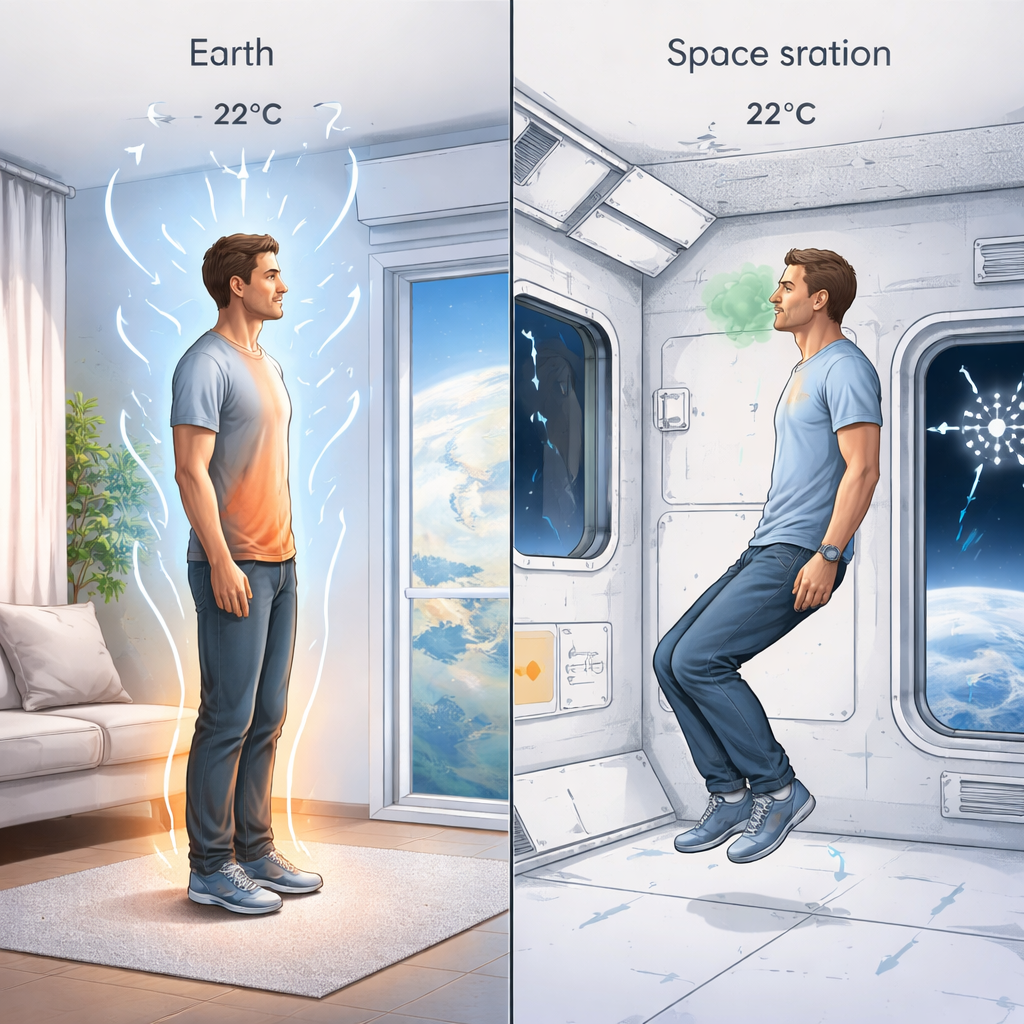
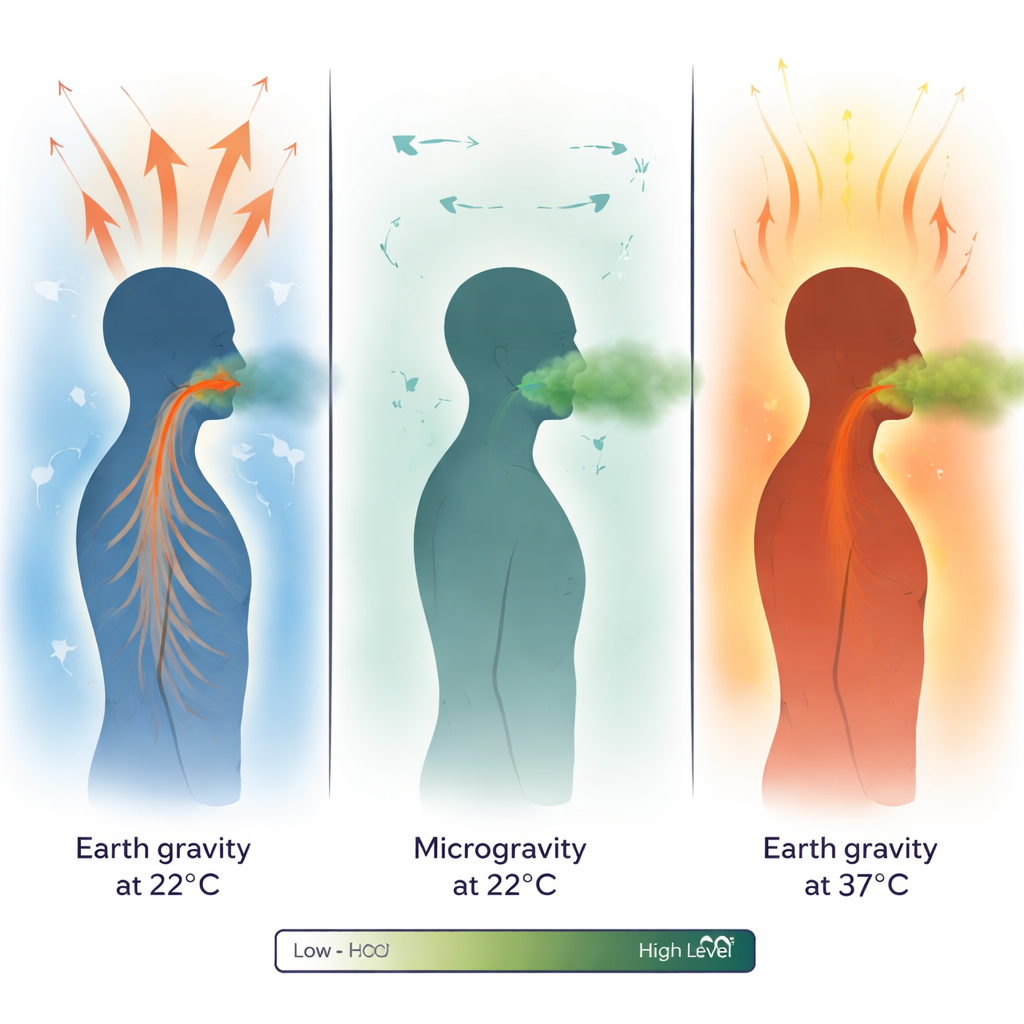
On Earth, each person is wrapped in a gentle, invisible stream of rising air created by body heat. The authors call this the human thermal body plume. Warm air next to our skin becomes lighter and drifts upward, pulling in cooler air from below. Using advanced computer simulations of fluid flow, the researchers show that this plume does more than carry off heat—it also helps sweep exhaled carbon dioxide away from our nose and mouth and draw in fresher air. In a normal room at about 22 °C, this upward flow forms a stable breathing envelope that quietly assists every breath we take.
Breathing in a Bubble in Space
In orbit, gravity all but disappears, and with it the buoyant rise of warm air. The simulations reveal that without gravity-driven convection, the warm plume around the body collapses. Exhaled carbon dioxide no longer rises toward the ceiling; instead, it hangs as a diffuse cloud in front of the face, like a slowly growing bubble. The study finds that in microgravity this trapped “CO2 bubble” is repeatedly inhaled, effectively doubling the local carbon dioxide levels at the mouth compared with the same room on Earth. This occurs even when the space station’s life-support system keeps the overall cabin air within safe limits, providing a physical explanation for astronaut reports of poor air quality.
Heat Waves That Imitate Space
The team then used the same model to ask what happens on Earth as temperatures climb. By gradually raising room temperature toward body temperature, they found that the driving force for the thermal plume weakens. At 27 °C the plume is slower but still functions; by 32 °C it is seriously impaired. At 37 °C—when the air is as warm as the human body—the buoyant flow virtually disappears, and a CO2-rich pocket forms in front of the face, much like in microgravity. Under these hot conditions, overall gas exchange becomes less efficient and more exhaled carbon dioxide is drawn back into each breath, especially if airflow in the room is weak or people are relatively still.
Health Risks for Astronauts and Everyone Else
Carbon dioxide is not just a harmless waste gas. Even moderately elevated levels can cloud thinking, strain the cardiovascular system, disturb cellular chemistry, and intensify the effects of other stresses, such as radiation in space or chronic disease on Earth. The authors argue that the localized CO2 bubble in front of the face may quietly worsen known spaceflight hazards, from fatigue and reduced cognitive performance to accelerated tissue damage. On Earth, the same physics suggests that people exposed to intense heat—especially older adults, outdoor workers, or those with lung disease—may face an overlooked kind of respiratory stress when the air is hot, stagnant, and only gently ventilated.
Designing Better Air for a Hotter, Spacefaring World
In simple terms, this work shows that gravity and temperature help stir the air we breathe and keep our own exhaust away from our faces. Take away gravity—or erase temperature differences during a heatwave—and that natural stirring stops, forcing us to rebreathe more of our exhaled carbon dioxide. The study suggests practical fixes, from smarter, targeted fans in spacecraft to better building ventilation during hot weather. By treating breathing as a physical as well as a biological process, the authors reveal a subtle but powerful link between spaceflight, climate change, and everyday human health.
Citation: Dutta, S., Tulodziecki, D., Schwertz, H. et al. Gravity and human respiration: biophysical limitations in mass transport and exchange in spaceflight environments. npj Biol. Phys. Mech. 3, 3 (2026). https://doi.org/10.1038/s44341-026-00033-x
Keywords: microgravity, carbon dioxide rebreathing, human thermal plume, spaceflight health, heat stress