Clear Sky Science · en
Demonstration of a subthreshold analog CMOS reservoir chip for temporal signal processing
Why tiny, low-power chips matter for smart devices
From fitness trackers to environmental sensors, many gadgets now need to recognize patterns in signals that change over time—like sounds, temperatures, or vibrations—without draining their batteries. This article describes a new kind of ultra‑low‑power chip that can learn and predict such signals efficiently, bringing sophisticated "brain‑like" processing closer to tiny, energy‑constrained devices at the edge of the network.

A different way to think about artificial intelligence
Most people associate artificial intelligence with large neural networks that run on power‑hungry servers. Reservoir computing is a lighter alternative built for handling time‑varying information, such as speech or chaotic motion. Instead of endlessly retraining all its internal connections, reservoir computing keeps an internal network fixed and only adjusts a simple output layer. As incoming signals ripple through the fixed network, they are spread out into many different internal states, making it easier for the output layer to recognize patterns or forecast what comes next using basic mathematical tools.
Turning physics into a computing resource
The study focuses on "physical" reservoir computing, where the network is not just software but is embodied directly in hardware. Prior work has used light, magnetic materials, nanoscale networks, and even soft robots as the physical core that transforms inputs. Silicon chips, however, remain attractive because they can be mass‑produced and integrated with existing electronics. The authors build on this direction by creating a custom analog chip in standard CMOS technology that acts as a reservoir for time‑dependent tasks, aiming for very low power use, small area, and compatibility with industrial chip fabrication.
A ring of simple elements that remembers the past
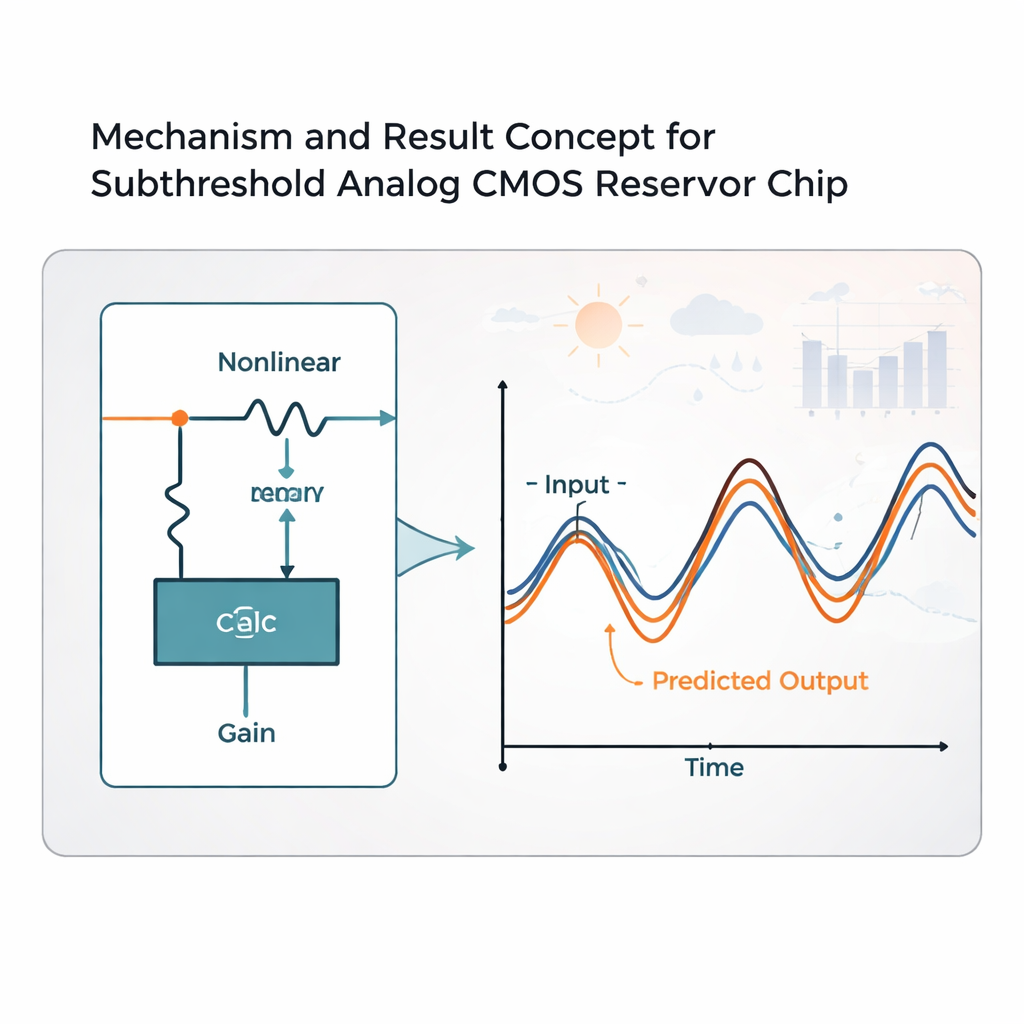
At the heart of the chip is a simple ring of interconnected nodes, called a simple cycle reservoir. Each node is an analog circuit with three main parts: a nonlinear element, a tiny capacitor that stores charge, and an amplifier. Signals enter all nodes at once while also passing from one node to the next in a single direction around the ring. This layout avoids the wiring complexity of more tangled networks but still produces a rich mix of internal states that encode both the recent and slightly older past. The designers deliberately operate the transistors in an energy‑saving regime where small changes in voltage cause smoothly curved responses, and they purposely vary transistor sizes from node to node. These built‑in differences make each node respond a bit uniquely, increasing the diversity of internal activity—useful for separating and recognizing patterns in time.
Testing memory and prediction on challenging signals
To see how capable this compact ring is, the team first measures how well it can remember and transform past inputs, a property called information processing capacity. The chip shows not only strong "linear" memory—remembering recent values—but also an ability to preserve more complex, warped versions of those values, which is crucial when dealing with nonlinear real‑world processes. They then move to tougher tests: standard benchmark problems that require combining inputs over several time steps, predicting the twists of a chaotic mathematical system, and forecasting monthly global surface temperatures. In these tasks, the chip’s predicted sequences track the true signals closely, including both rapid fluctuations and long‑term warming trends, while consuming only about 20 microwatts of power per core—far less than typical digital processors.
What this means for everyday technology
In simple terms, the researchers have shown that a small, custom analog chip can act like a specialized mini‑brain for time‑varying data, remembering just enough of the recent past and bending those memories in useful ways to make accurate predictions. Because it runs at extremely low power and is built with standard chip technology, this kind of reservoir computing hardware could eventually be embedded in sensors, wearables, or remote environmental monitors, allowing them to analyze streams of data on the spot instead of constantly sending everything to the cloud.
Citation: Matsuno, S., Yuki, A., Ando, K. et al. Demonstration of a subthreshold analog CMOS reservoir chip for temporal signal processing. npj Unconv. Comput. 3, 12 (2026). https://doi.org/10.1038/s44335-026-00059-3
Keywords: reservoir computing, low-power AI hardware, analog CMOS, time-series prediction, edge computing