Clear Sky Science · en
A mathematical framework for thermodynamic computing with applications to chemical reaction networks
Why chemistry could power future computers
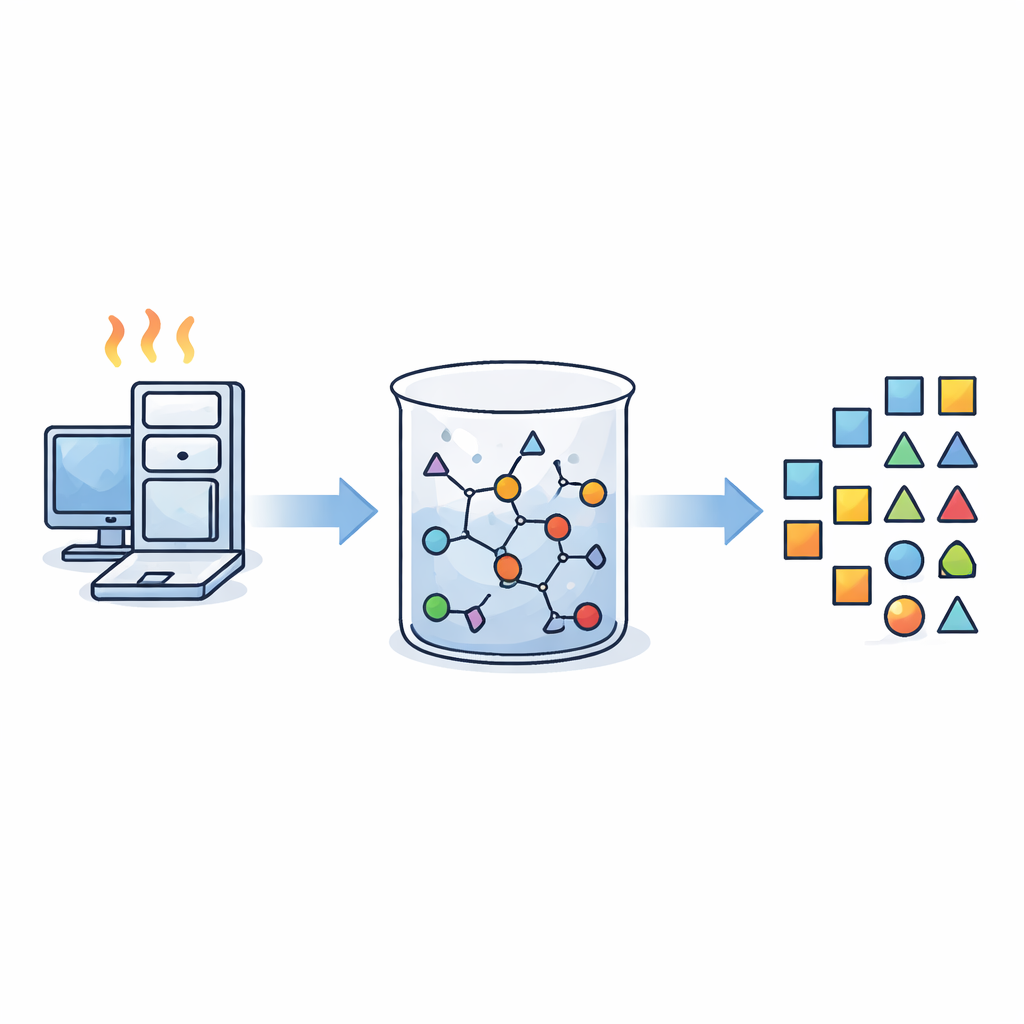
Computers are doing ever more work for us, from training artificial intelligence to simulating climate and new medicines, and that work burns a lot of energy. This paper explores a radical alternative: using the natural push and pull of energy in physical systems—especially chemical reactions—to do math. Instead of shuttling electrons around silicon chips, carefully arranged molecules could "compute" by simply following the laws of thermodynamics, potentially offering a path to far more energy‑efficient and massively parallel computation.
Turning energy flows into math
The authors start by building a general mathematical language that links basic thermodynamic ideas—like changes in energy and probability—to arithmetic operations. They imagine a system described by many measurable quantities, such as particle numbers or voltages, and track how the probability of the system’s state changes as a process unfolds. By expressing these changes in terms of a single progress variable, they show that addition and subtraction can be carried out by combining or comparing the energetic contributions of different parts of the system, while multiplication and division emerge when those same quantities are interpreted in exponential form. In other words, if you know how the system’s "effort" adds up along a process, you can repurpose that effort as a calculator.
Using reactions as analog calculators
Chemical reactions offer a particularly rich playground for this kind of computing. Each reaction links reactants and products through changes in free energy and chemical potential. The paper shows that these quantities behave like building blocks for math: sums of energy changes implement addition, and ratios of reactant and product concentrations implement multiplication through what chemists call equilibrium constants and reaction quotients. By choosing reactions whose energetics are well known, one can encode numbers in concentrations of different molecules, let them react, and then read out the answer from the resulting mixture. The authors work through examples where simple reactions effectively multiply very large numbers, with the outcome determined by how likely the reaction is to proceed.
From single sums to high‑dimensional problems
Because many reactions can occur at once, the same ideas scale naturally beyond single numbers. The framework shows how chains of reactions can multiply long lists of values, add independent products together, and even mimic matrix‑vector multiplication—an operation at the heart of scientific computing and machine learning. By treating the reaction network itself as a kind of analog circuit, the free energy changes across multiple reactions can be interpreted as the entries of a matrix acting on a vector of chemical potentials. This means, in principle, that systems of equations and even differential equations can be solved by guiding a mixture toward a steady state and measuring the resulting concentrations or energy changes.
Designing a tiny chemical computer
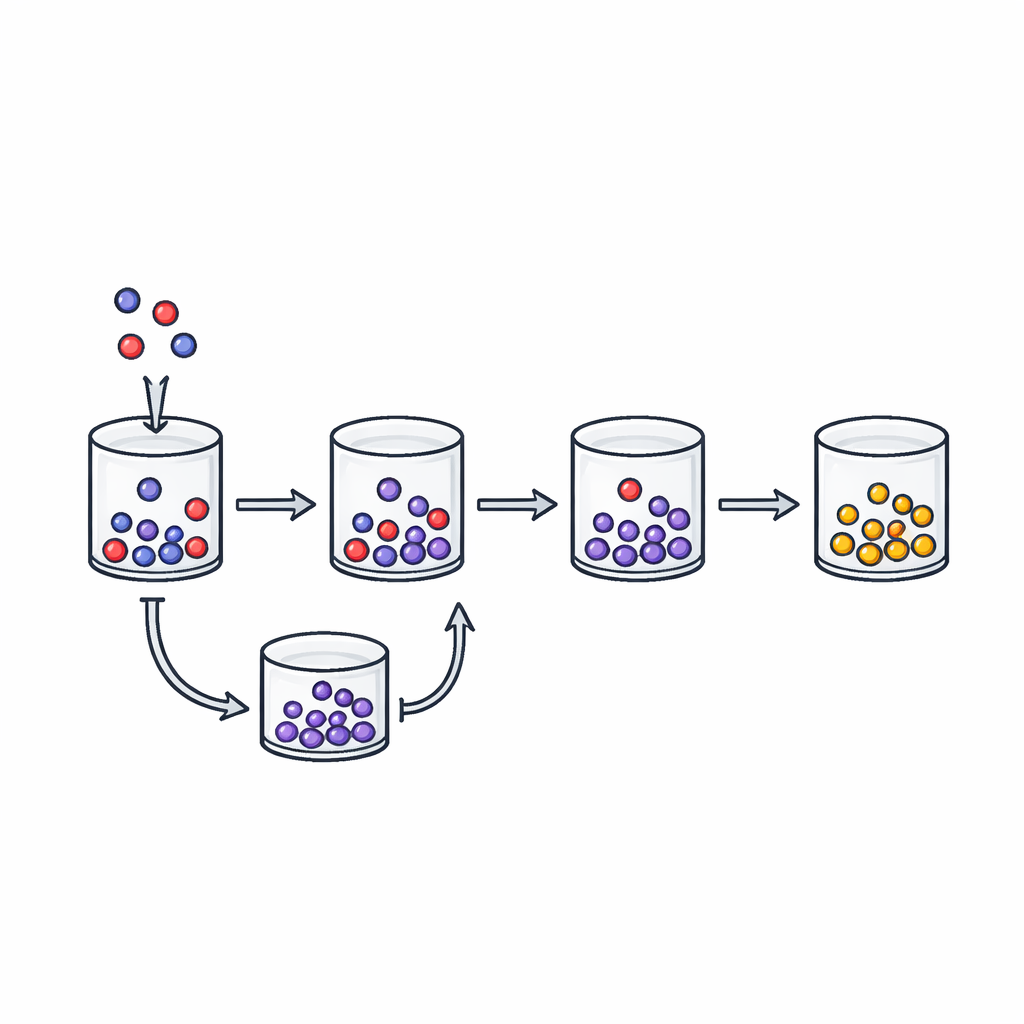
To move from theory to practice, the authors outline a microfluidic device—a small, layered chip of channels and chambers—that could host these reaction‑based computations. Reactants encoding input values would be injected into specific chambers, where flows, valves, and semi‑permeable membranes control how they mix and react. Some chambers operate in "open loop," where fixed inputs yield products to be measured, while others use feedback, adjusting inflow until a target state is reached, which corresponds to subtraction or division. Integrated sensors would detect concentrations, and a digital controller would route fluids and interpret outputs, much like an instruction scheduler in a conventional processor. The same hardware could also support reservoir computing, where the rich internal dynamics of the reaction network are harnessed for pattern recognition and time‑series prediction.
Promise and challenges of natural computing
The authors argue that all computation is ultimately thermodynamic; the difference here is that energy flows themselves are the medium of information rather than a hidden cost. That opens the door to devices that trade raw speed for huge gains in energy efficiency and parallelism, echoing how living cells process information through biochemistry. At the same time, practical chemical computers must contend with slow or noisy reactions, the need for accurate thermodynamic data, and the complexity of mapping abstract problems onto real reaction networks and microfluidic layouts. Even so, the work provides a clear mathematical and engineering roadmap for thermodynamic and chemical computing, suggesting that future scientific simulations and specialized AI tasks might one day run on tiny labs‑on‑a‑chip powered not by transistors, but by the quiet relentless drive of molecules seeking equilibrium.
Citation: Cannon, W.R., Johnson, C.G.M., Bohm Agostini, N. et al. A mathematical framework for thermodynamic computing with applications to chemical reaction networks. npj Unconv. Comput. 3, 16 (2026). https://doi.org/10.1038/s44335-026-00057-5
Keywords: thermodynamic computing, chemical reaction networks, microfluidic computing, analog computation, energy-efficient computing