Clear Sky Science · en
Analog counterdiabatic quantum computing
Why speeding up quantum problem-solving matters
From planning airline routes to designing robust communication networks, many real-world challenges boil down to choosing the “best” combination from an enormous number of possibilities. Classical computers struggle when the search space grows explosively. This article explores a new way to harness analog quantum machines made of individual atoms to attack such problems faster and more reliably, bringing practical quantum advantage a step closer.
Turning hard choices into patterns of atoms
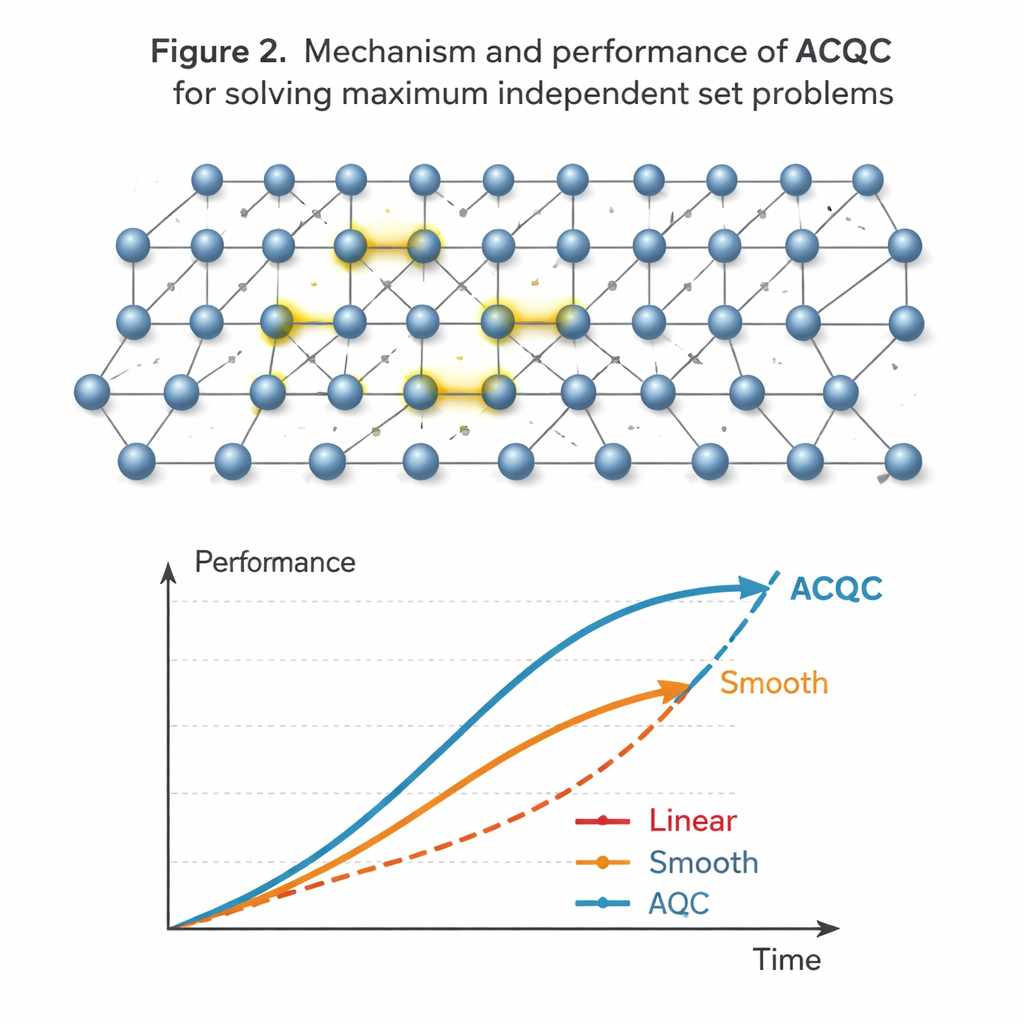
Many difficult tasks in logistics, finance, and network design can be rewritten as combinatorial optimization problems. A central example is the maximum independent set (MIS): pick the largest set of points in a network so that no two are directly connected. This abstract problem captures ideas like choosing non-conflicting tasks or placing network stations that do not interfere. In neutral-atom quantum processors, each atom acts as a quantum bit, and their physical arrangement naturally mirrors a graph: atoms close enough to interact represent connected nodes. By carefully tuning laser pulses, the lowest-energy configuration of this many-atom system encodes the solution to MIS, allowing the hardware to “relax” toward an optimal answer.
The speed limit of slow-and-steady quantum evolution
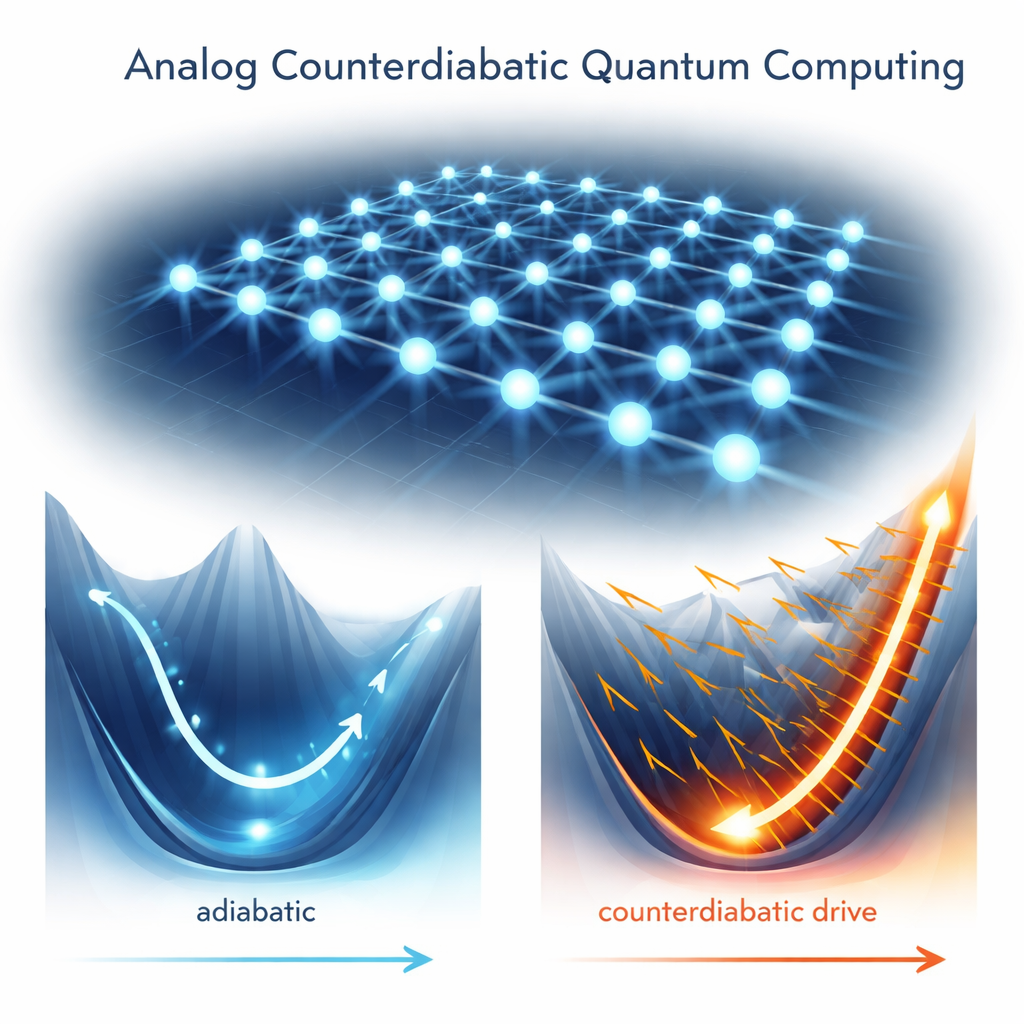
The conventional way to solve such problems on analog quantum devices is adiabatic quantum computing. One starts from a simple quantum state that is easy to prepare and then slowly changes the system’s conditions so that, ideally, the state follows the lowest-energy path all the way to the desired solution. In practice, however, quantum hardware has limited coherence time: if you evolve too slowly, the system loses its quantum character to noise; if you evolve too quickly, it can be “shaken” into unwanted excited states, reducing success. Neutral-atom processors, which already operate with hundreds of qubits, are especially constrained by this trade-off, making non-adiabatic errors a key obstacle to scaling.
A shortcut that keeps the system on track
The authors introduce analog counterdiabatic quantum computing (ACQC), a protocol designed specifically for neutral-atom platforms. Instead of merely slowing down the evolution, ACQC adds carefully chosen extra control terms—implemented by shaping the amplitude, frequency detuning, and phase of the driving laser—to cancel out unwanted transitions. Conceptually, it is like applying a steering force that keeps a particle glued to the bottom of a moving bowl even when the bowl is tilted quickly. Crucially, the team derives these corrective terms analytically from a simplified version of the atomic system, avoiding the heavy numerical optimization that variational methods typically require. The result is a practical recipe that can be applied directly on today’s hardware without iterative tuning.
Putting the new protocol to the test
To check whether ACQC really helps, the researchers first ran large numbers of noiseless simulations on graphs with up to 16 nodes, comparing three approaches: a simple linear schedule, a smoother improved schedule, and ACQC built on that smooth baseline. For short evolution times, where hardware limitations are most severe, ACQC clearly outperformed the others, improving both the average energy of the final states and the chance of obtaining an exact MIS solution. They then moved to real neutral-atom processors accessed via the cloud: QuEra’s 256-qubit Aquila device for a 100-node graph, and Pasqal’s Orion Alpha for 15- and 27-node graphs. Across these experiments, ACQC consistently delivered better approximation ratios and higher success rates at short times, achieving around a threefold speedup in reaching high-quality solutions compared with standard adiabatic methods.
What this means for future quantum machines
The study shows that smart control of analog quantum devices can significantly extend their practical usefulness without requiring new hardware components. ACQC works within current experimental constraints, needing only time-dependent adjustment of laser intensity, detuning, and, in one variant, a simple transformation that removes the need for phase control. While longer evolutions eventually let ordinary adiabatic protocols catch up, ACQC shines in the fast “quench” regime where today’s machines must operate. Because it already provides several-percent improvements on realistic, industry-motivated problems, this approach lowers the bar for demonstrating genuine quantum advantage and points toward a future where neutral-atom processors tackle large-scale, real-world optimization tasks.
Citation: Zhang, Q., Hegade, N.N., Cadavid, A.G. et al. Analog counterdiabatic quantum computing. npj Unconv. Comput. 3, 11 (2026). https://doi.org/10.1038/s44335-026-00056-6
Keywords: quantum optimization, neutral atom processor, adiabatic computing, counterdiabatic driving, combinatorial problems