Clear Sky Science · en
Thin-film DLP 3D printing of multi-material parts with closed-cell internal voids
Making Lighter 3D Prints with Hidden Hollow Spaces
Many of the most interesting 3D-printed objects—like artificial bones, soft robots, and tiny fluid channels—need empty spaces hidden inside them. Today’s popular resin printers struggle with these designs, because liquid resin gets trapped in those sealed pockets and is hard to remove. This paper introduces a new way to 3D print with light-sensitive liquid called “thin-film DLP” that keeps those inner spaces truly hollow while also making it easier to combine multiple materials in a single part.
Why Trapped Liquid Is a Big Problem
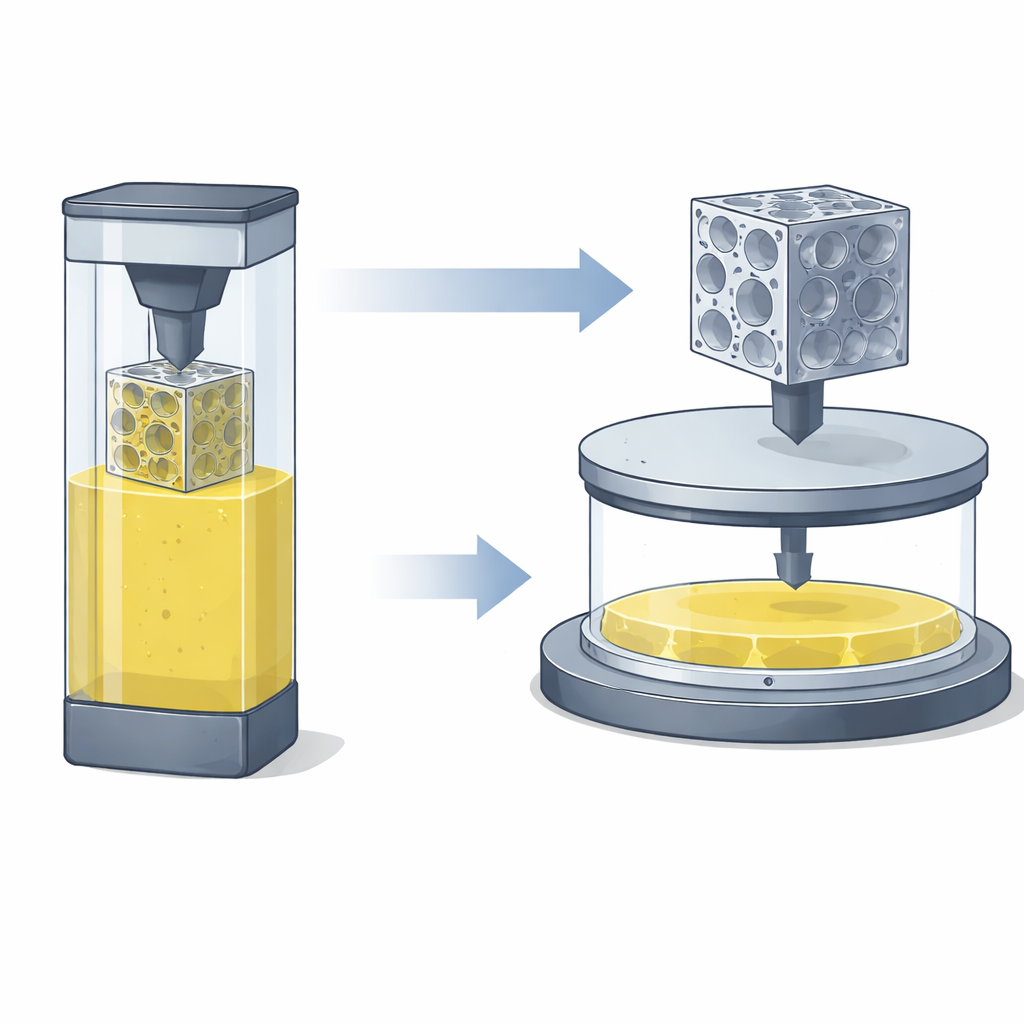
Most desktop and industrial resin printers work by lowering a platform into a vat filled with liquid and then shining patterns of light to harden each new layer. This classic setup is great for smooth surfaces and fine details, but it has a hidden flaw: whenever the design includes sealed inner cavities, those pockets fill with liquid resin that has nowhere to escape. The extra trapped resin makes the part heavier than intended, can distort its mechanical behavior, and may even leak or ooze over time. Engineers have worked around this with drainage holes or partial openings, but that often forces them to compromise the original design.
A New Way to Lay Down Liquid
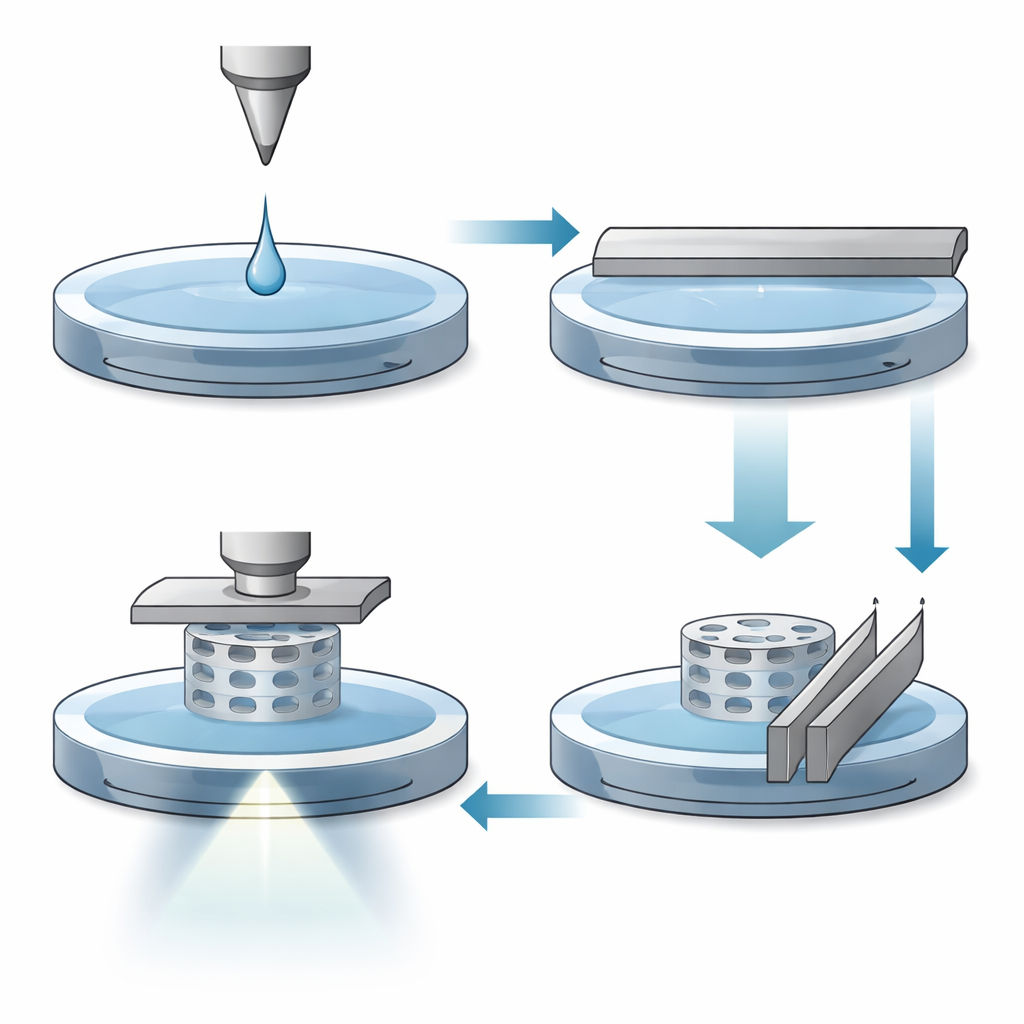
The thin-film DLP method avoids the vat altogether. Instead of dunking the growing part into a deep pool of resin, the system spreads a very thin, precisely controlled layer of liquid onto a clear plastic sheet. A rotating platform then presses the part into this thin coating while a digital projector shines ultraviolet light from below to cure only the regions needed for that layer. Because each layer starts with only a small amount of resin on the film, there is very little liquid left behind inside closed cavities once the solid layer peels away. A set of soft wipers and, when needed, a brief bath in a mild solvent help remove any remaining droplets before the next layer is formed.
Clean Hollow Spaces and Tunable Stiffness
Using this process, the researchers were able to print spheres and other hollow shapes whose final weight was almost exactly what you would predict if their interiors were truly empty—less than one percent extra mass from residual resin, compared with more than double the ideal weight in conventional vat printing. X-ray scans of test blocks filled with internal bubbles showed that cavities as small as three-quarters of a millimeter across could be formed reliably when a quick solvent rinse was added between layers. By arranging these tiny sealed bubbles in a regular pattern inside small cubes, the team could dial in how stiff or springy each cube was, simply by changing the bubble size. In some materials, they achieved up to a 25-fold change in stiffness without altering the outer shape at all.
Mixing Materials in a Single Print
Because the system only handles thin layers of liquid at a time, it also reduces the messy mixing that usually happens when a printer switches between different resins. The authors used a multi-resin supply to print parts that combine hard plastic, soft rubber-like materials, and a special water-soluble support resin. They produced a lattice-like “Hilbert curve” supported entirely by dissolvable material that vanished in plain water, leaving a clean, free-standing structure. They also demonstrated a denture model with rigid teeth, soft gums, and sacrificial supports, printed as one unified piece rather than assembled later. In another example, conductive resin was printed as built-in paths inside an insulating body to form a proximity sensor that could detect a metal object moving up to four centimeters away.
Where This Could Lead Next
The thin-film DLP approach shows that resin 3D printing does not have to be limited by trapped liquid or awkward support removal. By carefully rationing how much resin is present in each layer and sweeping away the excess, this method makes it possible to build lightweight objects with sealed hollows, tune how stiff they are from the inside out, and weave together functional materials like conductors and soft supports within the same print. For non-experts, the takeaway is simple: future 3D-printed devices—from medical implants to soft robots and embedded electronics—can be lighter, smarter, and more intricate on the inside, without giving up the smooth, precise surfaces that resin printing is known for.
Citation: Sun, B., Diaco, N.S., Chen, X. et al. Thin-film DLP 3D printing of multi-material parts with closed-cell internal voids. npj Adv. Manuf. 3, 15 (2026). https://doi.org/10.1038/s44334-026-00076-x
Keywords: 3D printing, digital light processing, thin-film coating, multi-material fabrication, lightweight structures