Clear Sky Science · en
Printing orientation and interfacial mechanical design enable superior bonding in multimaterial additive manufacturing
Stronger 3D Prints for Everyday Devices
From soft robot grippers to flexible phone holders and wearable sensors, many future gadgets depend on 3D prints that mix hard and soft plastics in a single object. Yet these combinations often fail at their weakest link: the seam where two very different materials meet. This study shows that by simply changing how an object is oriented during printing, and by shaping the tiny contact zone between materials, engineers can make that seam up to twenty times tougher—without special glues or new machines. 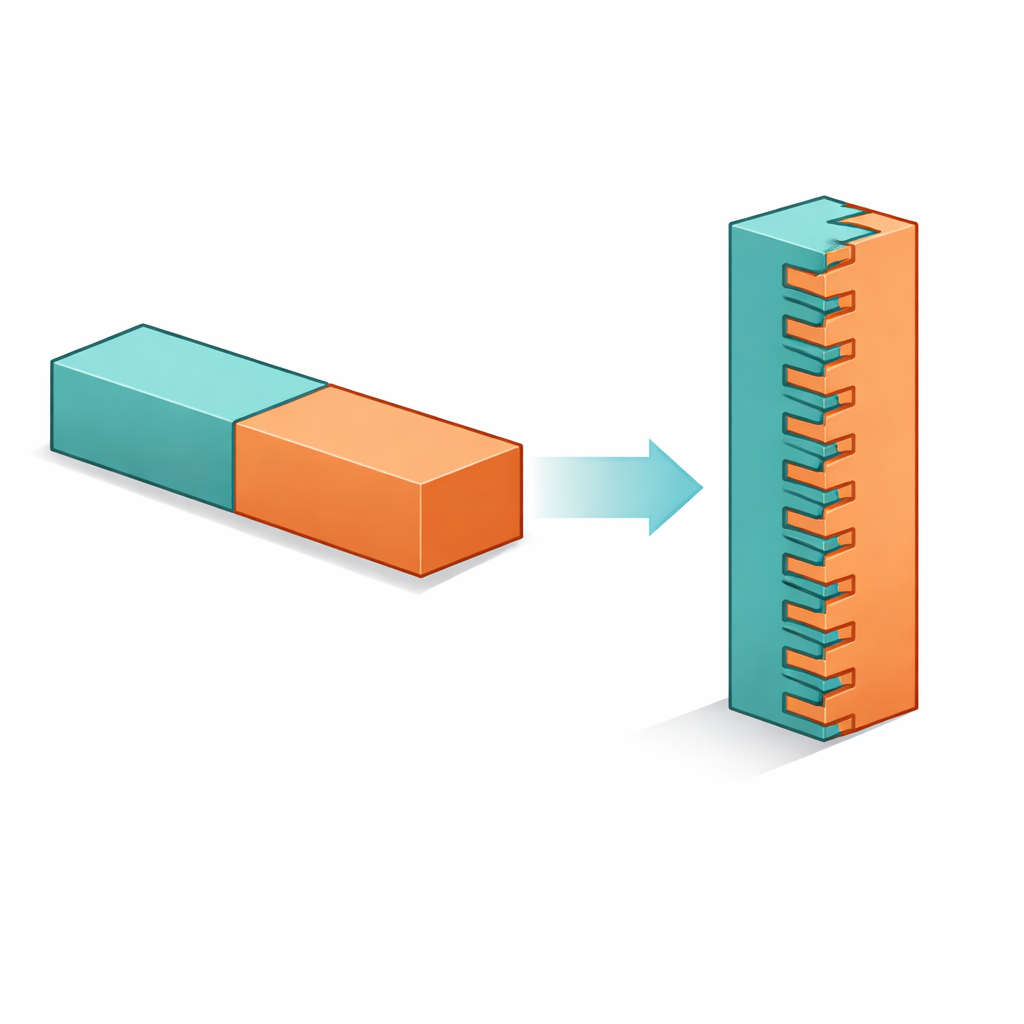
Why Mixing Hard and Soft Plastics Is Tricky
Multimaterial 3D printing lets a rigid plastic carry load while a rubbery one bends or cushions impact, all in one continuous part. Here the authors focus on a common pair: a stiff, plant-based plastic (PLA) and a stretchy, shock-absorbing plastic (TPU). PLA is strong but brittle, TPU is soft but very tough, and they do not naturally stick well to each other. In many real products—like soft robots, medical devices, or vibration-damping mounts—the interface between such materials is where cracks start and parts peel apart under use.
Turning Orientation into a Design Tool
Most printers lay material down as thin strands in stacked layers. Traditionally, designers focus on the 2D pattern in each layer, assuming the interface is just a flat contact between two blocks. The researchers asked what happens if you rotate the whole part relative to the printer. In the usual “flat” orientation, the hard and soft plastics meet across only two layers, and their connection depends on relatively weak bonds between layers. In the alternative “on edge” orientation, the interface runs vertically through many layers. This gives the printer more chances to weave the strands of the two materials side-by-side, greatly expanding the contact area and the opportunity for them to mechanically hook into each other.
Hidden Book-Like Structures at the Seam
Using carefully designed patterns at the interface and examining cross-sections under a microscope, the team discovered an unexpected but repeatable structure in the “on edge” prints: the strands of PLA and TPU formed a finely layered, interleaved pattern, reminiscent of two phone books with their pages meshed together. Instead of a single smooth boundary, the interface became a dense forest of tiny overlapping ridges and valleys. This dramatically increased the real contact surface—by up to nearly four times compared with a flat reference—and created many small anchors where the materials lock together. Even small changes in deposition path, driven purely by orientation and layer height, reshaped the internal geometry in ways not visible from the outside. 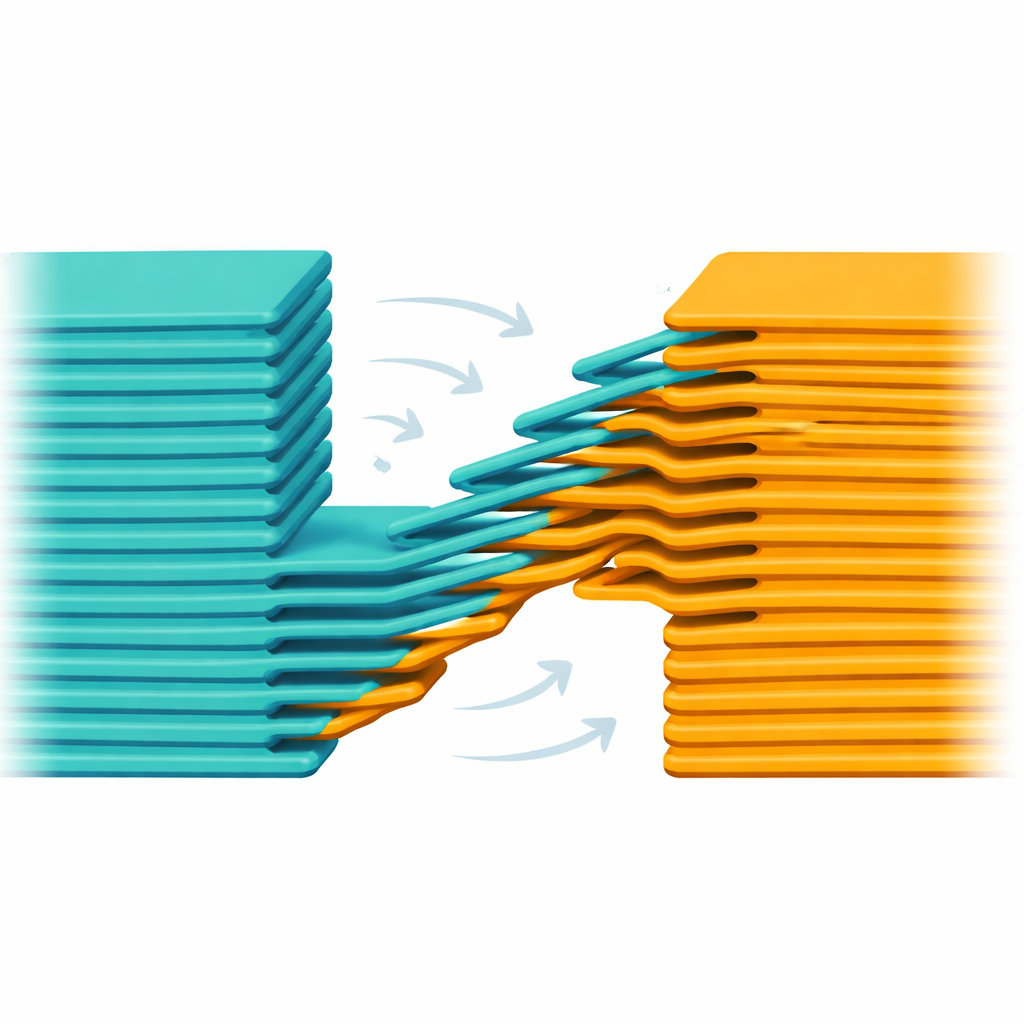
Measuring How Much Tougher the Seam Becomes
To translate this hidden geometry into numbers, the authors used a modified peel test that slowly pulled PLA away from TPU while recording the force and tracking how a crack advanced along the interface. They compared plain, flat interfaces with those containing different interlocking patterns, in both the flat and on-edge orientations. All patterned interfaces outperformed smooth ones, but the orientation made a striking difference. Certain “on edge” designs needed nearly four times more energy to keep a crack growing than the same designs printed flat, and up to nineteen times more than a simple, smooth interface. The force needed to start a crack could increase by factors of ten or more. In some flat designs, strands stretched across the opening like tiny bridges, also slowing crack growth, while in the on-edge case the dominant effect was the highly interlocked, phone-book-like contact.
What This Means for Future 3D-Printed Devices
In everyday terms, the study shows you can make the joint between hard and soft plastics vastly harder to peel apart just by choosing smarter print directions and seam patterns, rather than relying on chemical bonding or extra adhesives. Orienting the interface so the printer builds it in its highest-resolution plane, and shaping it to encourage interleaving, turns a fragile seam into a tough, energy-absorbing zone. Because this method relies on geometry rather than chemistry, it can be applied to many other material pairs that do not naturally bond well. The result is more durable, compact, and reliable multimaterial 3D-printed parts for soft robots, wearables, micromachines, and other advanced applications.
Citation: Farràs-Tasias, L., Topart, J., De Baere, I. et al. Printing orientation and interfacial mechanical design enable superior bonding in multimaterial additive manufacturing. npj Adv. Manuf. 3, 14 (2026). https://doi.org/10.1038/s44334-026-00075-y
Keywords: multimaterial 3D printing, PLA TPU interface, printing orientation, mechanical interlocking, additive manufacturing toughness