Clear Sky Science · en
Multi-material direct ink writing and co-sintering of gadolinium oxide – zirconium oxide components
Building Tougher Parts, Layer by Layer
From jet engines to nuclear reactors, many high-tech systems need ceramic parts that can handle intense heat without cracking. Engineers would love to build these parts from more than one ceramic so they can fine-tune properties like heat flow or radiation absorption in different regions of a single piece. This study explores how to 3D-print such multi-material ceramic parts and then heat-treat them so they shrink together instead of tearing themselves apart.
Why Mixing Ceramics Is So Hard
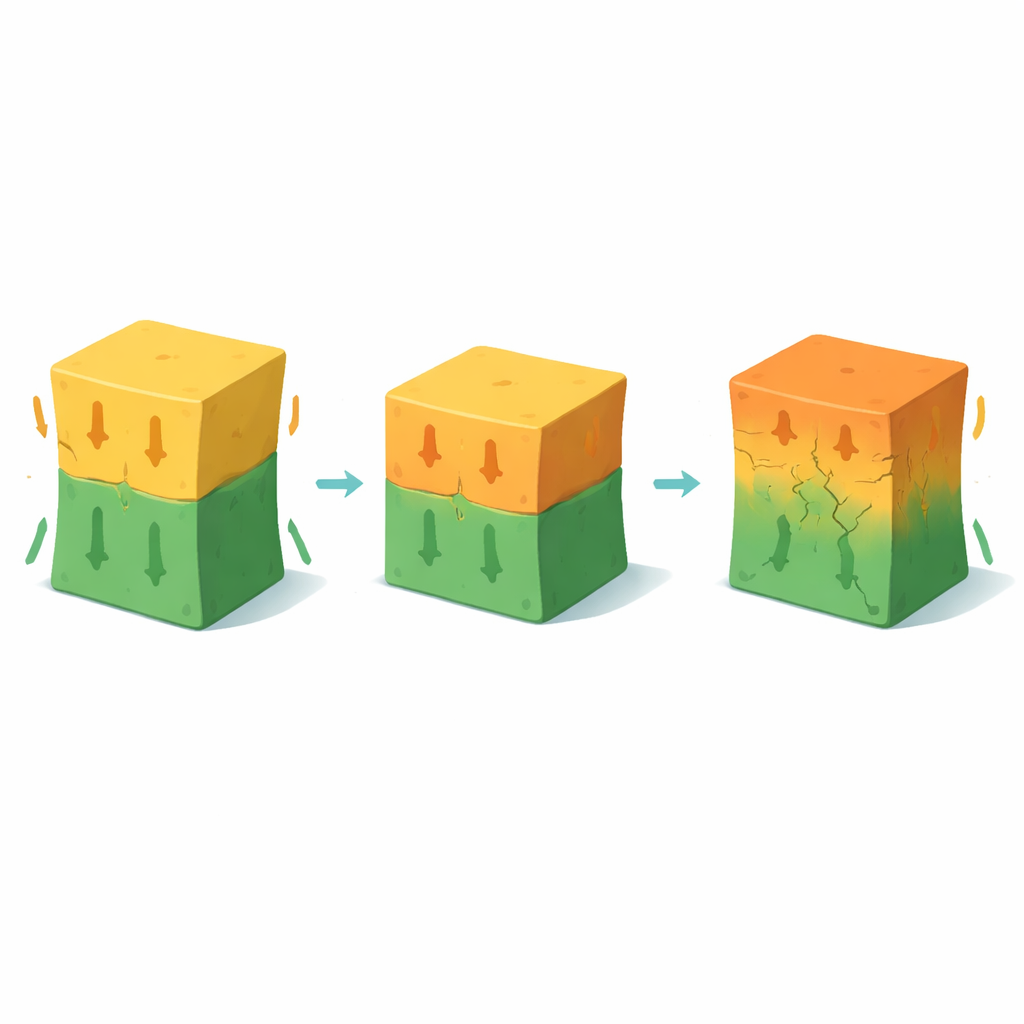
When two different ceramics are joined and then heated, they rarely behave the same way. Each material starts to densify at its own temperature, shrinks by a different amount, and expands and contracts at different rates as it heats and cools. If these changes are not synchronized, the interface between them is pulled and pushed until cracks form. That problem has held back the use of multi-material ceramic components, even though they could offer big performance gains in applications such as advanced nuclear fuel, where regions that absorb neutrons are intentionally blended with fuel that conducts heat well.
Using 3D Printing Inks as Control Knobs
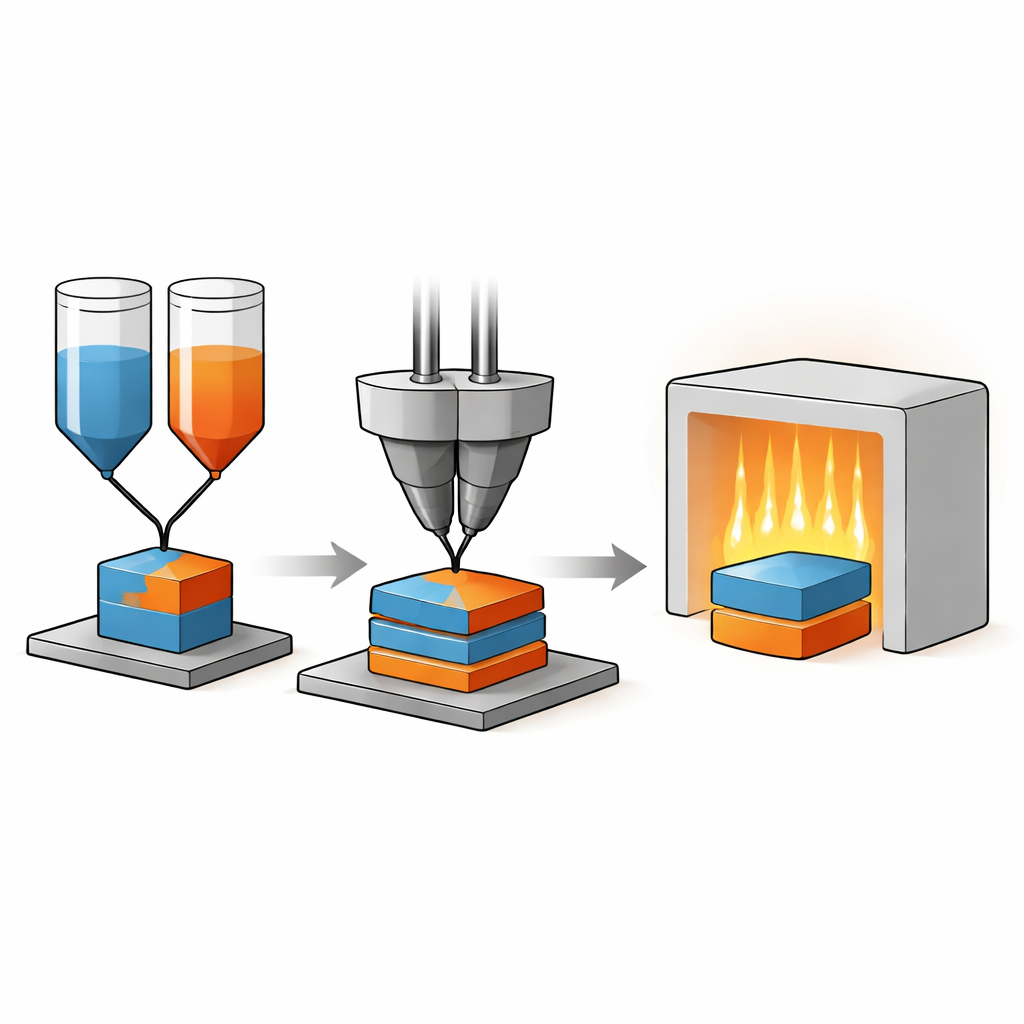
The team uses direct ink writing, a kind of 3D printing where pastes containing ceramic powders are extruded to build up a “green” part layer by layer. They work with two oxides: gadolinium oxide, which absorbs neutrons, and zirconium oxide, chosen as a safe stand-in for uranium oxide fuel. Instead of accepting the raw powders as they are, the researchers treat the printable inks themselves as engineering tools. By tuning factors such as how much powder is packed into the ink, how small the particles are, and how much polymer is added, they can adjust when and how quickly each material shrinks during firing. Careful measurements of particle charge in water and flow behavior under shear help them find stable, printable formulations for both ceramics.
Making Two Very Different Ceramics Shrink Together
Next, the authors systematically explore how heating schedules affect shrinkage. They record how small test pieces change length as they are fired under various ramp rates and peak temperatures, and they look for conditions where both ceramics reach nearly the same maximum shrinkage and shrinkage speed. A key adjustment is lowering the peak temperature to avoid a crystal-structure change in the zirconia that would otherwise cause a large jump in size. With an optimized firing profile and tailored ink recipes, they reduce the overall mismatch between the two pure materials by more than half, to about 5%. They also discover that the early “burn-out” stage, when organics and a hydroxide phase are removed, is especially delicate: even about 1% mismatch can be enough to crack fragile parts at that point.
When Gradual Blends Make Things Worse
It might seem natural to ease the stress between materials by printing a gradual blend of the two, rather than a sharp boundary. The team tests this by printing sandwich structures in which mixed layers, containing various ratios of the two inks, sit between pure layers. They then track how these mixtures shrink and inspect whether real printed parts survive after firing. Surprisingly, the mixtures often behave very differently from what a simple average of the end members would suggest. As the two oxides intermix at high temperature, they form new solid-solution phases that shrink much less or start shrinking at different temperatures. That leads to higher internal strains, distorted shapes such as “barreled” blocks whose middle barely shrinks at all, and both visible cracks and microscopic cracking along the interfaces.
Design Rules for Future Multi-Material Ceramics
The study concludes that for this type of oxide pair, the safest path is not to rely on smooth composition gradients to hide differences between materials. Instead, it is better to engineer each pure-material ink so that their sintering behaviors are closely matched, then join them with clean, discrete interfaces. The authors show that parts can tolerate a few percent of mismatch during full sintering, thanks to some viscoelastic relaxation at high temperatures, but the early burn-out stage demands much tighter control. These findings give engineers a practical playbook for designing multi-material ceramic components that come out of the furnace dense, intact, and ready for demanding service.
Citation: Snarr, P.L., Cramer, C.L., Cakmak, E. et al. Multi-material direct ink writing and co-sintering of gadolinium oxide – zirconium oxide components. npj Adv. Manuf. 3, 12 (2026). https://doi.org/10.1038/s44334-026-00073-0
Keywords: multi-material ceramics, direct ink writing, co-sintering, nuclear fuel materials, additive manufacturing