Clear Sky Science · en
Powder characterization for in-space additive manufacturing
Building What We Need, Where We Need It
As space travel becomes cheaper and missions stretch from quick visits to long-term stays, a new question looms: how do we fix things, build shelters, or make replacement parts without shipping everything from Earth? This paper explores how to turn the dusty soil of the Moon and Mars, along with junk metal orbiting our planet, into the fine powders needed for 3D printing in space. It explains why this powder-based manufacturing is both promising and tricky in the harsh, airless, low‑gravity environments beyond Earth.
Turning Dust and Junk into a Storehouse
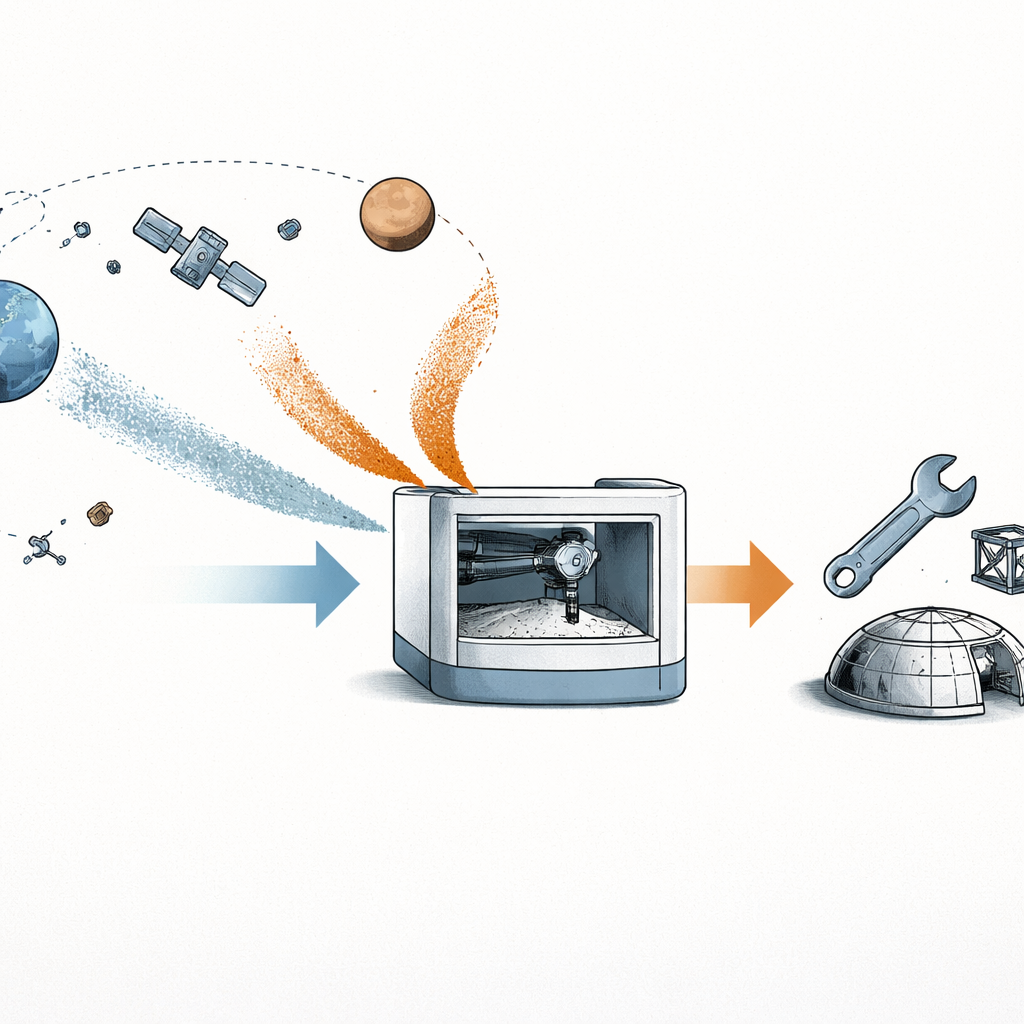
Instead of treating space debris and planetary dust as problems, the authors frame them as a resource bank. Old satellites, rocket stages, and fragments whizzing around Earth contain useful metals that can be collected, shredded, melted, and transformed into tiny powder particles. On the Moon and Mars, loose surface material known as regolith already comes in fine grains well-suited to powder-based techniques. But these powders are very different from the tidy, spherical particles used in factories on Earth: regolith grains are jagged, highly varied in size, and can carry electrical charge, making them prone to clumping and sticking. The paper reviews how these unusual materials could be harvested, cleaned, and processed into safer, more predictable feedstocks for 3D printers in orbit and on planetary surfaces.
Why Space Changes How Powders Behave
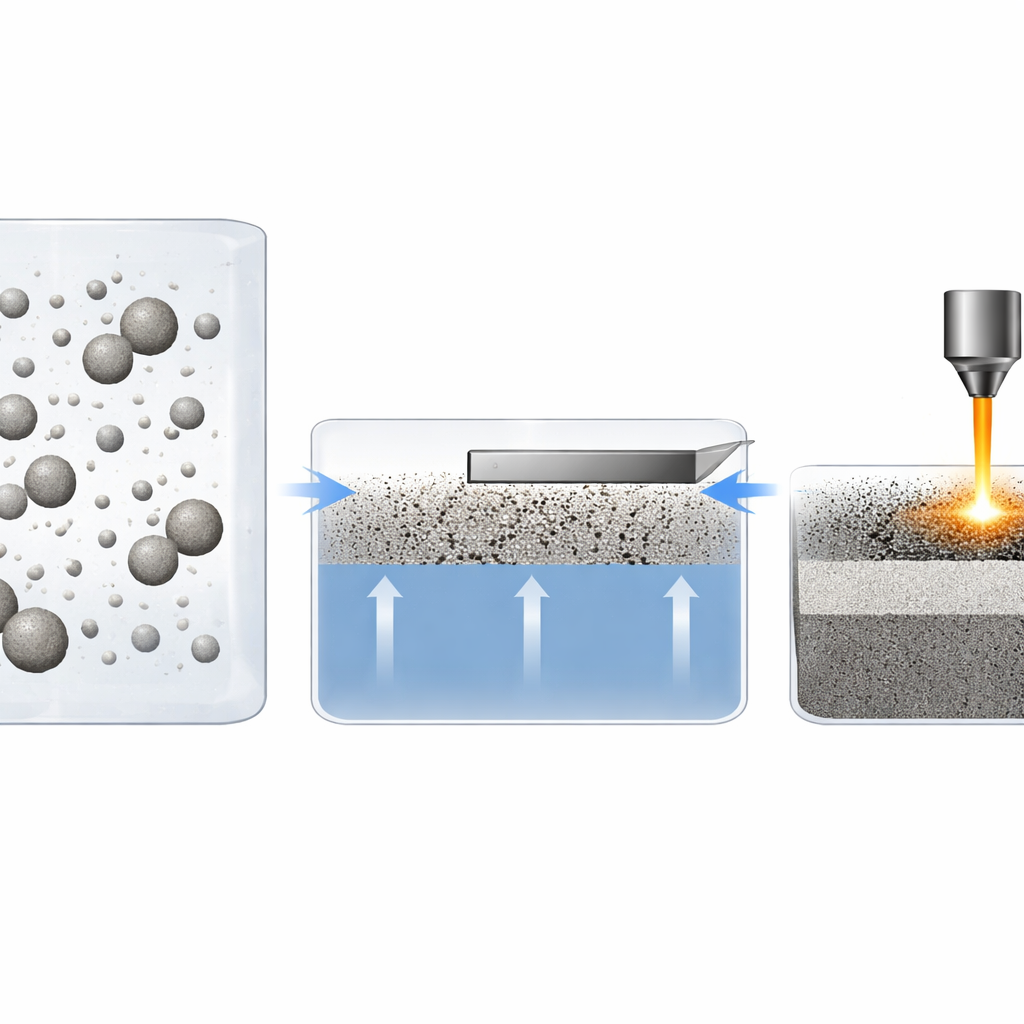
On Earth, gravity quietly keeps powders in place and helps them pour like sand in an hourglass. In space, that foundation disappears. Under microgravity or the weaker pull on the Moon and Mars, tiny forces that are usually overshadowed—such as molecular attraction, surface roughness, and static electricity—suddenly dominate. Vacuum and extreme temperatures further complicate things: the absence of air alters how particles charge and discharge, while wide swings in temperature can make powders either more sticky or partially melted. Radiation can subtly harden or damage particle surfaces over long periods. The review shows how these factors can disrupt even basic tasks like feeding powder through a nozzle or forming a smooth layer for a laser to melt, raising safety concerns about loose dust inside spacecraft and the reliability of printed parts.
Choosing and Making the Right Kind of 3D Printing
Many 3D-printing methods on Earth rely on powder, but not all translate well to space. The authors examine approaches where powder itself is the main ingredient—such as powder bed fusion, binder jetting, and directed energy deposition—and others where powder is mixed into liquids or filaments. Techniques that depend heavily on gravity to spread and pack powder layers must be redesigned with sealed chambers, controlled gas flows, or mechanical devices to hold particles in place. Even producing the powder is an engineering challenge: familiar industrial methods like spraying molten metal into droplets need careful rethinking when there is no natural convection to cool the spray. The paper highlights electrolysis and chemical reduction as especially promising for space, because they can draw metals directly from regolith or debris using electricity, potentially powered by sunlight.
Measuring and Controlling Invisible Powder Problems
To print reliably in space, engineers must be able to measure what the powder is like and monitor how it behaves in real time. On Earth, standard tests measure particle size, shape, density, flow, and chemistry—often with gravity quietly doing part of the work. Many of these tests simply do not function the same way in orbit or on the Moon. The authors map out which measurement methods can be adapted, such as imaging particles while they are suspended in liquids, or using gas-based volume measurements that do not depend on weight. They also survey emerging systems that watch the printing process directly: torque sensors that feel how hard it is to move powder, cameras that inspect each layer through a window, and laser-based acoustic checks that “listen” for hidden flaws. Alongside these tools, computer models are being developed to simulate how regolith and metal powders spread, pack, and fuse under altered gravity and pressure, helping designers test ideas virtually before risking costly space experiments.
From Printed Wrenches to Lunar Homes
The paper connects these technical details to tangible uses. Early space-based printers have already made plastic tools aboard the International Space Station, while a new generation of metal printers promises stronger replacement parts. Looking ahead, powder-based methods could help build landing pads, roads, radiation shields, and even portions of habitats from local regolith, dramatically cutting the mass that must be launched from Earth. Regolith-based thermal tiles and shields might protect vehicles on reentry, and ultra-clean conditions in orbit may even be ideal for growing high-quality semiconductor crystals. However, the authors stress that powders in space are a double-edged sword: they are both an unavoidable hazard and a key enabler of self-sufficient space industry.
What This Means for Living Off-World
For non-specialists, the takeaway is that dusty moons and scrap-filled orbits may be the raw material for building a lasting human presence in space. The review concludes that powder-based manufacturing in space is feasible but will require new ways to make, contain, test, and model powders under conditions unlike anything on Earth. If researchers can tame how these fine particles behave in low gravity and vacuum, future explorers could 3D-print tools, structures, shields, and electronics using what is already there—turning space from a place we visit into a place we can truly inhabit.
Citation: Fernander, D.S., Karunakaran, R., Mort, P.R. et al. Powder characterization for in-space additive manufacturing. npj Adv. Manuf. 3, 11 (2026). https://doi.org/10.1038/s44334-026-00071-2
Keywords: in-space additive manufacturing, lunar regolith, space debris recycling, powder behavior microgravity, 3D printing in space