Clear Sky Science · en
Maximizing solids loading for aqueous slurry robocasting of silicon carbide
Building Tough Parts for Harsh Places
From jet engines to fusion reactors, many advanced machines need parts that can survive blistering heat, sudden temperature swings, and corrosive chemicals. Silicon carbide, a ceramic known for its hardness and heat resistance, is a prime candidate—but it is notoriously difficult to shape and densify. This study shows how to finely tune a special “ink” made of silicon carbide particles in water so it can be 3D printed into complex shapes and then fired into strong, nearly fully dense parts, opening a path to rugged components for extreme environments.
Why Silicon Carbide Is So Appealing
Silicon carbide combines several traits that engineers dream of: it is very hard, light compared with metals, resistant to chemical attack, and stable at temperatures well above 1400 °C. These qualities make it attractive for heat exchangers, aerospace components, energy systems, and precision optical mirrors. The catch is that machining silicon carbide into intricate forms is difficult and expensive. Additive manufacturing—building objects layer by layer—offers a way around this, but only if the starting material can be printed smoothly and then packed tightly enough to form dense, crack-free parts after firing.
Turning Powder into Printable Ink
In this work, the researchers focused on a printing method called direct ink writing, where a thick paste is squeezed through a nozzle like frosting from a piping bag. Their goal was to pack as much silicon carbide as possible into a water-based slurry without making it too thick to flow. They began by characterizing the powder, which had sub-micron particles chosen to allow dense sintering. Then they used measurements of surface charge, known as zeta potential, to understand how particles interact in water. By adding a small amount (2 percent by volume) of a polymer called polyethyleneimine, they coated the particle surfaces so they repelled one another just enough to stay well dispersed without adjusting the liquid’s acidity. This balance helped keep the slurry fluid during printing but stable enough to hold its shape once deposited. 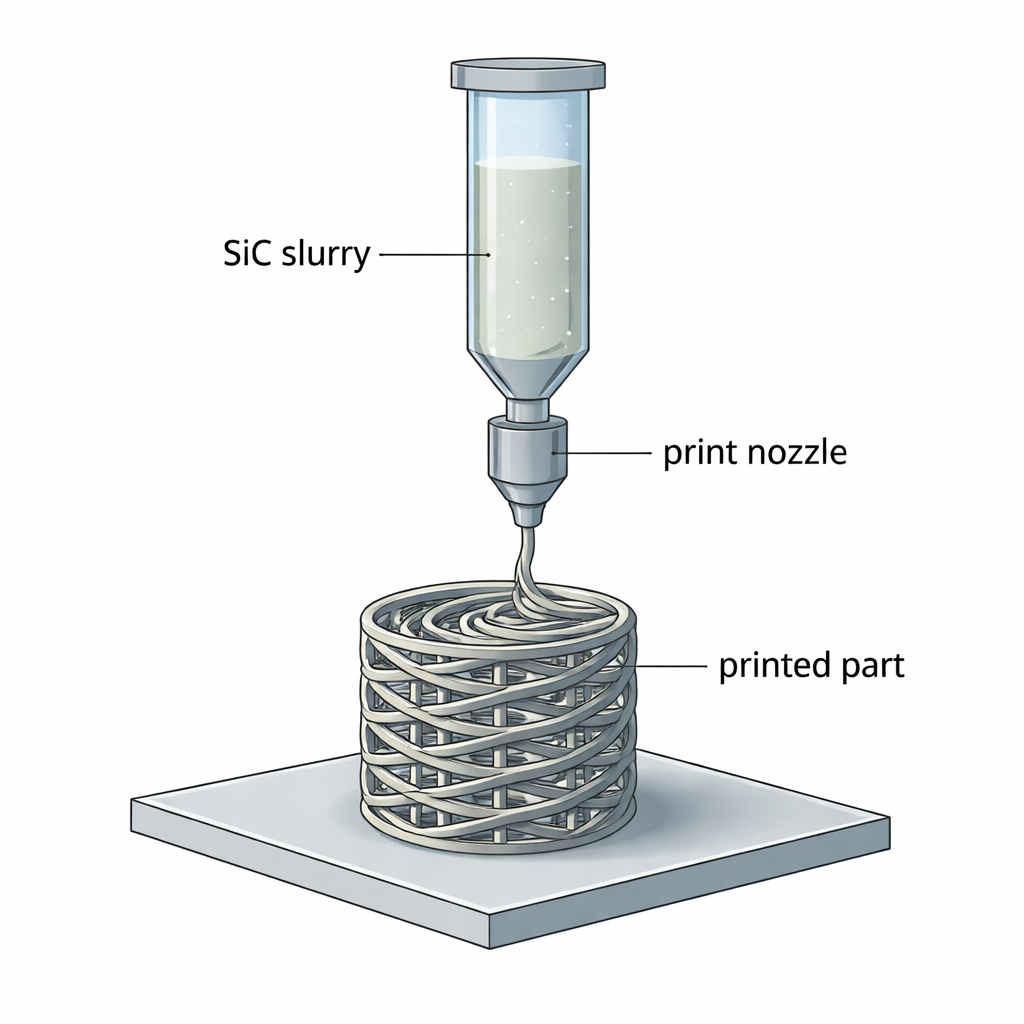
Finding the Sweet Spot in Flow Behavior
The team systematically adjusted how much polymer they used, as well as its chain length, and watched how the slurry’s resistance to flow changed. They found that 2 percent of a mid-range molecular weight polymer produced the lowest viscosity—meaning the slurry deformed easily under stress—while too little or too much polymer caused the ink to thicken. Changing the acidity or basicity of the liquid also made flow worse. With the optimal recipe in hand, they gradually pushed the solids content from 35 up to 56 percent by volume. As expected, the slurry became thicker and its yield strength—the stress needed to make it start flowing—rose sharply at higher loadings. Above about 49 percent, their particular printing hardware could no longer reliably push the ink through the nozzle, so the thickest mixtures were instead shaped by casting into molds. 
From Green Bodies to Dense Ceramics
After shaping, the parts were dried slowly in a humid environment to avoid cracking as water left the structure. The dried “green” bodies were then heated to burn out the polymer additives and finally sintered at about 2200 °C in an inert atmosphere so the ceramic particles could fuse. Measurements using the Archimedes method—essentially weighing parts in air and water—showed that higher initial solids loading produced denser final pieces. Samples starting at 45 percent solids reached about 88 percent of the theoretical density, while those starting at 56 percent reached roughly 93.5 percent. Optical and electron microscopy confirmed that pores and voids shrank dramatically as solids loading increased, leading to more uniform microstructures. X-ray diffraction revealed that the silicon carbide also transformed from a cubic to a more stable hexagonal crystal form during the high-temperature firing step.
What This Means for Future Devices
For non-specialists, the central message is that carefully tuning a few key ingredients in a thick, particle-filled ink can make or break the quality of 3D-printed ceramics. By using surface chemistry and flow measurements as guides, the authors pushed the amount of silicon carbide in a printable or castable water-based slurry to the highest levels yet reported for this type of powder, while still achieving strong, nearly fully dense parts after sintering—without resorting to extra silicon or polymer-derived phases. This framework can be adapted to other ceramic systems and printing setups, moving industry closer to on-demand production of complex, high-performance components that can withstand some of the harshest conditions technology can throw at them.
Citation: Feldbauer, J., Cramer, C.L. & Gilmer, D. Maximizing solids loading for aqueous slurry robocasting of silicon carbide. npj Adv. Manuf. 3, 10 (2026). https://doi.org/10.1038/s44334-026-00070-3
Keywords: silicon carbide 3D printing, direct ink writing, ceramic slurries, high temperature materials, additive manufacturing