Clear Sky Science · en
Additive manufacturing pathways for polymer-derived ceramics: processing, structure, and function
Turning Plastics into Heat-Proof Ceramic Parts
Many of the hottest, harshest places in modern technology—like rocket noses, jet engines, and nuclear plants—demand materials that ordinary metals cannot survive. This article explores a surprising route to such extreme materials: starting from liquid-like polymers (plastics) that are shaped by 3D printing, then transformed by heat into tough ceramics. The result is a highly controllable way to build intricate, heat‑proof components that would be nearly impossible to machine from hard ceramic blocks.
From Liquid Building Blocks to Ceramic Skeletons
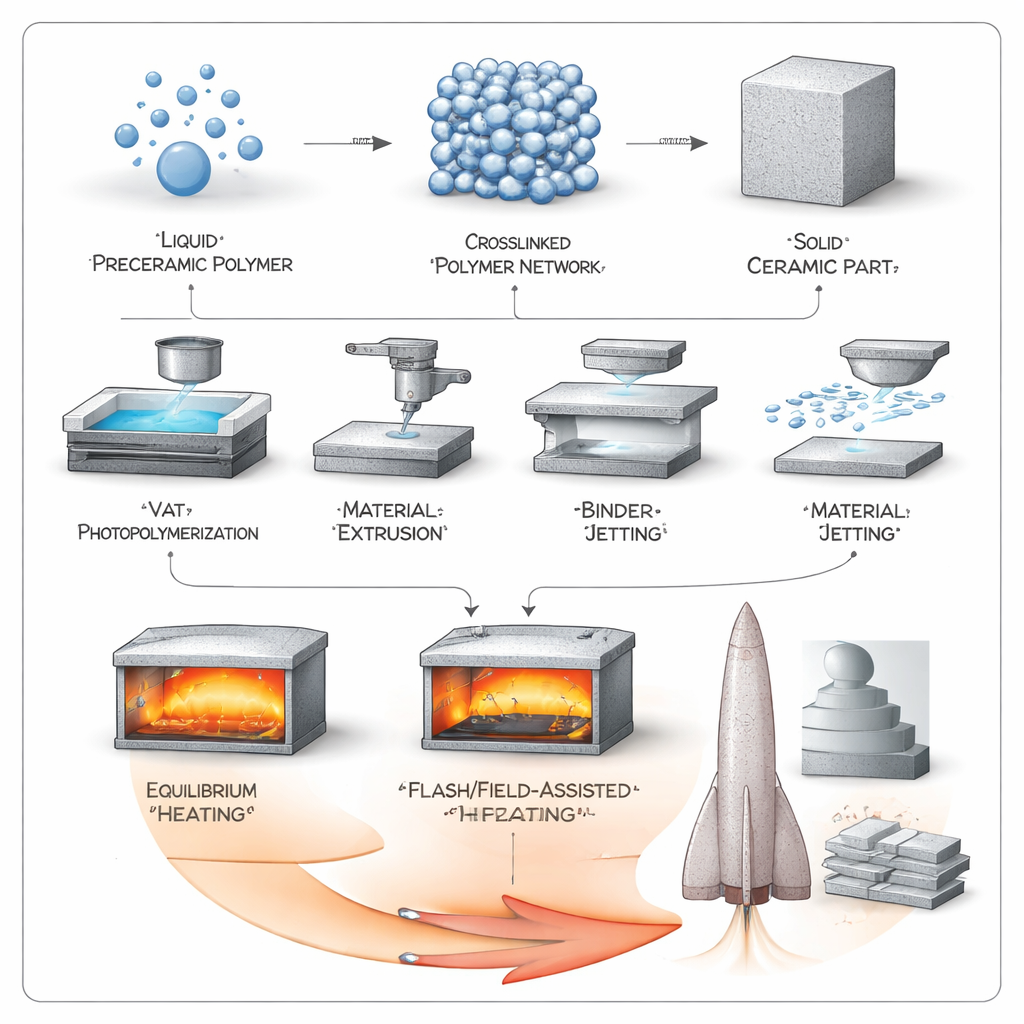
The story begins with preceramic polymers, specially designed molecules that behave like plastics at room temperature but turn into ceramics when fired. Because these polymers flow, cure, and dissolve much like conventional resins, they are easy to cast, print, or infiltrate into complex molds. By carefully choosing the polymer’s chemistry, researchers can dial in how much ceramic is left after heating, how porous it is, and whether the final material is closer to a silicon carbide, a silicon nitride, or a mixed glassy ceramic. This "chemistry first" strategy allows engineers to control composition from the molecular scale upward, something that traditional ceramic powder routes struggle to achieve.
Helping Additive Manufacturing Handle the Heat
These preceramic polymers pair naturally with a wide family of 3D-printing methods. In vat photopolymerization systems, light hardens thin layers of liquid resin to build parts with very fine details and smooth surfaces. Material extrusion approaches, such as fused filaments or direct ink writing of pastes, are well suited for thicker, architected lattices and scaffolds. Binder jetting and inkjet-style material jetting print droplets or binders into powders, offering large build volumes and design freedom. In each case, the polymer acts as a shapeable precursor that later "locks in" as ceramic when heated, allowing the same digital design to be realized across multiple printing platforms, from micro‑devices to centimeter‑scale structures.
Using Fillers to Tame Shrinkage and Cracking
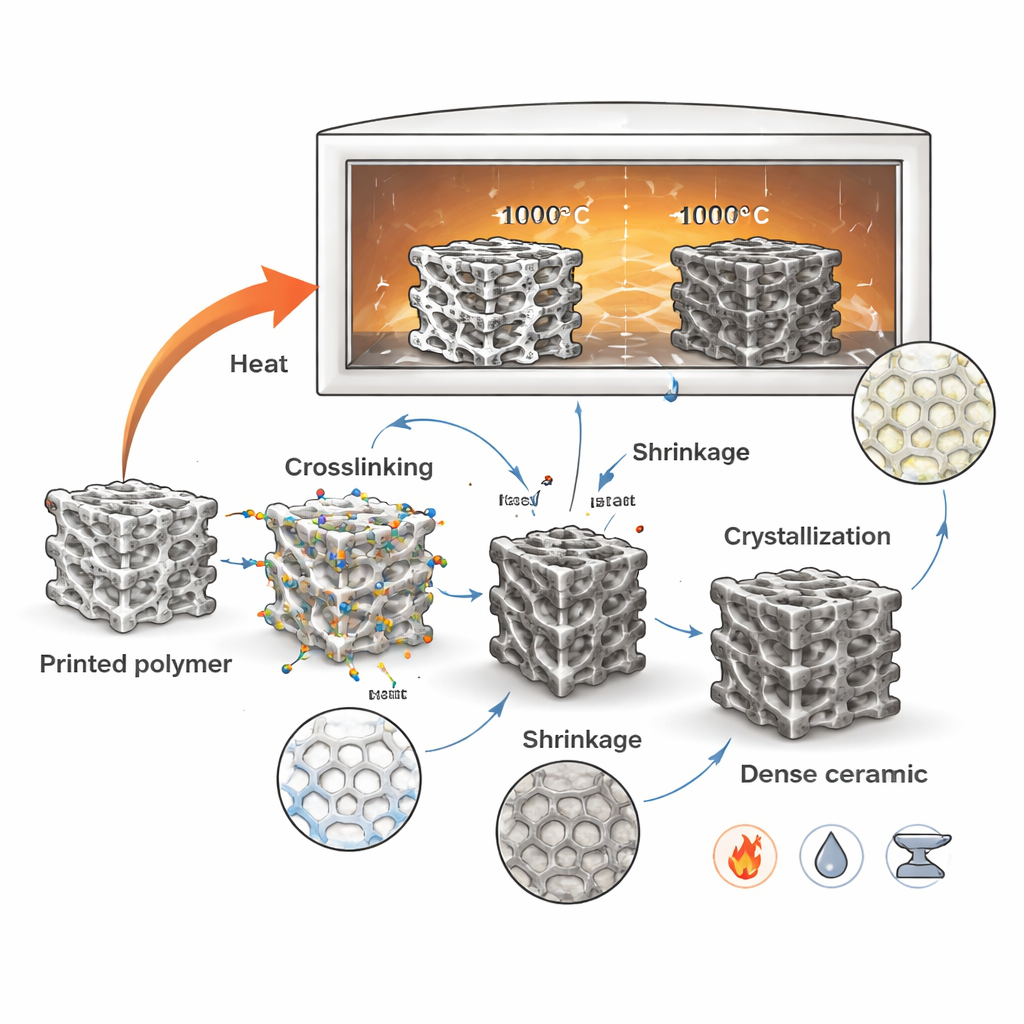
Transforming a plastic-rich part into a ceramic is not gentle: gases escape, mass is lost, and the object can shrink by 20–40%. Left unchecked, this can cause warping, cracking, and large pores. To manage these stresses, the review explains how engineers mix in carefully chosen fillers—tiny particles, whiskers, fibers, or even hollow beads. Some fillers are passive, acting like a rigid skeleton that supports the shape and relieves internal stresses during firing. Others are active, reacting with the evolving gases or the polymer itself to form new ceramic phases that can expand and fill space, offsetting shrinkage. By balancing polymer and filler, researchers can make dense, tough components or highly porous, insulating foams from essentially the same starting chemistry.
Designing with Heat: Slow Roast or Flash Fry
Heating, or "pyrolysis," is where the magic happens. Under slow, even furnace conditions, the printed polymer first crosslinks into a rigid network, then gradually sheds organic groups, leaving behind an amorphous ceramic that can later crystallize. Changing the gas atmosphere—from inert nitrogen to reactive ammonia—shifts what phases form, from silicon carbonitrides to nearly pure silicon nitride. The review also highlights faster, non‑equilibrium routes such as spark plasma sintering, flash sintering, and laser-driven conversion. These methods use electric currents or focused beams to heat parts very rapidly, helping densify them at lower overall temperatures and sometimes locking in unusual microstructures that would not survive a long, slow bake.
From Smart Shapes to Extreme Environments
Beyond simply surviving heat, polymer‑derived ceramics can be made to move and adapt. By programming stresses or shape-memory behavior into the polymer stage and then converting to ceramic, researchers achieve 4D-printed components that fold, unfold, or recover shapes when heated—essentially "smart" ceramic origami. At the same time, more chemically complex precursors are being pushed toward ultra‑high‑temperature compositions such as zirconium and hafnium carbides and borides, which stay solid near 3000 °C. The article concludes that by uniting digital design, clever polymer chemistry, and advanced thermal treatments, additive manufacturing of polymer‑derived ceramics is turning once‑brittle, hard‑to‑shape materials into customizable, multifunctional parts ready for the most extreme conditions.
Citation: Khuje, S., Ku, N., Bujanda, A. et al. Additive manufacturing pathways for polymer-derived ceramics: processing, structure, and function. npj Adv. Manuf. 3, 8 (2026). https://doi.org/10.1038/s44334-026-00068-x
Keywords: polymer-derived ceramics, additive manufacturing, preceramic polymers, high-temperature materials, 4D printing