Clear Sky Science · en
Screening of liquid photopolymer resins exposed to high-vacuum
Building Space Hardware with Liquid Glue
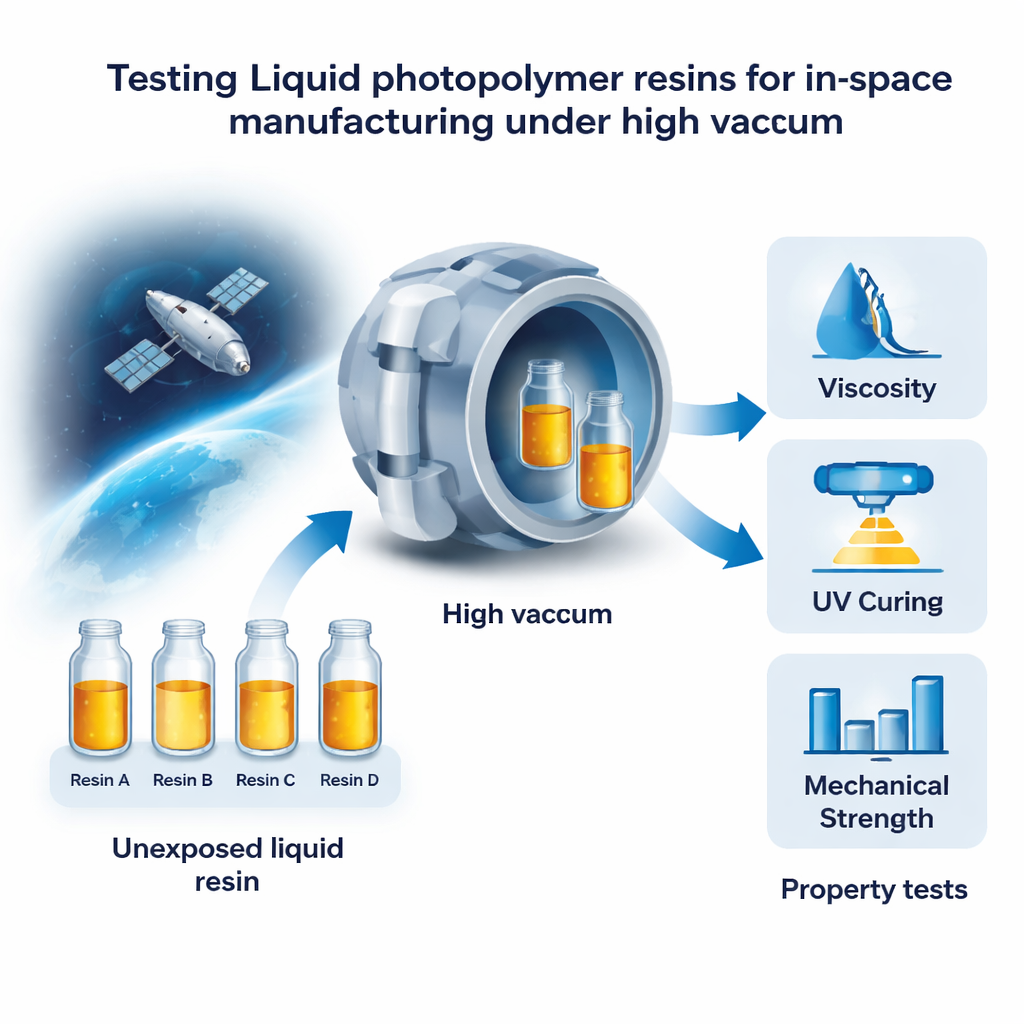
Many future space missions imagine building large antennas, booms, and solar sails directly in orbit instead of launching them fully assembled from Earth. A promising approach is to squeeze special liquid glues, called photopolymers, out of a nozzle and harden them with light to form strong structures. But in the near‑perfect vacuum of space, liquids can boil away or change their behavior in unexpected ways. This study asks a practical question: which off‑the‑shelf photopolymer resins can survive harsh space‑like vacuum conditions and still work as reliable building materials?
Why Space Vacuum Is Tough on Sticky Liquids
Inside a spacecraft factory in orbit, these resins would be processed as liquids under extremely low pressures—far lower than any industrial vacuum on Earth. Under such conditions, small, easily evaporated molecules in the resin can escape. That loss can thicken the liquid, slow or weaken the light‑driven curing process, and reduce the final stiffness of the solid material. Escaping vapors can also condense on sensitive surfaces such as cameras or solar panels, a problem known as contamination. Space agencies therefore demand “low‑outgassing” materials that hardly lose mass or shed condensable vapors in vacuum.
Putting Four Candidate Resins Through a Space‑Style Trial
The researchers selected four commercially available UV‑curable resins that are already used as industrial adhesives or coatings. These included two high‑performance epoxies from Delo, a fiber‑reinforced epoxy from Polymer‑G, and an acrylated urethane from Loctite. First, the team measured how each resin behaved “as delivered” in both liquid and cured form. Then they exposed the liquids to high vacuum for 24 hours at room temperature, simulating an extreme but controlled version of the processing conditions they might face in orbit. After this treatment, the resins were re‑tested for viscosity (how runny or thick the liquid is), how efficiently they cured under ultraviolet light or heat, how stiff the solid became over temperature, and how much material evaporated away.
What Changed When the Air Was Taken Away
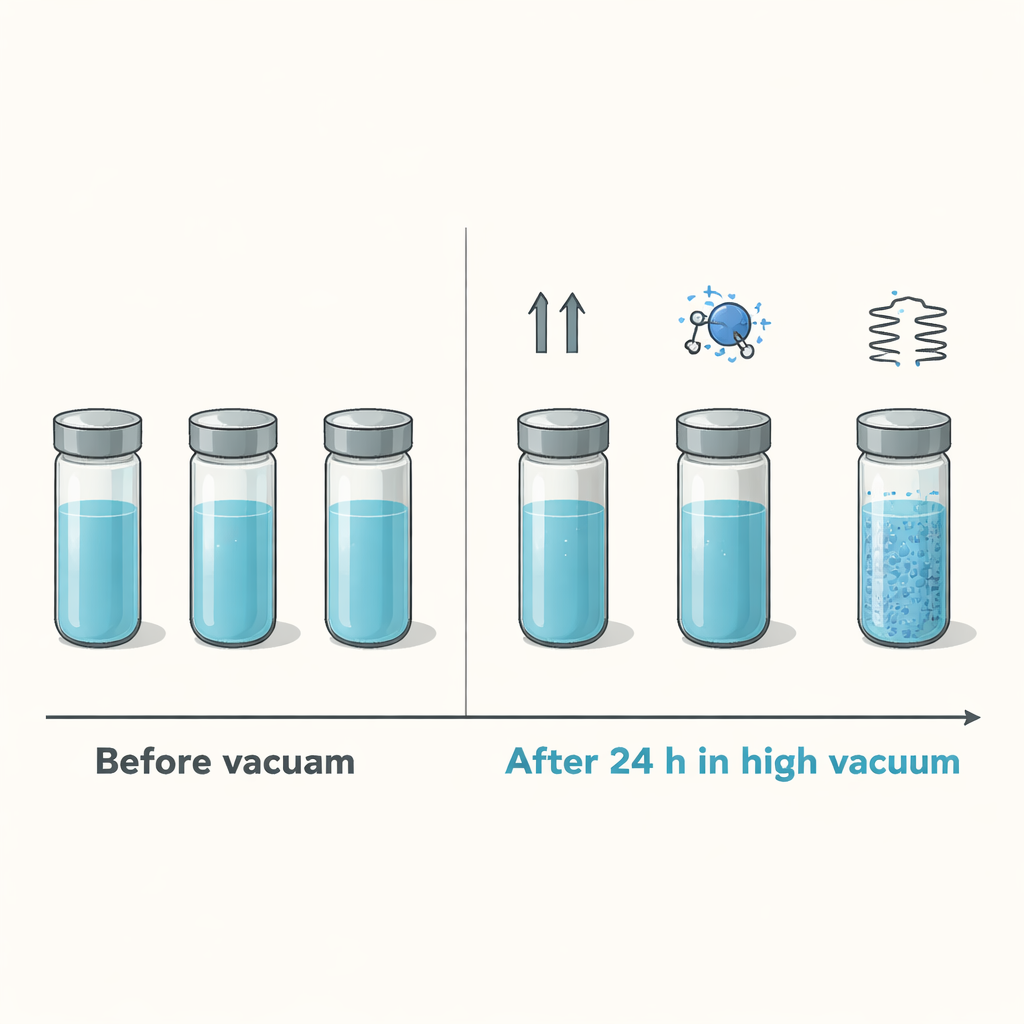
All four resins became thicker under high vacuum, as expected when the smallest molecules evaporate out of the mix. For three of the resins, the viscosity increased moderately—by about 4 to 34 percent—while one Loctite resin turned from a thin liquid into a gum‑like gel that could no longer be measured with the same instruments. Light‑curing behavior also shifted: one Delo resin needed several times more UV energy to reach the same cure depth after vacuum exposure, suggesting that key light‑sensitive ingredients had partly escaped. By contrast, the Polymer‑G resin and one Delo formulation kept nearly the same curing behavior before and after vacuum, hinting at a more robust recipe.
How Strong and Clean the Final Solids Remained
Once cured, the resins were tested like miniature beams, flexed gently while being heated. All materials showed some “post‑curing” as they were warmed, meaning their internal networks continued to lock together and stiffen. After vacuum exposure, several resins lost up to roughly one‑third of their stiffness at certain temperatures, likely because tiny voids or bubbles formed as vapors escaped. Yet their basic transition temperatures—where they soften significantly—changed little for three of the four resins, indicating that the underlying chemistry stayed mostly intact. Outgassing tests told a more mixed story: all liquids lost more than 1 percent of their mass under hot vacuum, but two of the cured Delo resins remained safely below standard limits for space contamination, while the other two cured systems did not.
Picking the Most Promising Glues for Space Construction
Seen through a builder’s eyes, the message is cautiously optimistic. The study finds that two materials—Delo Katiobond GE680 and Polymer‑G EPV9511—stand out as practical candidates for in‑space manufacturing, provided engineers remove trapped air and volatile ingredients with careful pre‑degassing and limit vacuum exposure time during printing or bonding. Both resins stayed curable after an aggressive 24‑hour vacuum treatment, and their stiffness in the solid state, although slightly reduced, remained high enough for structural uses. The other two resins suffered from excessive mass loss, severe thickening, or unreliable stiffness at higher temperatures, making them poor choices for building hardware in orbit. Overall, the work offers a first systematic roadmap for screening liquid photopolymers for space factories, bringing the idea of “3D printing” large structures in the vacuum of space a step closer to reality.
Citation: Kringer, M., Pimpi, J., Sinn, T. et al. Screening of liquid photopolymer resins exposed to high-vacuum. npj Adv. Manuf. 3, 5 (2026). https://doi.org/10.1038/s44334-025-00066-5
Keywords: in-space manufacturing, photopolymer resin, high vacuum, outgassing, space structures