Clear Sky Science · en
Predicting energy consumption in directed energy deposition using incremental learning-integrated transfer learning
Why smarter 3D printing power use matters
Metal 3D printing can create intricate jet engine parts and medical implants, but it often gulps down electricity. That energy has both a financial cost and a climate cost. This paper explores a way to teach computers to reliably predict, and eventually reduce, the energy used in a particular type of metal 3D printing, even when only a small amount of data is available. For anyone concerned with greener manufacturing or cheaper high‑tech products, this work points toward smarter, more efficient factories.
How metal parts are built with light
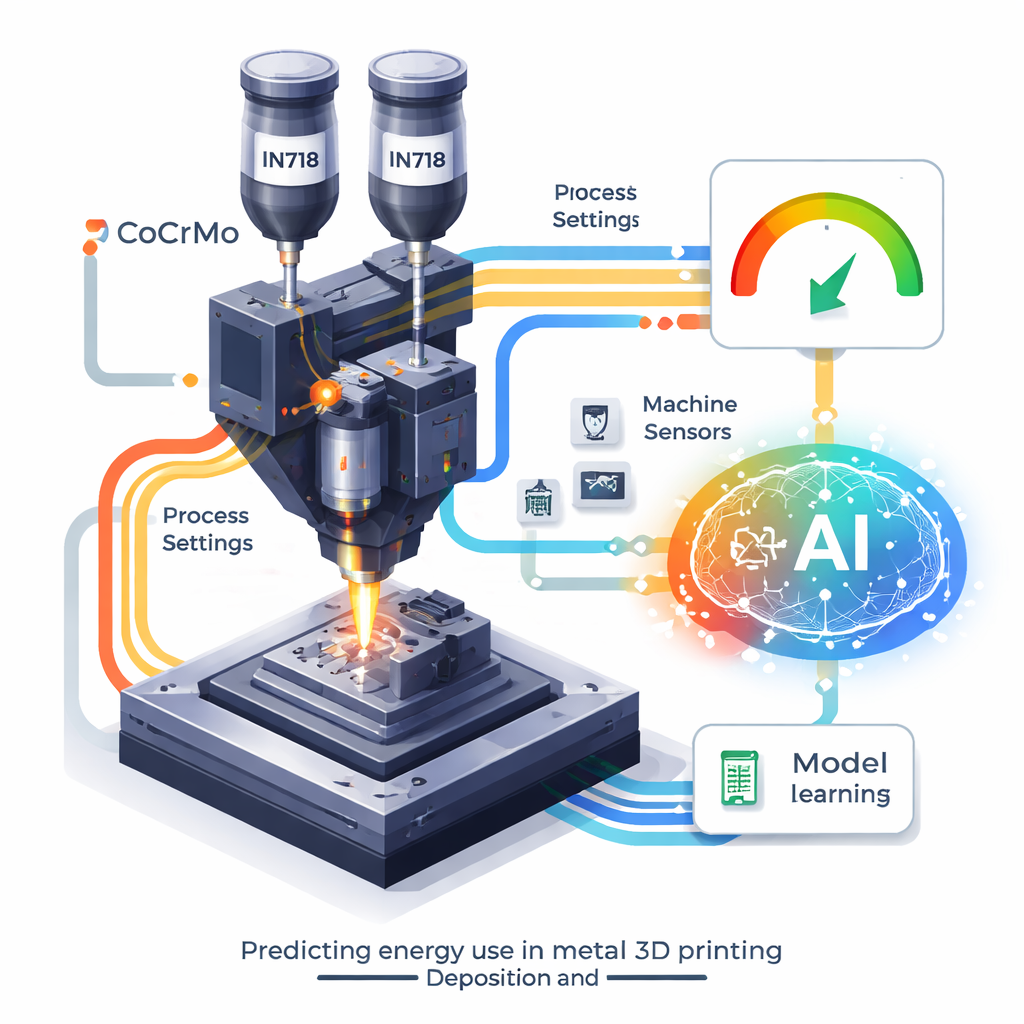
Many metal 3D printers work by shining an intense laser or electron beam onto a stream or bed of metal powder. In the directed energy deposition (DED) process studied here, powder is blown into a tiny molten pool created by a laser, building the part layer by layer. While this approach wastes less raw material than cutting parts from blocks, it still uses a great deal of power because the machine must repeatedly melt and solidify metal. The exact energy used depends on the alloy, the laser power, the speed of motion, and how quickly powder is fed, among other factors. Predicting energy use from these settings is difficult, yet crucial for controlling costs and estimating carbon emissions.
Why usual prediction tools fall short
Researchers have tried using both physics equations and conventional machine learning to forecast energy consumption in additive manufacturing. Physics-based models struggle to capture all the messy real-world influences, while standard machine learning typically needs large, rich datasets that include not only process settings but also sensor readings and images. Collecting such detailed data is expensive and time-consuming. Worse, models trained on one metal or one machine setup often fail when conditions change. A model that works for one nickel alloy may not work for a cobalt-chromium alloy, and a model tuned to one laser power may perform poorly at another.
A learning framework that builds on what it already knows
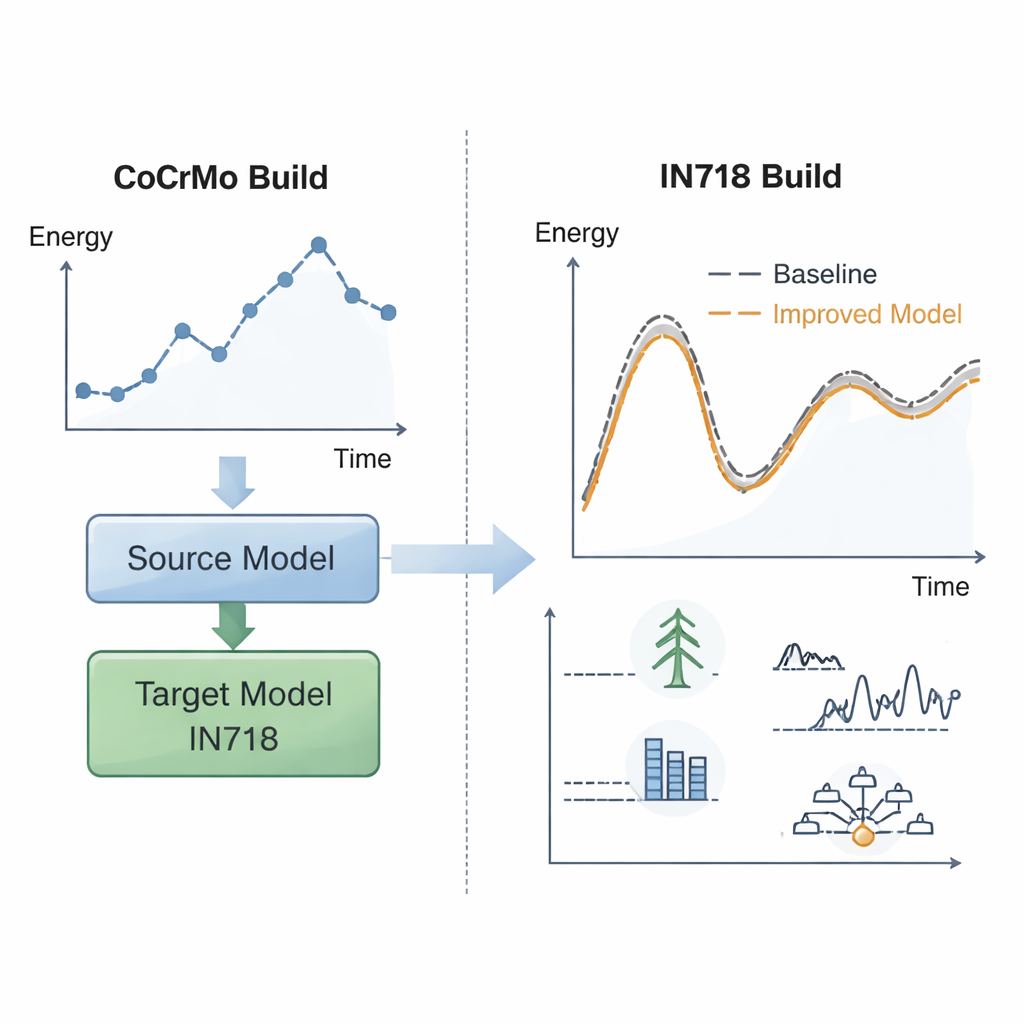
The authors combine two ideas—transfer learning and incremental learning—to tackle these limits. Transfer learning lets a model reuse what it has learned about energy use from one situation, such as printing with cobalt-chromium (CoCrMo), when it is applied to another, such as printing with a nickel-based alloy (IN718). Incremental learning allows the model to be updated step by step as new data arrives, rather than retraining from scratch. In their framework, the model is first trained in stages on one material, starting with samples made at lower laser powers and then adding samples made at higher powers. The trained model is then lightly retrained on just a few samples from the new material or new power level so it can adapt without needing a large new dataset.
Testing different ways for computers to recognize patterns
To see how well this framework works, the team printed 20 small test parts using CoCrMo and IN718 powders while measuring the electrical energy used at each moment. They used only six simple inputs—time step, laser power, scanning speed, powder feed rate, layer number, and whether the machine was actively building or not—to predict the energy at each time. Four types of models were compared: a tree-based method (XGBoost), a recurrent neural network (LSTM), a temporal convolutional network (TCN), and a transformer model that uses attention mechanisms. Across three tasks—switching from CoCrMo to IN718, from IN718 to CoCrMo, and from lower to higher laser power in IN718—the incremental transfer learning approach consistently made predictions closer to the actual measurements than models trained in the usual way.
Which approach worked best
Among the four models, the temporal convolutional network stood out. With the incremental transfer learning framework, it achieved an average error of about 4.65 percent and explained about 92 percent of the variation in energy use, while still being reasonably fast to train. The LSTM also performed well, while the transformer and XGBoost models lagged slightly in accuracy, though XGBoost trained the fastest. The improved models were especially better at capturing sudden dips and spikes in energy—the peaks and troughs that mark when the laser starts, stops, or changes layers—rather than smoothing them away.
What this means for cleaner manufacturing
In plain terms, the study shows that a smart, layered learning strategy lets computers accurately predict how much power a metal 3D printer will draw, even when engineers have only a handful of test runs to learn from and when materials or process settings change. This kind of prediction is a key step toward automatically tuning printers to use less energy while maintaining part quality, and toward estimating emissions without exhaustive measurements. Although real factories involve even more variation than the controlled conditions in this study, the approach of reusing and gradually updating learned knowledge offers a promising path to more energy-aware, climate-friendly manufacturing.
Citation: Duan, C., Zhou, F., Liu, Z. et al. Predicting energy consumption in directed energy deposition using incremental learning-integrated transfer learning. npj Adv. Manuf. 3, 6 (2026). https://doi.org/10.1038/s44334-025-00065-6
Keywords: metal additive manufacturing, energy consumption prediction, transfer learning, incremental learning, directed energy deposition