Clear Sky Science · en
A causal discovery and inference framework for on-demand food delivery delays
Why your takeout sometimes arrives late
Anyone who has waited hungrily for a late food delivery knows how frustrating those extra minutes can be. Behind that delay is a surprisingly complex system involving restaurants, couriers, algorithms, traffic, and even the timing of your order. This study looks under the hood of a major Chinese food delivery platform to ask a simple but powerful question: which parts of the system actually cause delays, and which are just along for the ride?
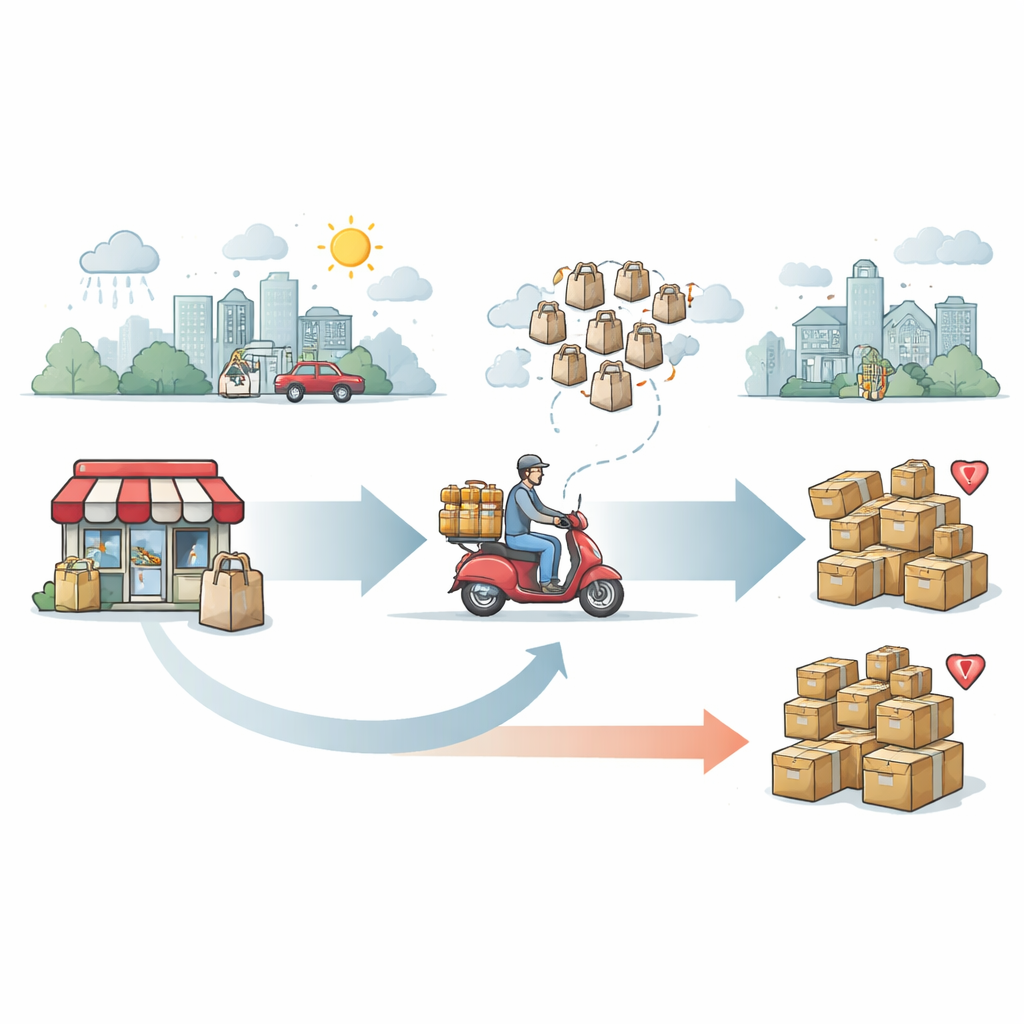
From order tap to doorstep
The researchers analyzed more than 400,000 orders from a large city in northern China, served by one of the country’s biggest delivery platforms. They broke each delivery into three main stages: processing (when the platform assigns a courier), pickup (when the courier travels to the restaurant and collects the food), and transport (the trip from restaurant to customer). On average, transport took just over half of the total time, pickup about a third, and processing the rest. Roughly one in six orders arrived later than the time promised to customers, reflecting the scale of the problem for platforms, couriers, and diners alike.
Looking for causes, not just patterns
Most earlier studies tried to predict delivery times using advanced machine learning, ranking which variables seem most important. But those tools mostly reveal correlations. A long distance and a late order tend to go together, for example, without telling us whether distance itself is the root cause or just linked to some deeper issue. This study instead uses a two-step causal framework. First, a Bayesian “causal discovery” model builds a directed graph showing which factors appear to directly influence others. Then, a technique called double machine learning estimates how much changing each factor would shift the delay, on average, while controlling for all the others. This approach aims to separate true drivers from mere bystanders.
What really slows deliveries down
The causal graph reveals that several parts of the workflow directly push orders toward being late. Longer processing, pickup, and transport times all increase delay risk, as does longer meal preparation at the restaurant and having many orders bundled together in a courier’s “wave” of deliveries. The standout finding is that pickup time—the period from when a courier accepts an order to when they leave the restaurant—has the largest causal impact. Minute for minute, stretching pickup adds more to final delay than stretching the road portion of the trip. Transport time is the second-strongest driver, reflecting congestion, routing choices, and distance. The study also finds that midday lunch peaks causally raise delays, whereas evening rush and weekends mainly act indirectly by increasing courier workload.
How one late order makes the next late
A particularly important discovery is delay propagation: a “domino effect” where being late on one order makes the next orders by the same courier more likely to be late as well. The model shows that both how late the previous order was and how long its internal stages took directly affect the delay of the next order in the same wave. If a courier finishes one delivery behind schedule, the time buffer for the following delivery shrinks, and small hiccups can tip it into lateness. Follow-up analyses highlight critical thresholds. Pickup times that exceed about 10 minutes and transport times beyond roughly 17 minutes sharply raise the risk of missing the promised window. For previous orders, finishing roughly 10 minutes early is enough, on average, to avoid passing delay on to the next job.
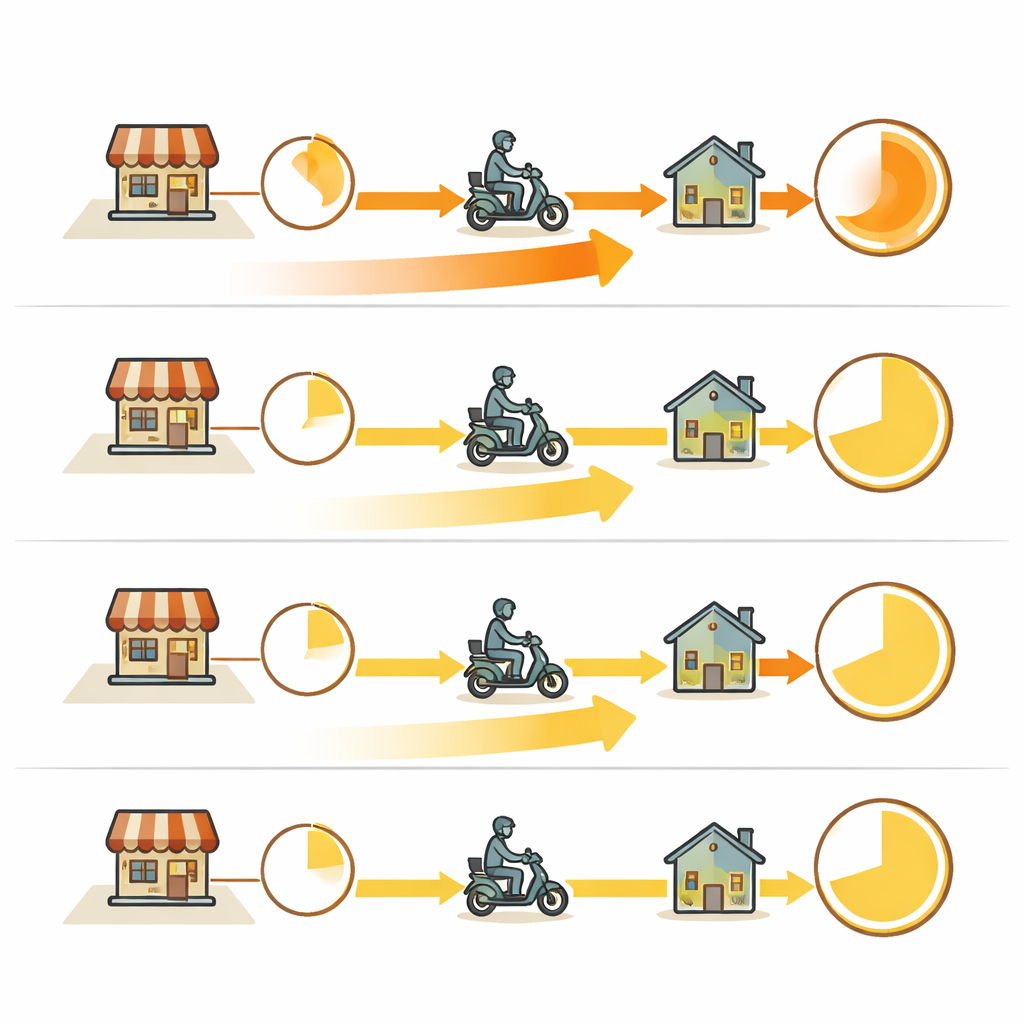
Turning insights into better service
By comparing their causal results with a popular correlation-based model, the authors show that traditional methods can underestimate the importance of some factors, such as restaurant preparation times, or even misread the sign of certain effects. Building on the more reliable causal picture, they suggest several practical strategies: better aligning courier arrival with when food will be ready, capping how many orders a courier handles in a single wave when risk is high, adding “slack time” when a courier is on track to finish an order with too little buffer, and redesigning routing so that adding extra orders does not unduly lengthen first customers’ waits. For everyday users, the takeaway is that late deliveries are not just about a slow rider or bad traffic; they emerge from how the entire system schedules, bundles, and sequences orders. Tuning those hidden rules could make your next meal more likely to arrive hot and on time.
Citation: Lu, M., Liu, R., Jin, Z. et al. A causal discovery and inference framework for on-demand food delivery delays. npj. Sustain. Mobil. Transp. 3, 22 (2026). https://doi.org/10.1038/s44333-026-00097-1
Keywords: food delivery delays, causal inference, last-mile logistics, on-demand platforms, courier operations