Clear Sky Science · en
Global trajectories for urban passenger transport decarbonisation: a policy-based modelling approach
Why city travel and climate change are closely linked
More and more people are moving to cities, and every new job, school run, or shopping trip usually means another journey through crowded streets. How we move around urban areas is already a major source of climate-warming pollution and local air pollution. This paper asks a simple but urgent question: if cities all over the world pushed hard for cleaner, smarter transport policies, how far could we cut emissions while still keeping urban life convenient, healthy, and fair?
Tracing how city travel might grow
The authors build a global model that tracks everyday passenger travel within 9,234 urban areas worldwide, from small towns to giant megacities. Their framework brings together population growth, economic change, land-use patterns, and the supply of different transport options—from walking and cycling to buses, trains, shared cars, and private vehicles. By simulating individual trips rather than just counting vehicles, the model can estimate not only total travel but also how long trips are, which modes people choose, and how those choices differ by city size and income group.
Two futures for urban transport
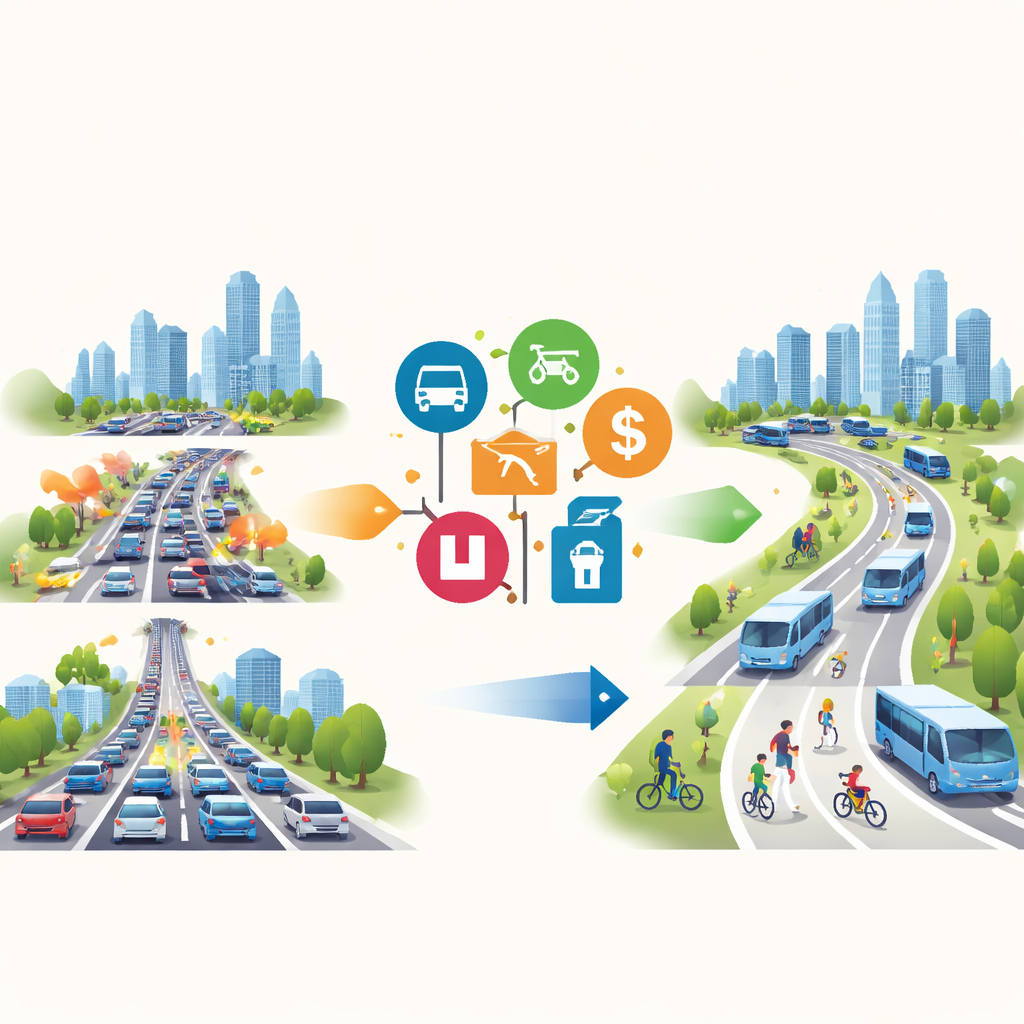
Using this model, the study compares two broad futures. In the “Business-as-Usual” path, countries broadly follow their current policies and commitments. In the “Increased Ambition” path, cities and governments introduce a strong package of measures judged to be tough but still realistic in each world region. These measures include greatly expanding public transport and safe bike lanes, making better use of road space, encouraging teleworking, supporting new shared mobility services, and steadily tightening rules and charges on polluting, space-hungry vehicle use. Experts from around the globe helped determine how far each region could feasibly go with each measure.
Cutting emissions while reshaping travel
The model shows that ambitious policies can substantially cut both travel demand and emissions, especially in large and fast-growing cities. By 2060, passenger travel in East and Northeast Asia falls by more than a third compared with the business-as-usual path, and by roughly a quarter in Europe, North America, and Latin America, mainly because people travel shorter distances and rely less on private cars. At the same time, cleaner technologies and a switch to electric vehicles drive down exhaust emissions, particularly in richer regions where new vehicles spread faster. Europe, high-income English-speaking countries, and East and Northeast Asia come close to net-zero annual emissions from urban passenger transport by mid-century; Latin America follows by 2060. However, limits on policy strength and slower technology turnover in many lower-income regions mean global urban transport still falls short of what would be needed to keep warming to 1.5 °C.
Healthier streets and fairer access
Beyond climate, the study tracks a suite of “co-benefits” that matter for daily life. Under Increased Ambition, tailpipe air pollutants from urban passenger vehicles are almost wiped out in richer regions and drop by more than 95% elsewhere, promising major health gains. Shifting trips to walking, cycling, shared transport and mass transit reduces congestion and frees up road space for parks and public services, especially in Latin America and East Asia. Better public transport networks also make cities more resilient: in many regions, nearly all urban trips could still be completed by transit if roads were disrupted. Yet there are trade-offs. Higher road and parking charges make car use less affordable for many, particularly lower-income groups, even as public and active modes become cheaper. The authors highlight that extra protections, such as guaranteed basic mobility services funded by these new charges, will be needed to prevent exclusion.

What this means for the future of city travel
For non-specialists, the main message is that technology alone will not solve urban transport emissions. Electric cars help, but they do not by themselves fix congestion, road danger, or unequal access. The paper shows that combining cleaner vehicles with strong demand-management policies and better alternatives—reliable public transport, safe walking and cycling, and thoughtfully planned neighbourhoods—can dramatically cut emissions while improving health and daily life. At the same time, the authors caution that their scenario likely represents a best case. Real cities will still need careful local analysis and political will to turn these global trajectories into on-the-ground changes that are both effective and fair.
Citation: Caros, N., Trouvé, M. & Martinez, L. Global trajectories for urban passenger transport decarbonisation: a policy-based modelling approach. npj. Sustain. Mobil. Transp. 3, 24 (2026). https://doi.org/10.1038/s44333-026-00092-6
Keywords: urban transport, decarbonisation, public transit, active travel, transport policy