Clear Sky Science · en
Operationalizing the environmental safe operating space into target distributions for mobility and batteries
Why this matters for everyday travel
As the world races to cut greenhouse-gas emissions, electric cars and their batteries are often promoted as a clean solution. But how clean is clean enough for the planet to stay within safe limits? This study asks a deceptively simple question with big consequences for drivers, cities, and industry: given Earth’s limited capacity to absorb pollution and supply fresh water, how much environmental impact can our mobility and its batteries "spend" each year—and are today’s vehicles anywhere near those limits?
Turning planetary limits into everyday numbers
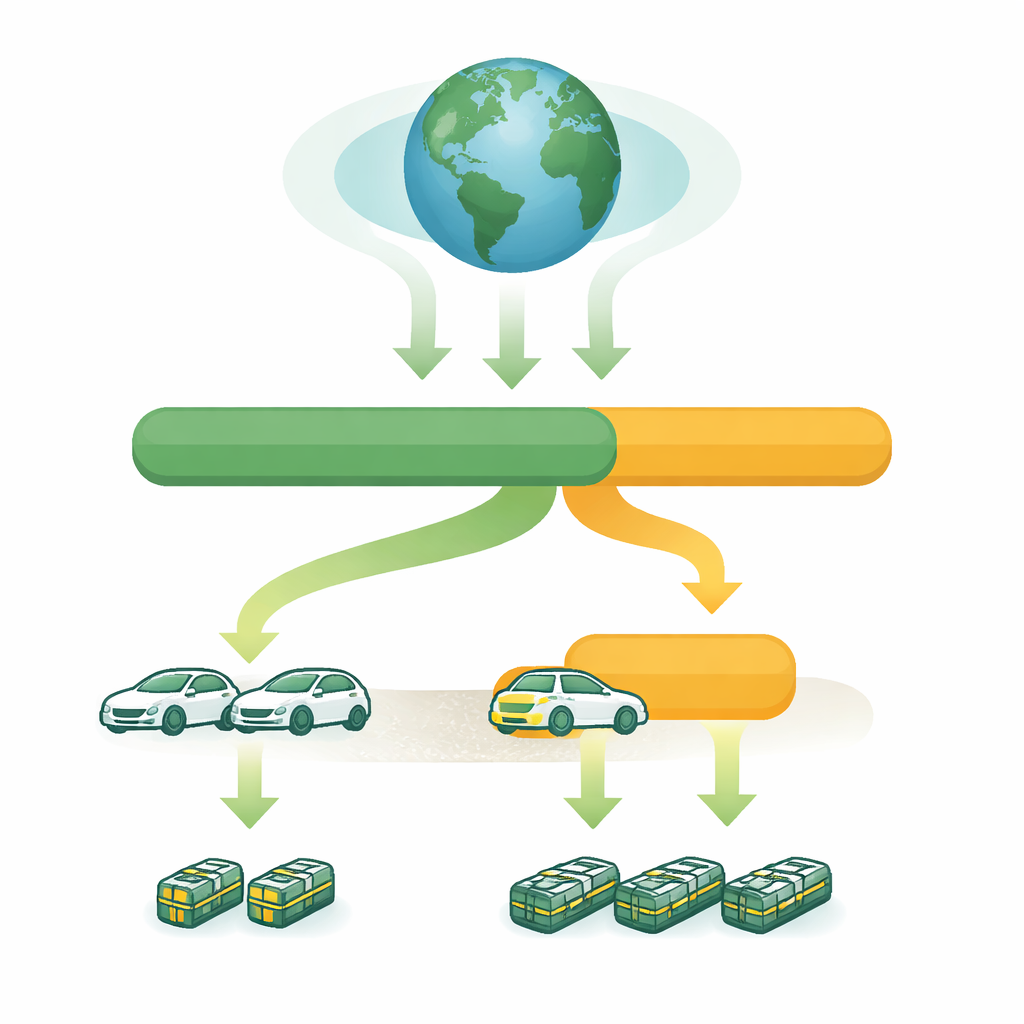
Scientists have defined a “safe operating space” for humanity: boundaries for climate change, freshwater use, and other Earth systems beyond which the risks of abrupt, damaging shifts rise sharply. The challenge is translating these big, global limits into concrete targets for specific activities—like driving a car or building a battery. In this work, the authors design a step-by-step method to downscale Earth’s environmental budgets all the way from the planet, to countries, to the mobility sector, to passenger cars, and finally to the battery in each electric vehicle. They focus on two types of pressure: climate-warming emissions and the use of fresh water.
From planet to person to kilometer traveled
The team starts by selecting several plausible global limits for climate pollution, based on different scientific approaches and carbon budget scenarios, and then divides these fairly across the world’s population. Next, they assign a share of each person’s “allowable” footprint to mobility, and then a slice of that to passenger cars, reflecting either current usage patterns or sufficiency-based visions that rely more on public and active transport. When this hierarchy is applied to Germany and Canada—two car-dependent countries—the resulting climate targets for mobility are very tight. In 2030, sustainable emissions per passenger-kilometer fall in the single-digit grams of CO₂ for strict planetary-boundary cases, and only reach the low hundreds of grams in the most generous carbon-budget scenarios. For comparison, a diesel bus or a new subway line can already use dozens of grams per passenger-kilometer, and even manufacturing a bicycle corresponds to about 5 grams per passenger-kilometer when averaged over its life.
What this means for cars and how much we drive
When the same logic is applied to passenger cars, the picture becomes more demanding still. Using realistic annual driving distances of around 12,000 vehicle-kilometers per year, the authors find that present-day gasoline and diesel cars sit far above any fair share of the climate budget, even under relatively loose scenarios. To fit within the safe space, either car use must drop dramatically, or vehicles must become much cleaner—or both. Small battery electric cars fare better: under future low-carbon electricity and improved manufacturing, their life-cycle emissions could, by mid-century, fall close to some of the more permissive climate targets per kilometer and per vehicle. However, these vehicles still struggle to meet the strictest planetary-boundary-based targets, especially if people continue to own many cars and drive long distances.
Batteries under the environmental microscope
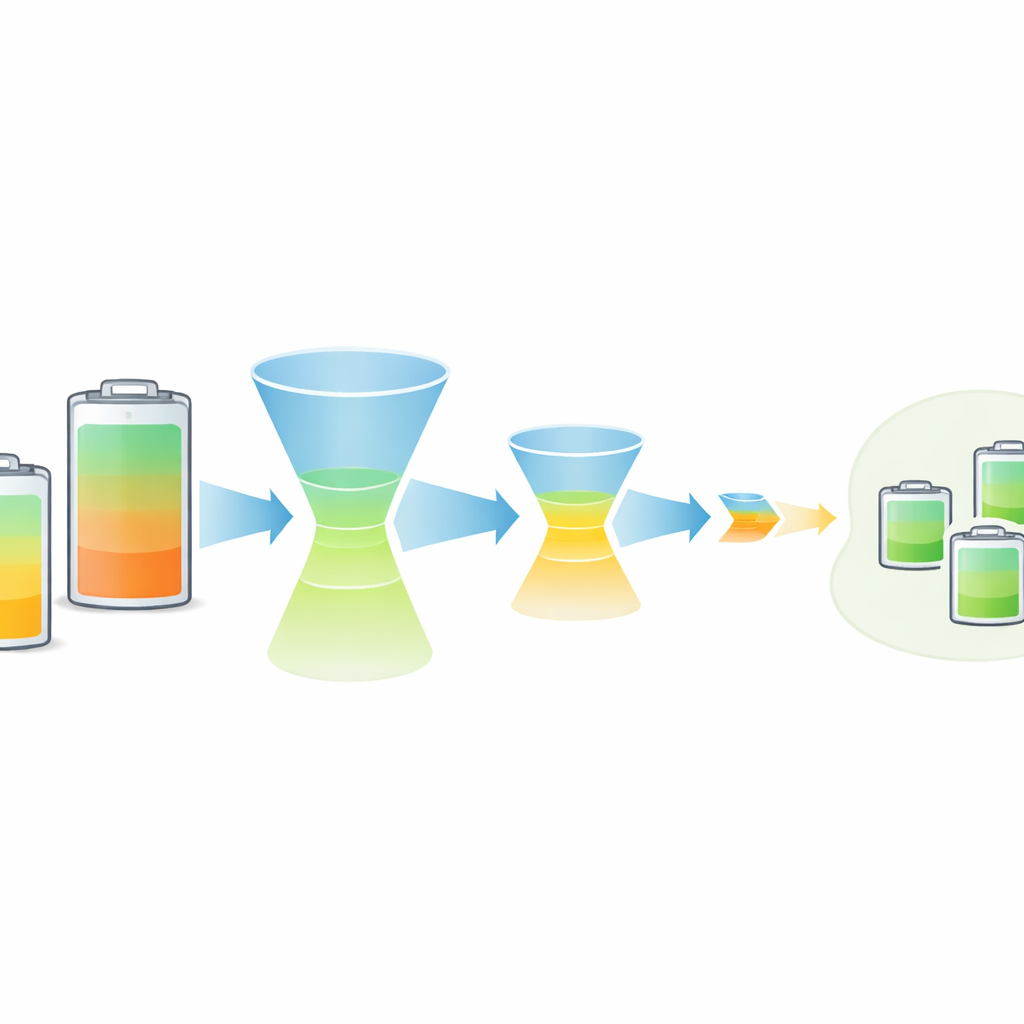
Because batteries are material- and energy-intensive, the study zooms in further to assign climate and water-use targets per kilowatt-hour of battery capacity. Using a Monte Carlo analysis that samples many combinations of assumptions—such as how much of the car’s impact comes from the battery, how long vehicles last, and how heavily they are driven—the authors generate ranges of acceptable impacts instead of a single “yes-or-no” threshold. For 2030, sustainable climate targets for battery packs in mid-size cars fall around 1 to 25 kilograms of CO₂ per kilowatt-hour, shrinking to roughly 0.4 to 6 or 7 kilograms by 2050. Current batteries, by contrast, typically cause on the order of 90 to 190 kilograms of CO₂ per kilowatt-hour, well outside their fair share. Freshwater use shows a similar story: acceptable withdrawals per kilowatt-hour tighten from about 0.1–2.0 cubic meters in 2030 down toward roughly 0.1–1.1 cubic meters by 2050, even before accounting for added water use in recycling or the fact that many lithium resources lie in water-scarce regions.
Rethinking “sustainable” mobility
To a layperson, the core message is stark but constructive: if we take planetary limits seriously, today’s car and battery designs—and especially our habits of owning many cars and driving them far—are not yet compatible with a safe and stable Earth. Internal combustion cars fall entirely outside any reasonable safe operating space unless their use shrinks drastically. Electric vehicles can be part of the solution, but only if their batteries become much more efficient in their use of energy, materials, and water, and if societies shift toward fewer, smaller vehicles, more shared rides, and more public and active transport. Instead of a single rigid threshold, the study offers realistic bands of target values that policymakers, manufacturers, and city planners can use to benchmark technology roadmaps and regulations. In doing so, it provides a concrete way to design mobility systems that stay within humanity’s fair share of the planet’s environmental safety margins.
Citation: Roy, S., Ali, AR., Harvey, JP. et al. Operationalizing the environmental safe operating space into target distributions for mobility and batteries. npj. Sustain. Mobil. Transp. 3, 19 (2026). https://doi.org/10.1038/s44333-026-00089-1
Keywords: planetary boundaries, electric vehicles, battery sustainability, climate targets, sustainable mobility