Clear Sky Science · en
Decoupled safety supervision empowering efficient and safe energy management for fuel cell vehicles
Why this matters for future green buses
As cities search for cleaner ways to move people, hydrogen fuel cell buses look promising: they emit only water and can refuel quickly. But inside these buses, powerful batteries quietly face heat and wear that can shorten their life or even pose safety risks. This study shows how an artificial intelligence–based control system can run a fuel cell bus more efficiently while keeping its battery safely cool, pointing toward greener and more reliable public transport.
Balancing power and safety on the road
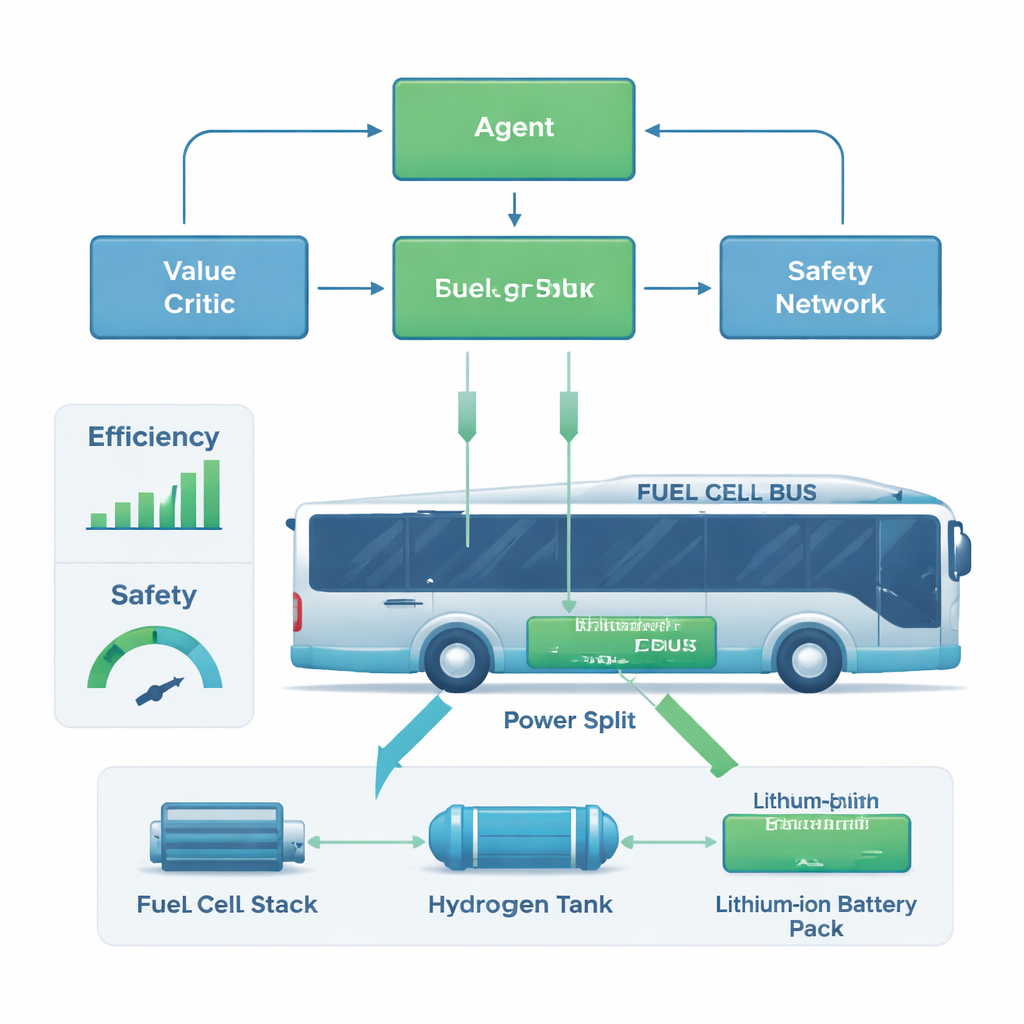
Modern fuel cell buses combine a hydrogen fuel cell with a lithium‑ion battery. The fuel cell provides steady power, while the battery handles rapid bursts, such as acceleration and hill climbing, and soaks up energy during braking. This partnership improves efficiency but also makes control far more complex. The bus must constantly decide how much power should come from hydrogen and how much from the battery—decisions that affect fuel use, battery temperature, and long‑term health all at once.
The problem with teaching machines about risk
Engineers increasingly rely on deep reinforcement learning, where a computer “agent” learns good control strategies by trial and error in simulations rather than being hand‑programmed. Traditionally, designers fold everything—fuel savings, comfort, and safety—into a single score that rewards good choices and penalizes bad ones. But this blend can be messy. If the penalty for overheating the battery is set too low, the agent may chase fuel savings and overstrain the battery; if it is too high, it may play overly safe and waste hydrogen. Tuning these penalties is labor‑intensive, may not generalize to new routes or weather, and can still miss rare but dangerous situations.
A separate “guardian” for safety
The authors propose a different approach: give safety its own specialized “guardian” network, separate from the main fuel‑saving brain. Their control system still uses a powerful learning algorithm to decide how to split power between the fuel cell and the battery, but this agent is guided by two advisors. One advisor focuses on long‑term fuel and battery cost, while the other continuously judges whether a proposed action risks pushing the battery temperature beyond a safe limit. During learning, the safety guardian steers the agent away from risky behavior without being mixed into the same score as fuel use. Because safety and economy are decoupled, engineers can update safety rules or add new limits—such as on battery charge level or component power—without redesigning the whole system.
Putting the smart controller to the test
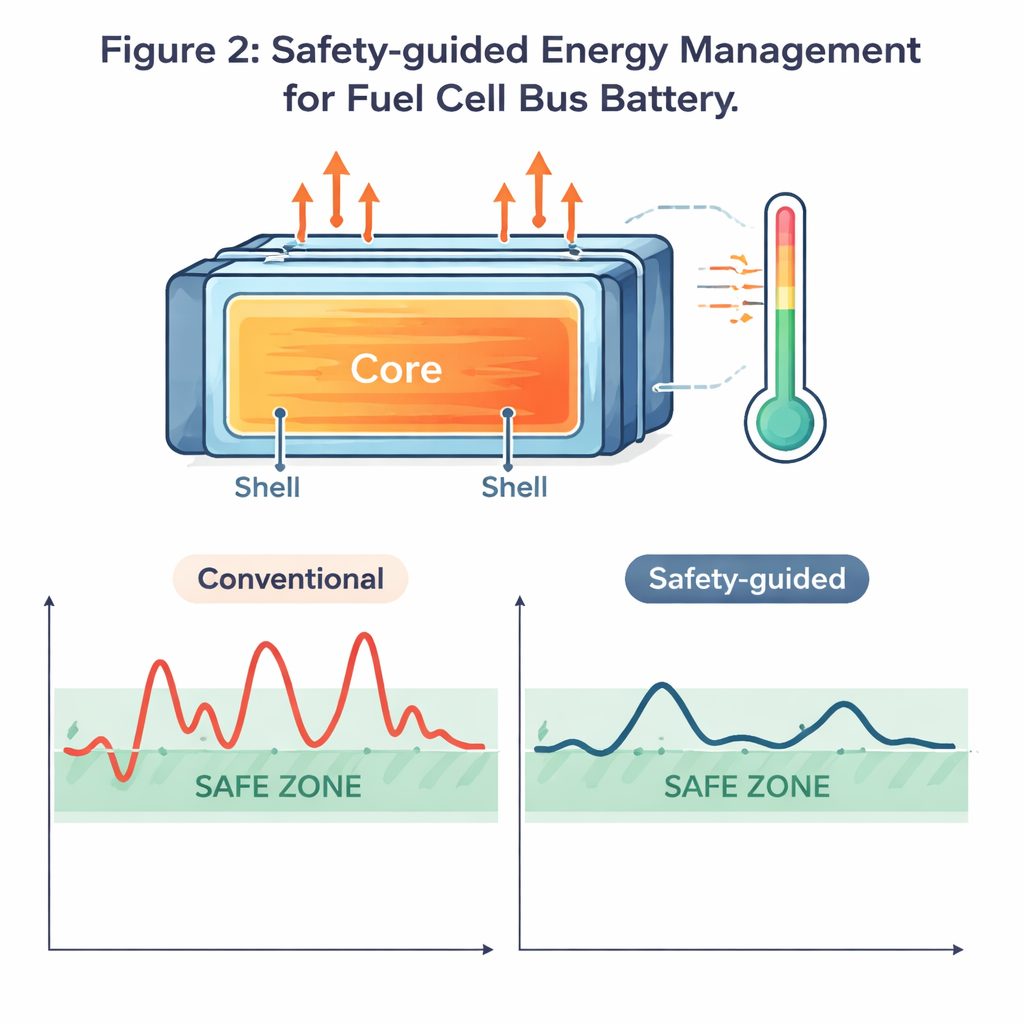
The team tested their method on a detailed computer model of a real fuel cell bus running on city routes recorded from commercial operations in Zhengzhou, China. They compared three strategies: their new safety‑guided controller, a standard method that uses penalty terms for safety, and a purely economy‑driven controller with no safety protection. All three kept the battery’s charge level within practical limits, but they behaved very differently in temperature and wear. The safety‑guided controller kept battery temperatures well below the danger line most of the time, while the penalty‑based method occasionally overheated and the unconstrained method did so often. Over repeated drives, the safety‑guided approach also slowed down battery aging, implying fewer replacements and lower long‑term costs.
Safer buses that also save fuel
Beyond safety, the new controller actually improved efficiency. Across different routes, vehicle loads, and weather conditions, it used less hydrogen and caused less battery damage than the other two methods. Under demanding full‑load conditions, it cut overall driving cost by more than 8% compared with the penalty‑based strategy and nearly 15% compared with the unconstrained one, while keeping safety violations effectively at zero under typical scenarios. Even in extreme heat, when every strategy struggled, the safety‑guided controller still reduced how far battery temperature strayed beyond the safe range.
What this means for everyday riders
For non‑experts, the takeaway is straightforward: smarter control can make clean buses both safer and cheaper to run. By giving safety its own voice inside the control system rather than treating it as just another number in an equation, the authors show that we do not have to trade battery health for fuel savings. Their framework could be adapted to other kinds of electric and hybrid vehicles, helping cities deploy zero‑emission fleets that are reliable in hot climates, heavy traffic, and varied terrain—all while keeping the critical batteries under careful thermal watch.
Citation: Jia, C., Liu, W., He, H. et al. Decoupled safety supervision empowering efficient and safe energy management for fuel cell vehicles. npj. Sustain. Mobil. Transp. 3, 16 (2026). https://doi.org/10.1038/s44333-026-00087-3
Keywords: fuel cell bus, battery safety, energy management, reinforcement learning, thermal management