Clear Sky Science · en
Disparities in the impacts of extreme heat events on subway ridership in New York City
Why summer heat and subway trips matter to you
As summers grow hotter, heat waves are no longer just uncomfortable—they can be dangerous, especially in crowded cities. This study looks at how extreme heat in New York City changes the way people use the subway, and who is most affected. Understanding these patterns helps explain why some riders can adapt more easily than others, and what cities can do to keep public transit safe and reliable in a warming world.
Heat waves meet a transit-dependent city
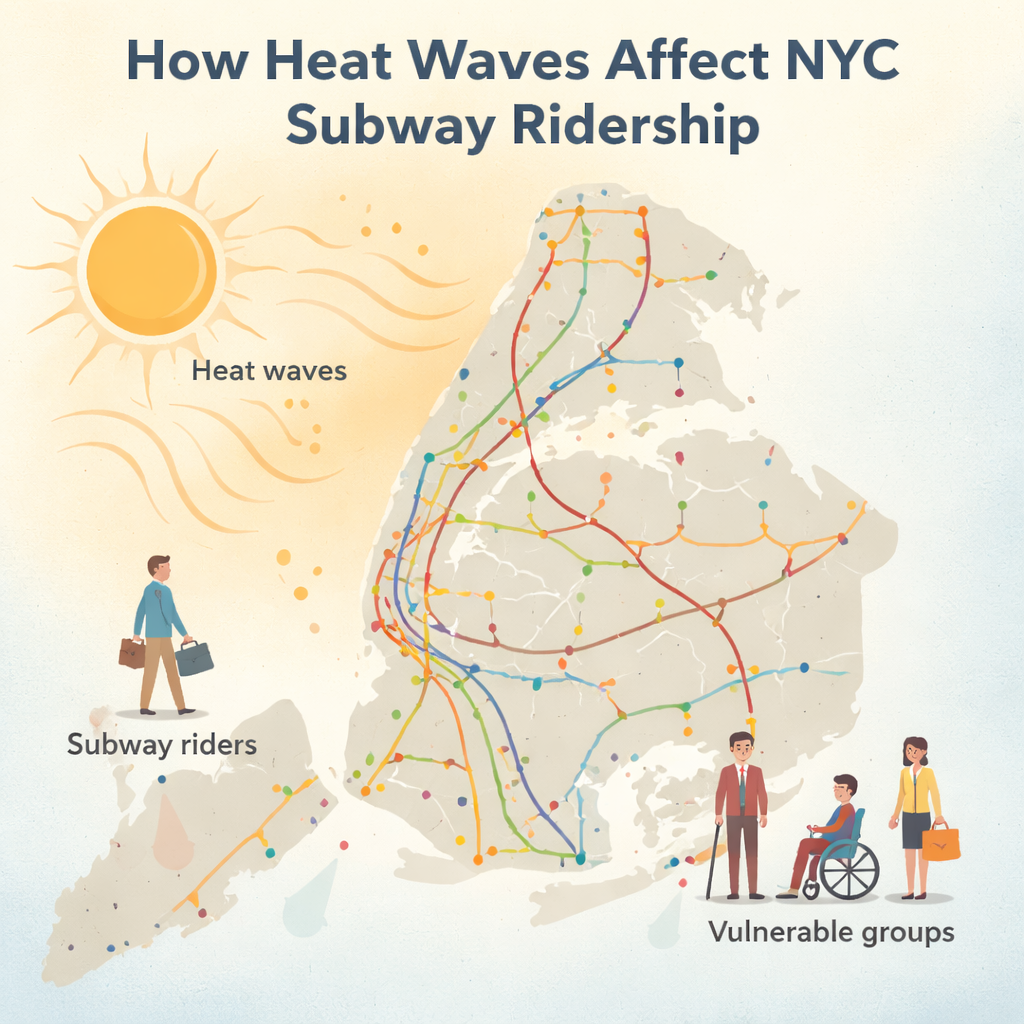
New York City relies heavily on its subway system, with millions of rides every day and many residents who do not own cars. Yet subway platforms are often several degrees hotter than the streets above, turning stations into heat traps during heat waves. The researchers examined hourly turnstile data from 2022 to 2024 for all 423 station complexes during the warm months from May to September. They focused on days when the city issued heat alerts, defined by the National Weather Service based on how hot and humid it feels, not just the air temperature. They then compared ridership on these extreme heat days with typical summer days, looking closely at patterns across the day and across different parts of the city.
Who keeps riding, and who stays home
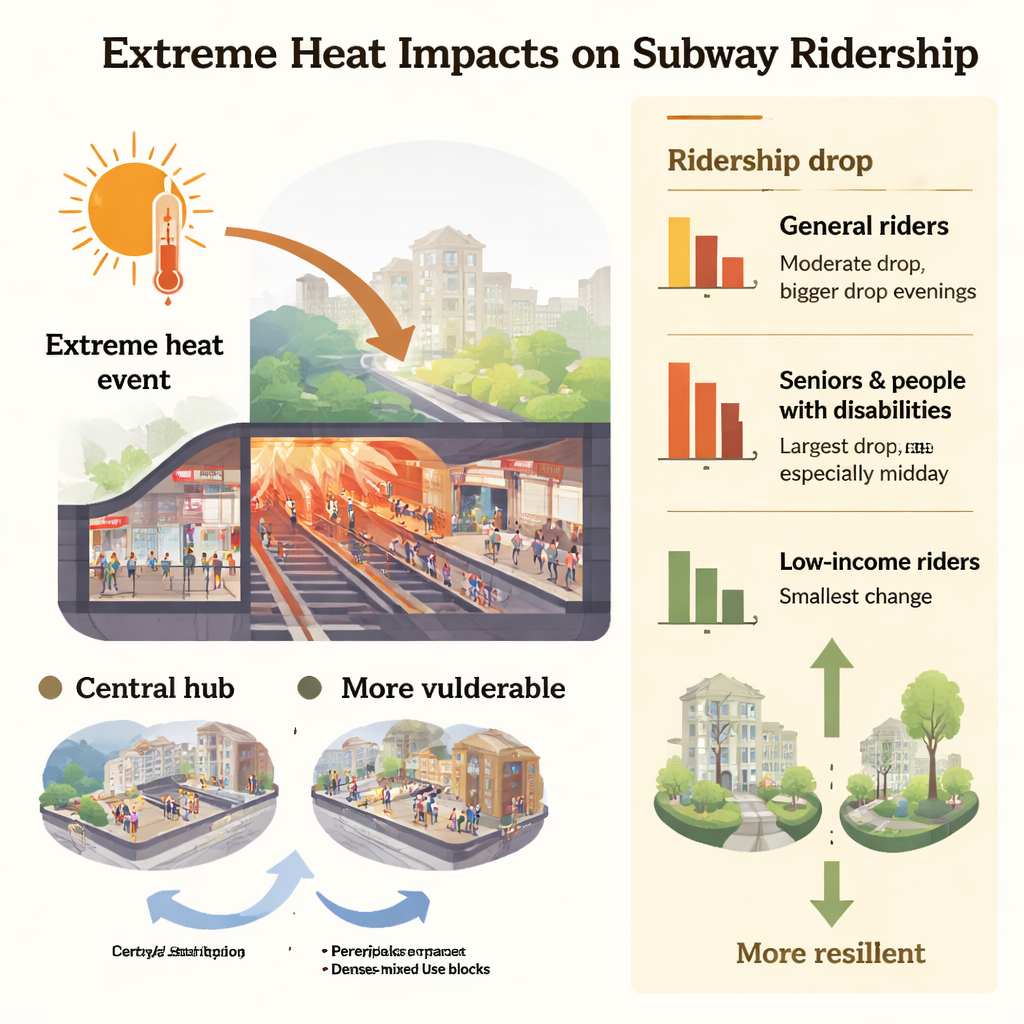
Not everyone rides the subway for the same reasons, or with the same options. The study separated riders into broad groups: the general ridership, low-income riders enrolled in the city’s Fair Fares discount program, and seniors and people with disabilities using special fare categories. Overall, subway use dropped on very hot days, but the size and timing of the drop varied. On weekdays, ridership dipped mainly during the hottest midday and evening hours; on weekends, when more trips are optional, the losses were larger. Low-income riders showed relatively steady use across the day, suggesting that many could not easily cancel trips or switch to other modes. By contrast, seniors and riders with disabilities cut back the most, especially in the middle of the day when heat stress is greatest, highlighting their greater health risks and more cautious behavior.
How daily rhythms shift in extreme heat
Looking hour by hour, the familiar weekday “M-shaped” pattern—morning and evening rush-hour peaks—flattened during heat waves. Fewer people traveled during rush and midday hours, pointing to both reduced travel and some shifts to other modes, such as private cars or ride-hailing services. On weekends, when many trips are for shopping, leisure, or social visits, the entire ridership curve shrank more noticeably. Seniors and people with disabilities already tended to avoid rush-hour crowds, traveling more during off-peak times. During extreme heat, their off-peak trips shrank too, particularly at midday, signaling that heat can effectively confine those with higher health risks indoors. For Fair Fares users, ridership fell somewhat during heat events, but with smaller changes across different times of day, reinforcing the idea that financial and life constraints limit their flexibility.
Why some stations are more resilient than others
The study went beyond citywide totals to examine how individual stations fared. Using statistical tests, the authors labeled stations as “high-resilience” if ridership stayed stable or even grew during heat waves, and “low-resilience” if it dropped. Surprisingly, many peripheral stations on the edges of the network proved more resilient, especially on weekends. These outlying areas often have fewer other transit options, so riders keep using the subway even when it is uncomfortably hot. In contrast, major central hubs—where multiple lines intersect and platforms are often underground and crowded—saw larger declines. Nearby land uses also mattered. Stations surrounded by public facilities, parks, and open spaces tended to hold ridership better, suggesting that these places double as destinations or cooling refuges. Dense areas with a heavy mix of uses did not always fare as well, particularly for vulnerable riders, perhaps because of longer or more complex trips and less comfortable walking conditions.
What cities can do to keep riders safe
For a layperson, the key message is simple: extreme heat does not affect all riders, or all stations, in the same way. Seniors and people with disabilities pull back the most, low-income riders have the least room to adapt, and big central hubs are especially fragile points in the system. The authors argue that city planners should prioritize cooling and ventilation upgrades at the busiest transfer stations, improve shade and waiting conditions at bus-subway connections, and make better use of air-conditioned public buildings as informal cooling centers near transit stops. They also point to the need for targeted support—like service adjustments, subsidies, and safer alternatives—for those who cannot easily change when or how they travel. As heat waves become more frequent, these kinds of changes will be crucial to keeping urban transit both resilient and fair.
Citation: Zhao, M., Lei, S., Li, S. et al. Disparities in the impacts of extreme heat events on subway ridership in New York City. npj. Sustain. Mobil. Transp. 3, 17 (2026). https://doi.org/10.1038/s44333-026-00083-7
Keywords: extreme heat, subway ridership, New York City, vulnerable populations, climate-resilient transit