Clear Sky Science · en
Rebound effects of power enhancement in internal combustion and electric vehicles
Why Bigger Engines Matter for Our Climate
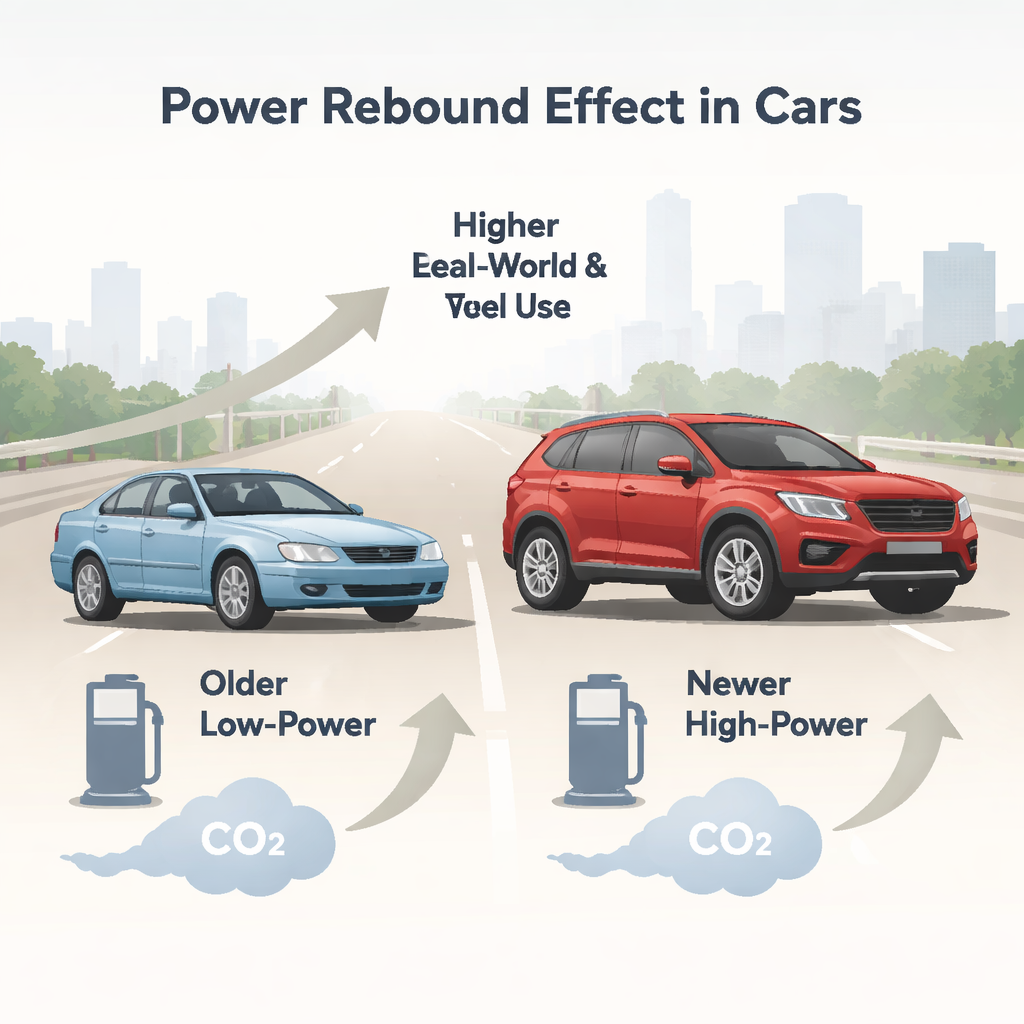
Many of us assume that as cars become more efficient, their pollution must be going down. After all, today’s vehicles boast sleek designs, smart gearboxes, and in some cases electric motors. Yet climate data tell a different story: emissions from passenger cars keep rising. This paper uncovers a hidden culprit—the steady race toward more powerful and heavier cars—which quietly eats away at the climate benefits of better technology.
When Efficiency Doesn’t Deliver
Over the past few decades, engineers and regulators have pushed hard to cut fuel use in passenger cars. Engines burn fuel more cleanly, aerodynamics have improved, and new test procedures aim to reflect real driving conditions. Hybrid and fully electric vehicles promise even deeper cuts in emissions. On paper, all of this should have driven total carbon dioxide output down. Instead, global emissions from passenger cars have grown from about 2.2 to 3.2 billion tons in just twenty years, and Europe has seen transport emissions climb rather than fall. Part of the problem lies in the gap between laboratory tests and what happens on real roads, where cars typically consume around 20 percent more fuel than official ratings suggest.
The Hidden Cost of Extra Power
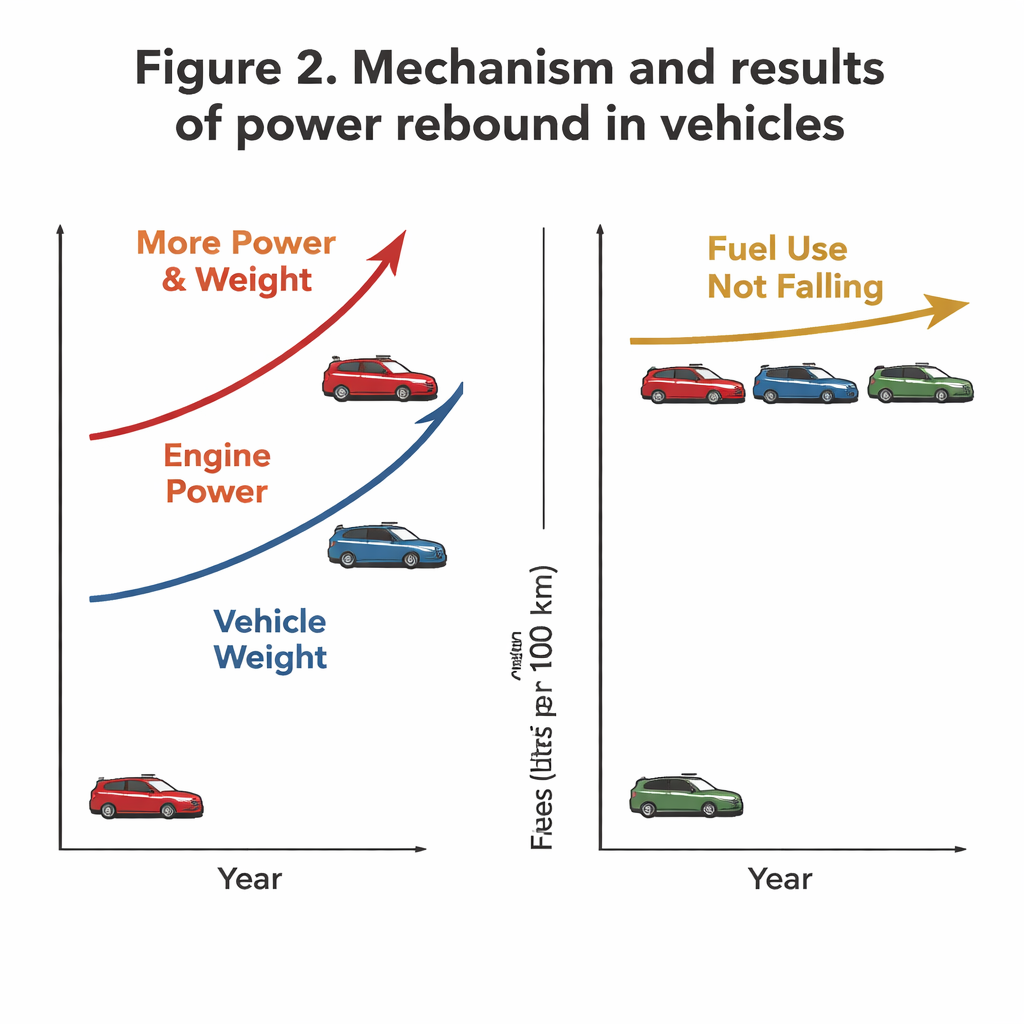
The authors introduce the idea of a “power rebound effect.” Traditionally, rebound effects describe how people drive more when each kilometer becomes cheaper due to better fuel economy. Here, the focus shifts from how efficient a car is to how powerful it is. Using data from 15 years of road tests on 531 car models conducted by the Italian magazine Quattroruote, the researchers looked at how rated engine power, vehicle weight, shape, and gearing relate to actual fuel use in everyday-style driving. They found that, especially in petrol cars, as average horsepower has crept up year after year, real-world fuel consumption has risen instead of falling as much as technical progress would allow.
What the Road Tests Revealed
By applying statistical models to the test data, the study shows that for petrol cars, a 1 percent increase in engine power is linked to about a 0.26 percent rise in fuel used per 100 kilometers, once weight and other factors are held constant. Over 15 years, this “power rebound” accounts for roughly a 6 percent increase in fuel intensity, enough to noticeably erode efficiency gains from better engines and aerodynamics. Rising vehicle weight has an even larger effect: heavier cars, regardless of technology, demand more energy to move. Diesel cars show a smaller power effect but a very strong influence of weight. For electric cars, the dataset was still too small for firm conclusions, though weight again stood out as a major driver of energy use.
Why Drivers Use Extra Power
The findings suggest that the way people use more powerful vehicles matters as much as the mechanical design itself. Extra horsepower makes rapid acceleration easier and climbing hills or overtaking more tempting, even if drivers are not fully aware they are burning more energy. Over thousands of trips, these small choices accumulate into higher fuel consumption. The study highlights that multiple rebound effects can stack up: we may drive farther because trips feel cheaper, drive faster when cars are more efficient, and accelerate harder when more power is available. Together, these habits blunt or even reverse the climate benefits that engineers and policymakers expect from efficiency standards.
Rethinking Car Design and Policy
To a layperson, the bottom line is straightforward: bigger, stronger cars are canceling a chunk of the climate gains from smarter engineering. The authors argue that policies cannot focus only on tailpipe tests and efficiency labels; they must also address power and weight. Possible tools include higher taxes or registration fees for very powerful vehicles, distance-based road charges, and strict speed limits. History shows that societies can adapt—during the oil crises of the 1970s, average car power dropped sharply before climbing again in later decades. If we want cleaner transport, the study suggests we must question the cultural obsession with ever more horsepower and find ways to reward cars that are not just efficient in the lab, but modest and thrifty on the road.
Citation: Huang, K., van Lith, B., Galvin, R. et al. Rebound effects of power enhancement in internal combustion and electric vehicles. npj. Sustain. Mobil. Transp. 3, 14 (2026). https://doi.org/10.1038/s44333-026-00082-8
Keywords: vehicle efficiency, engine power, fuel consumption, rebound effect, transport emissions