Clear Sky Science · en
An integrated electrochemical platform for low-volume biosensing
Bringing Lab-Grade Testing to Tiny Drops
Modern medical and environmental tests often depend on machines that need large samples, trained technicians, and careful handwork. This paper describes a small, low-cost device that can run sensitive chemical and biological tests using just a few drops of liquid, while handling much of the work automatically. The goal is to make reliable measurements easier to perform outside specialized labs, such as in clinics, field stations, or resource-limited settings.
A Compact Test Bench on a Small Footprint
The researchers built a fully integrated electrochemical platform, a kind of electronic “nose” that senses molecules by measuring tiny currents. Their system combines three main parts: a custom 3D-printed flow cell that holds a disposable test strip, a microfluidic pumping module that moves liquid through the device, and a computer program that controls everything and analyzes the signals. At the heart of the setup is a screen-printed electrode, a flat, low-cost sensing strip commonly used in point-of-care devices. Instead of relying on a hand-placed droplet, the new platform pushes liquid through a precisely shaped chamber above the strip. Only about 15 microliters—the volume of a pinhead-sized droplet—actually contacts the sensor during each run, even though a slightly larger plug is used to keep the flow steady. 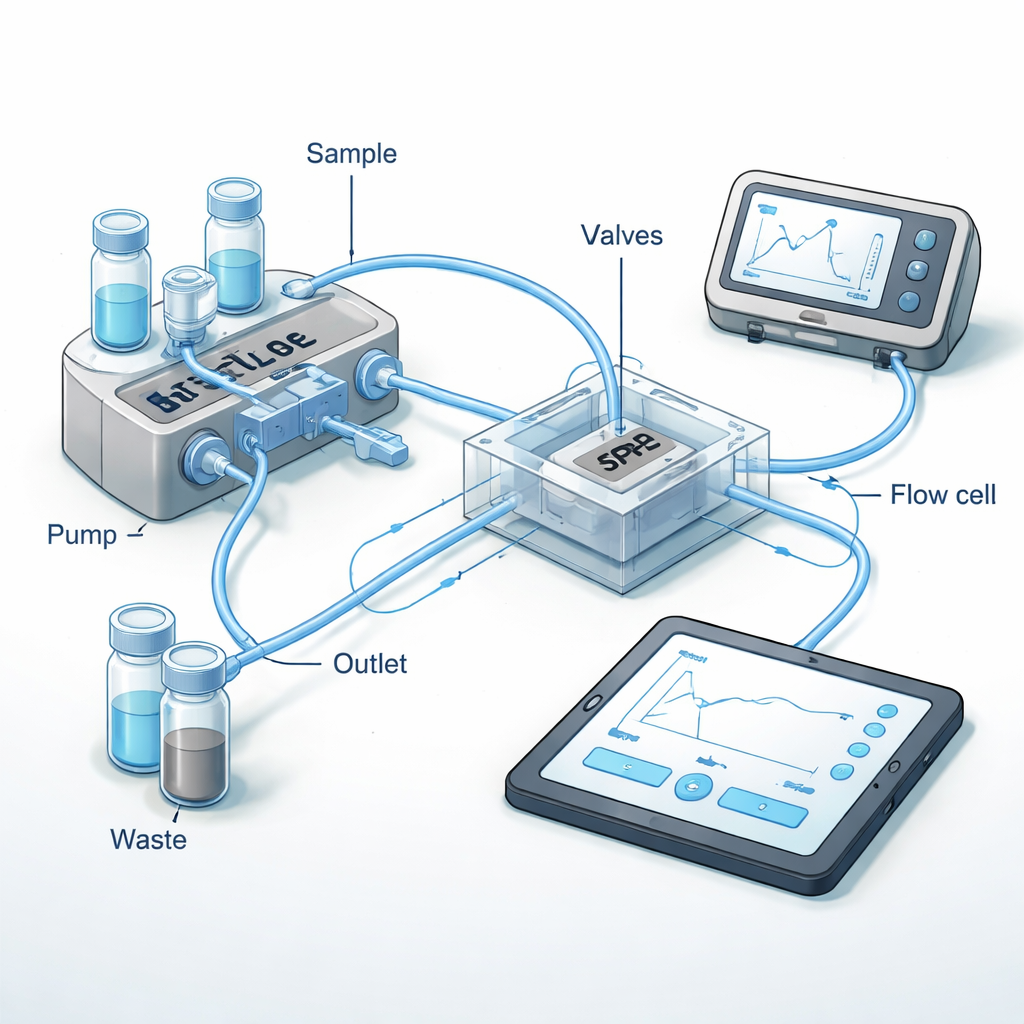
Why Flowing, Not Dropping, Makes Tests More Reliable
Conventional use of these disposable electrodes often involves pipetting a droplet onto the surface, which can spread unevenly, evaporate, and depend heavily on the operator’s technique. The new system solves this by enclosing the sensor in a rigid, transparent housing sealed with an elastic O-ring, and by driving liquid with a tiny pump located downstream of the sensor. A set of computer-controlled valves selects between sample, rinsing solution, and a regeneration fluid, while a built-in flow sensor and feedback loop keep the flow rate very stable. Computer simulations and experiments confirm that the liquid moves smoothly and gently across the sensing area in a laminar fashion, without dead zones or turbulence. This controlled flow improves how evenly molecules reach the electrode, reduces carryover between runs, and prevents random shifts in the baseline signal.
Testing with DNA as a Stand-In Target
To prove that the platform can deliver trustworthy measurements, the team used double-stranded DNA from calf thymus as a model analyte. DNA sticks to the activated carbon surface of the test strip and produces an electrical signal when a fixed voltage is applied. By injecting DNA solutions of increasing concentration under continuous flow and recording the current over time, the researchers obtained clean, step-like curves that grew with concentration. When they plotted the steady current against DNA level, the result was a straight-line calibration between 100 and 1000 micrograms per milliliter, with good agreement to simple statistical fits. Under matched conditions, the flow-based system produced similar average signals to traditional pipette-based tests, but with markedly better reproducibility, lower drift, and shorter hands-on time. Only about 15 microliters needed to touch the sensor for each run, compared with roughly 100 microliters in a typical droplet-based assay. 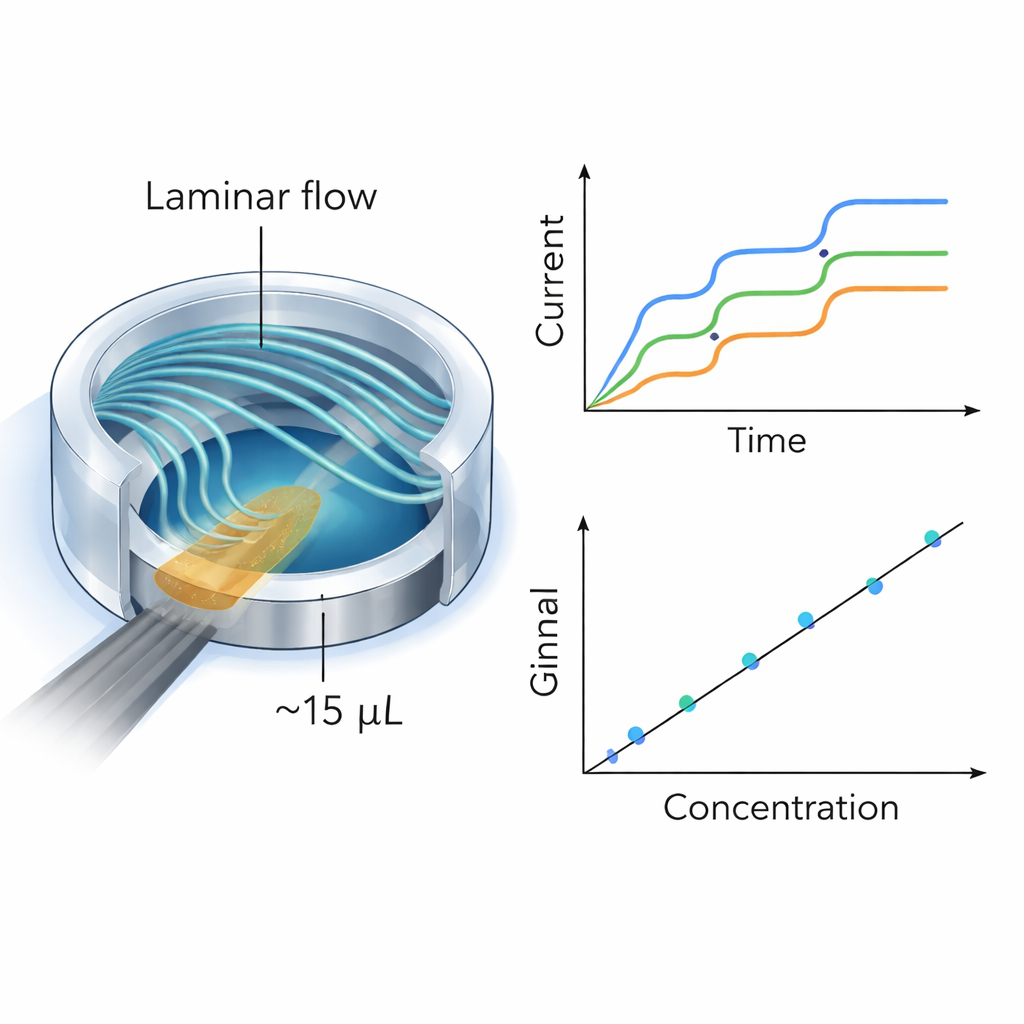
Making Disposable Sensors Go a Little Further
Disposable strips keep contamination low but increase costs. The authors explored whether each screen-printed electrode could be safely reused by applying a short, strong cleaning voltage in buffer, a process they call regeneration. After one regeneration cycle, the sensor still delivered about 90 percent of its original signal and preserved the same overall peak pattern, which is promising for modest reuse. However, additional cycles caused the signals to weaken and broaden, indicating permanent damage to the surface. The takeaway is that a single extra use is realistic, but repeated recycling is not, at least with the current materials and conditions.
Friendly Software for Non-Specialists
A key part of the platform is its custom graphical user interface, built in C#. The software not only starts and stops measurements but also controls the pump and valves, calculates solution dilutions, cleans up noisy data, and builds calibration curves automatically. Users can choose common electrochemical techniques from menus, set flow rates and timing, and watch the signals appear in real time as plots and tables. Built-in tools compute basic performance numbers such as detection limits and help detect peaks in the data without requiring deep expertise. This “single dashboard” approach reduces operator-to-operator variability and lowers the barrier for adopting the system in new labs.
What This Means for Future On-the-Spot Testing
In plain terms, this work shows that a low-cost, 3D-printed flow cell, a tiny pump, and smart software can turn simple disposable electrodes into a more precise and automatic testing platform. While the present study uses DNA in clean buffer as a demonstration, the same hardware could host many different chemistries aimed at medical markers, environmental pollutants, or food contaminants. The authors emphasize that their contribution is a general “chassis” for low-volume sensing: it keeps the liquid handling, timing, and analysis consistent, so future developers can focus on tailoring the surface chemistry for specific targets. With further refinement—such as testing in real biological fluids, adding wireless links, and shrinking the electronics—this kind of integrated platform could help bring sophisticated analyses closer to the bedside, the clinic, or the field site.
Citation: Kurul, F., Aydogan, D., Topcu, D. et al. An integrated electrochemical platform for low-volume biosensing. npj Biosensing 3, 18 (2026). https://doi.org/10.1038/s44328-026-00083-0
Keywords: electrochemical biosensor, microfluidic flow cell, screen-printed electrodes, low-volume diagnostics, point-of-care testing