Clear Sky Science · en
Biosensors in dental, oral and craniofacial applications
A New Window Into Whole-Body Health
Trips to the dentist usually focus on fixing what hurts right now: a cavity, bleeding gums, or a cracked tooth. But the mouth is more than a set of teeth to repair—it is a busy gateway to the rest of the body, bathing our tissues in saliva rich with clues about disease. This review article explores how a new generation of tiny biosensors placed on teeth, mouthguards, or pacifiers could turn the oral cavity into a real-time health dashboard, catching problems such as gum disease, tooth decay, jaw disorders, and even oral cancer long before they become severe.
Why Dentists Want Continuous Clues, Not Occasional Snapshots
Oral diseases are astonishingly common, affecting nearly half the world’s population and often undermining quality of life, nutrition, and self-confidence. Yet today’s care is largely reactive: people seek help when they feel pain, and doctors rely on occasional exams, lab tests, and X-rays. These methods provide only brief snapshots of complex, slow-moving disease processes driven by bacteria, inflammation, and mechanical forces on teeth and jawbones. Many conditions—like gum disease, early caries, or oral cancer—can smolder silently for years. The authors argue that low-cost, easy-to-wear devices that continuously track chemical markers in saliva and physical forces in the mouth could give dentists the ongoing picture they need to prevent irreversible damage and tailor treatment to each patient.
What Biosensors Can "Smell" and "Feel" in the Mouth
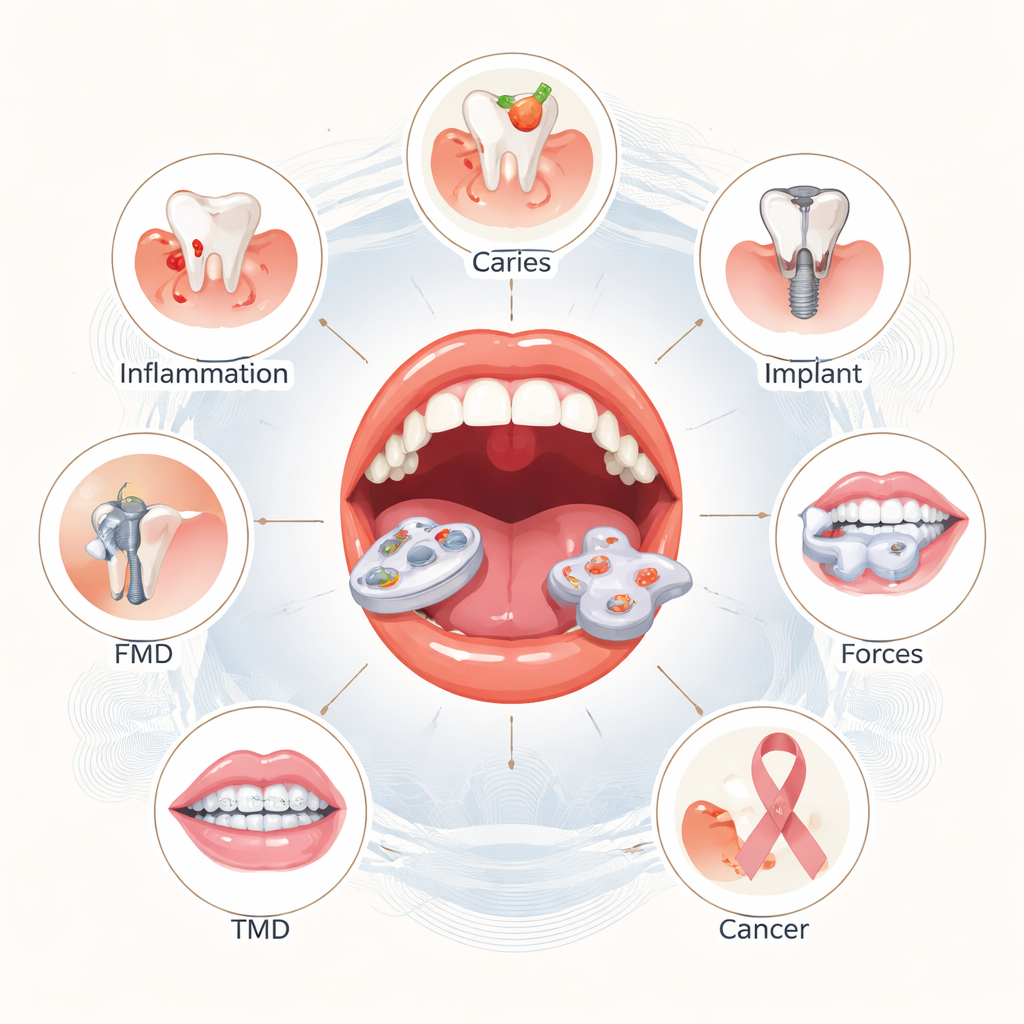
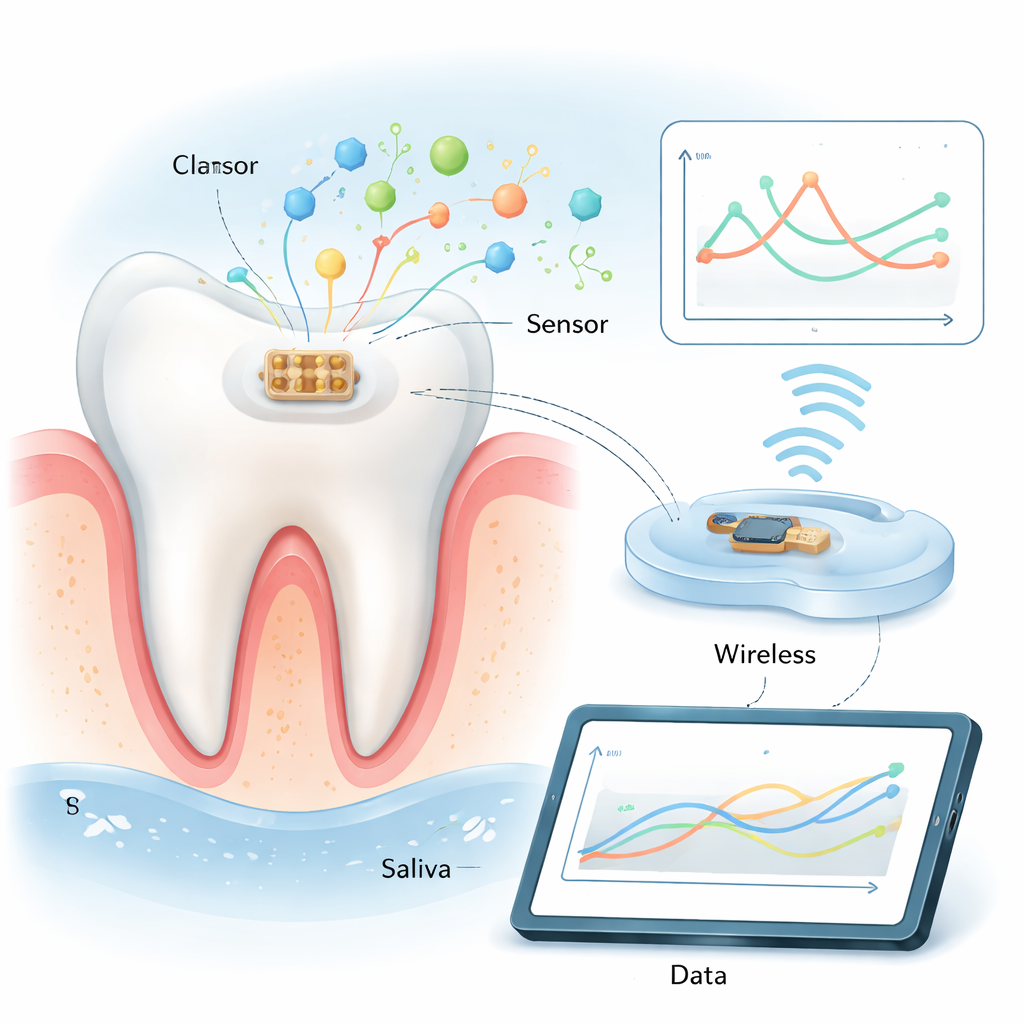
Modern biosensors combine three parts: a biological "nose" that recognizes a specific target, a transducer that turns that event into an electrical or optical signal, and a small circuit that processes and sends the data. In the mouth, these systems are being built into pacifiers, smart toothbrushes, tooth-mounted patches, mouthguards, and even dentures. On the chemical side, sensors already measure abundant targets such as salt ions, fluoride, glucose, and small acids related to tooth decay. Researchers are also working on devices that can detect delicate proteins involved in inflammation and cancer, such as cytokines and enzymes that break down bone and ligament around teeth. On the physical side, force sensors are being woven into brackets and clear aligners to track how strongly teeth are being pushed, and into bite plates to measure chewing strength and damaging nighttime grinding.
New Tools Against Cavities, Gum Disease, and Oral Cancer
The review highlights how biosensors could reshape care for several widespread problems. For dental caries, sensors that follow changes in pH, lactic acid, and bacteria like Streptococcus mutans can reveal when the mouth repeatedly dips into an acid zone that erodes enamel, and whether protective factors such as ammonia and urea are present. For gum diseases like gingivitis and periodontitis, salivary levels of molecules such as interleukins, C‑reactive protein, and enzymes that digest collagen rise well before teeth loosen, offering early warning of both local damage and links to systemic illness, including heart disease and diabetes. In oral cancer, subtle shifts in tumor-related proteins in saliva may allow clinicians to flag suspicious changes far sooner than visual inspection alone, especially if sensors can watch these markers fluctuate over days and weeks instead of at a single office visit.
Watching Forces to Guide Braces, Implants, and Jaw Health
Not all trouble in the mouth is chemical. The forces created by braces, clear aligners, dental implants, dentures, and the jaw joints themselves are just as important. Too much pressure can resorb tooth roots or damage bone; too little, and treatments simply do not work. The authors describe piezoresistive, capacitive, and piezoelectric sensors thin enough to fit inside a bracket or aligner, capable of measuring three-dimensional forces with fine precision over days or weeks. Similar technologies, embedded in bite splints or dentures, can log chewing strength, detect clenching and grinding during sleep, and help tune prostheses or jaw therapy. These measurements could turn orthodontics and jaw rehabilitation from an art guided by occasional adjustments into a data-driven science that responds to each person’s biology in real time.
From Lab Gadgets to Everyday Dental Tools
Despite rapid progress, there are still major hurdles before oral biosensors become routine in the dentist’s office or at home. Many disease markers exist at very low levels in a complex, ever-changing mix of saliva, food debris, and microbes, making it hard to build devices that stay sensitive and accurate for weeks. Sensors must resist fouling, fit comfortably in the tight and moving space of the mouth, use very little power, and transmit data wirelessly and securely. Most of today’s prototypes are proof-of-concept systems tested in the lab or short pilot studies. The authors emphasize the need for better materials to prevent buildup on sensor surfaces, smarter electronics for long-term use, and carefully designed clinical trials that show how continuous oral monitoring actually improves diagnosis, treatment decisions, and patient outcomes.
Turning the Mouth Into a Health Monitor
The article concludes that the mouth is uniquely suited to serve as an accessible, noninvasive monitoring site that reflects both oral and overall health. Biosensors there can continuously sample saliva and mechanical forces, offering a far richer picture than occasional clinic visits ever could. If the engineering challenges of miniaturization, durability, and safety can be solved—and if regulators and clinicians gain confidence through solid clinical data—these devices could usher in an era of precision oral healthcare. For patients, that could mean earlier warnings, fewer emergencies, and dental treatments that are tuned not just to a mouthful of teeth, but to the whole person behind the smile.
Citation: Tai, Y., Li, Y., Mornay, K.M. et al. Biosensors in dental, oral and craniofacial applications. npj Biosensing 3, 14 (2026). https://doi.org/10.1038/s44328-026-00079-w
Keywords: oral biosensors, saliva diagnostics, smart dental devices, wearable health sensors, orthodontic force monitoring