Clear Sky Science · en
Population-based risk adjusted outcomes for out-of-hospital cardiac arrest
Why Where You Collapse Can Shape Your Chances
When someone’s heart suddenly stops outside a hospital, every second counts. Yet in the United States, a person’s odds of surviving this kind of crisis can depend heavily on where they live and which hospitals serve their community. This study digs into why survival after out-of-hospital cardiac arrest differs so much from region to region, focusing on older adults covered by Medicare, and asks what kinds of health systems give people the best shot at making it home alive.
Heart Emergencies Before the Hospital
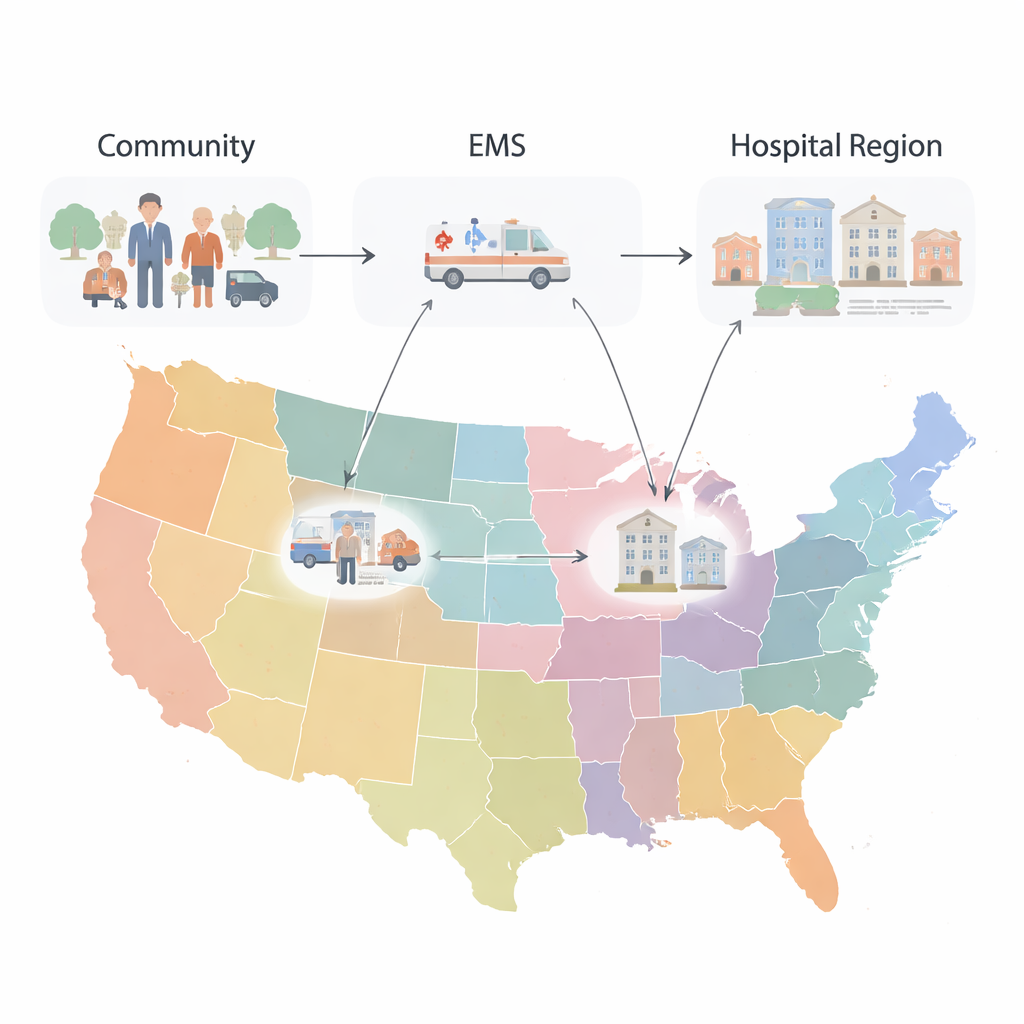
Out-of-hospital cardiac arrest happens when the heart abruptly stops beating in homes, streets, or public places. It is less common than heart attacks or strokes but far more deadly, and it places enormous strain on emergency responders and hospitals. The American Heart Association has argued that communities should treat these events like major trauma or severe strokes—conditions where carefully organized regional systems of care have already boosted survival. Instead of each hospital acting alone, the idea is to build “heart rescue” networks that link 911 dispatch, ambulances, and hospitals into a coordinated system that can deliver rapid, high-quality care from sidewalk to intensive care unit.
Taking a Nationwide Look at Outcomes
To see how well different parts of the country were doing, the researchers analyzed over 200,000 cardiac arrests among Medicare fee-for-service patients from 2013 to 2015, spread across 205 empirically defined hospital regions. They paired this massive claims database with a detailed registry of cardiac arrest cases called CARES to build a risk-adjustment model—essentially a way to estimate how many patients in each region should have survived, given their age, health conditions, and other factors. Comparing the number of people who actually survived to the number expected allowed the team to calculate a standardized incidence ratio (SIR) for each region and flag those performing better or worse than predicted.
Regions Falling Behind and Pulling Ahead
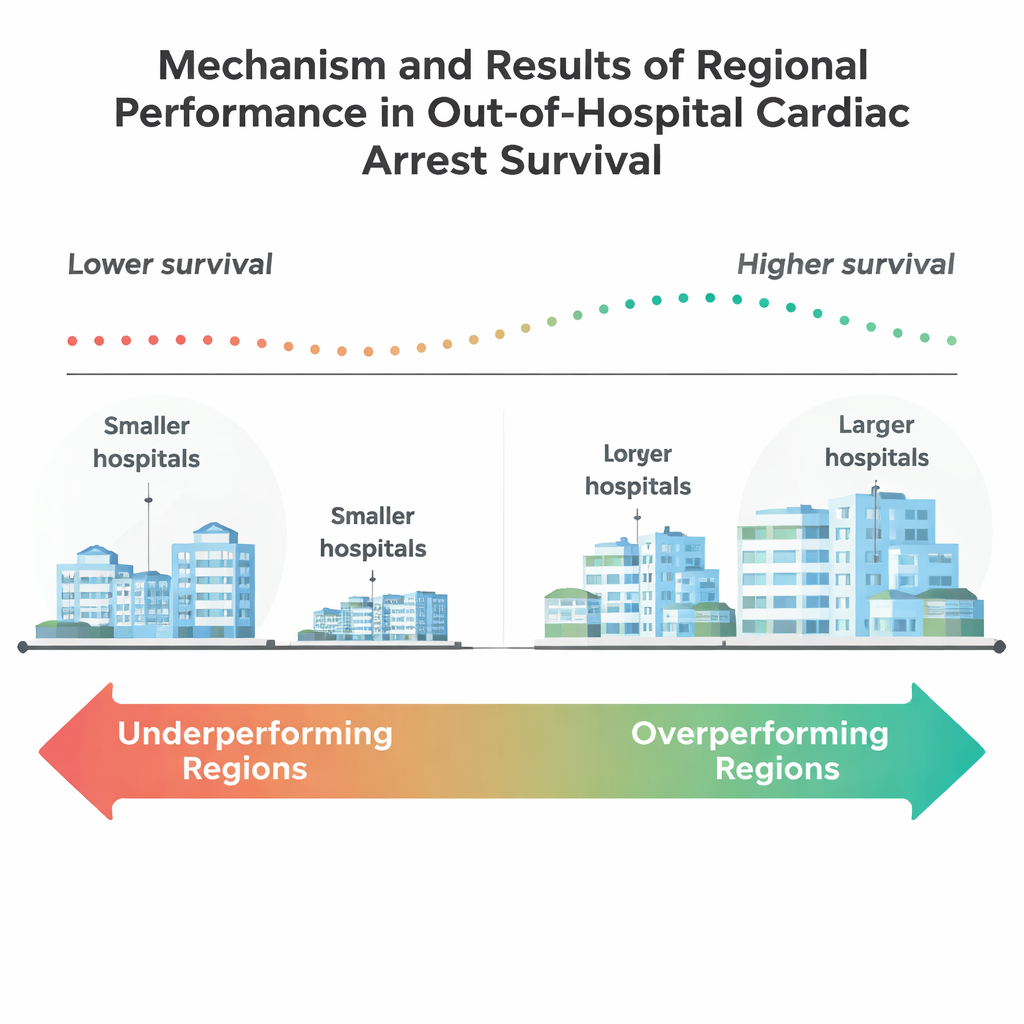
The results were sobering. Overall, only about 15% of these older patients survived to hospital discharge. About half of the 205 regions had survival rates significantly worse than expected after adjusting for patient risk, while only nine regions did better than expected. These overperforming regions tended to be smaller in population, with a higher share of residents aged 65 and older. They also had more large hospitals and more major teaching hospitals, suggesting that higher-capacity centers and academic institutions may be better equipped to deliver complex post–cardiac arrest care. In contrast, many large, densely populated regions lagged behind despite having more resources on paper.
Hospitals, Communities, and Hidden Inequities
Digging deeper, the study found that hospital size mattered: regions with more hospitals of at least 100 beds—and especially those with 400 or more—were more likely to outperform. Surprisingly, simply having a cardiac catheterization lab, which can open blocked arteries, was not linked to better regional performance by itself. This suggests that survival depends less on one high-tech procedure and more on the overall system: how EMS, emergency departments, intensive care units, and rehabilitation services work together. The team also found striking differences in community makeup. Overperforming regions had higher proportions of White residents and lower proportions of Black and Hispanic residents, along with lower unemployment and slightly higher high-school graduation rates. These patterns echo longstanding concerns that race, education, and neighborhood conditions can influence who benefits most from advances in emergency care.
What These Findings Mean for Patients and Policymakers
To a layperson, the take-home message is straightforward: survival after sudden cardiac arrest is not just about luck or personal health—it is also about how well your local health system is organized. Many regions across the United States are doing worse than they should be, even after accounting for how sick their patients are. Building stronger regional networks that emphasize large, capable hospitals; clear transfer pathways; standardized training; and community-wide support for CPR and early care could help close these gaps. The authors argue that policymakers, insurers, and health systems should move beyond a single-hospital mindset and invest in regional “cardiac arrest systems of care,” so that where your heart stops matters less—and your chances of going home again matter more.
Citation: Abbott, E.E., Buckler, D.G., Petrozzo, K. et al. Population-based risk adjusted outcomes for out-of-hospital cardiac arrest. npj Cardiovasc Health 3, 8 (2026). https://doi.org/10.1038/s44325-026-00108-7
Keywords: out-of-hospital cardiac arrest, emergency medical systems, regional health disparities, Medicare outcomes, cardiac resuscitation centers