Clear Sky Science · en
Development and validation of AI-Enhanced auscultation for valvular heart disease screening through a multi-centre study
Listening to the Heart in a New Way
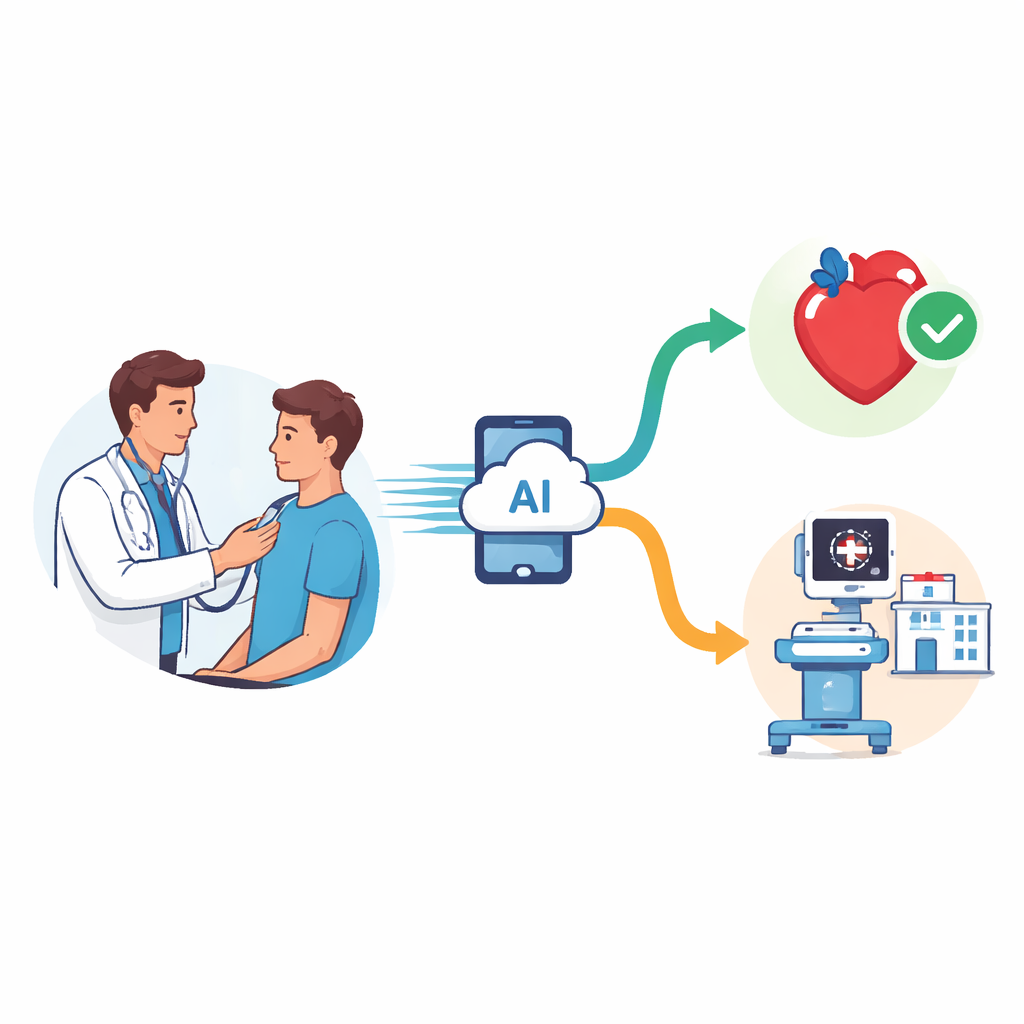
Heart valve problems are common, especially as people get older, but they are often missed until serious damage has already occurred. This study explores whether combining an electronic stethoscope with artificial intelligence (AI) can turn a one‑minute bedside recording into a powerful early warning test, helping family doctors spot hidden valve disease before it leads to heart failure or risky emergency treatment.
Why Silent Valve Problems Matter
Valves act as doors inside the heart, making sure blood flows in the right direction. When they narrow or leak—a condition called valvular heart disease—patients may feel only vague symptoms such as tiredness or breathlessness, which can easily be blamed on age, weight, or lung problems. As a result, more than half of valve disease cases are never recognised until the heart has begun to stretch and weaken, making treatment more dangerous and less effective. The best test, an ultrasound scan called an echocardiogram, needs expensive equipment and highly trained staff, so it cannot be used to screen everyone with mild symptoms.
The Idea of an AI Stethoscope
Doctors have long relied on the stethoscope to pick up heart murmurs, the whooshing sounds caused by faulty valves. But today many general practitioners lack the time or confidence to detect these subtle clues, and even skilled listeners miss cases. Earlier attempts to use AI simply tried to copy what expert cardiologists hear and label as a murmur. That strategy has limits: it cannot learn from sound features outside human hearing, and it depends on small, noisy teaching datasets. The researchers behind this paper took a different approach. Instead of training the computer to imitate human ears, they trained it to match the results of echocardiography directly, asking: given this sound recording, does the patient truly have clinically important valve disease?
Building and Testing the Tool
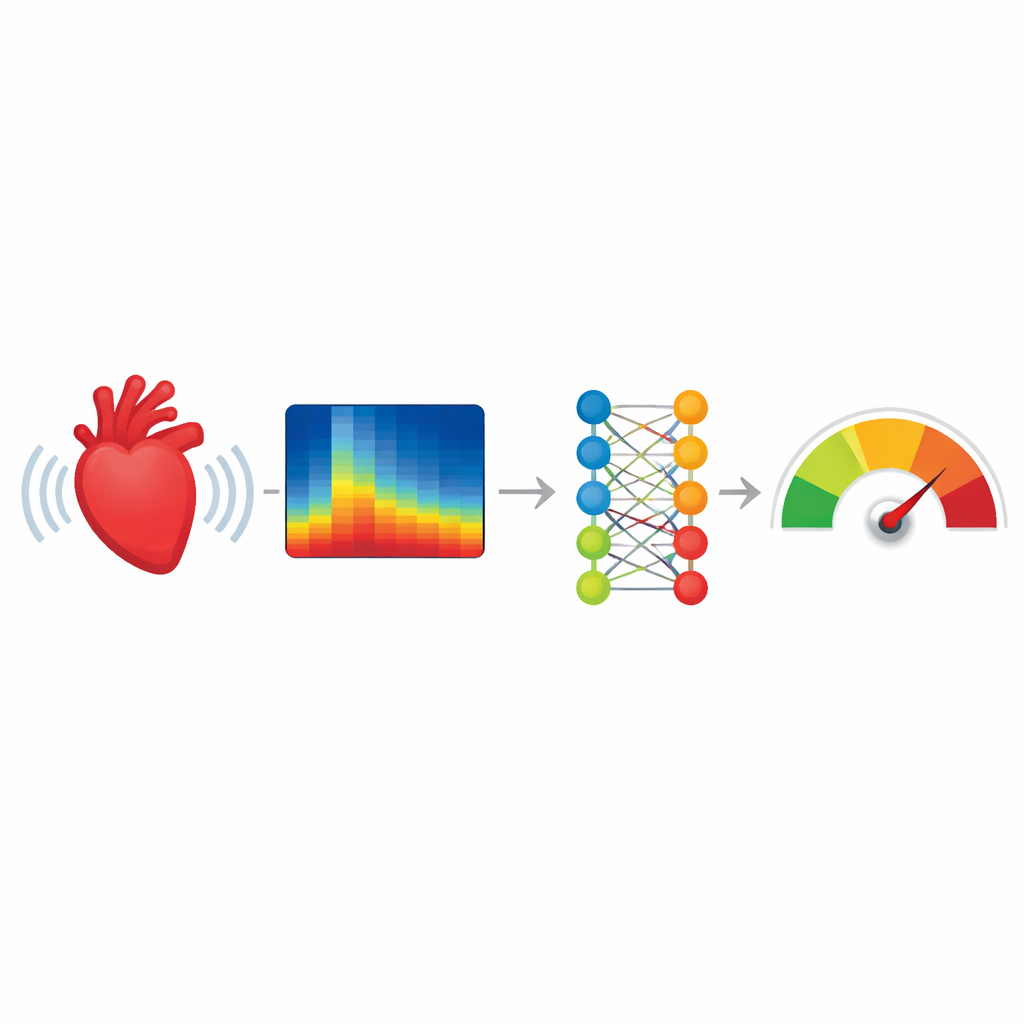
The team gathered heart sound recordings and matching ultrasound results from 1,767 adults across several UK hospitals and general practices. Nearly half had significant valve disease, most commonly a narrowing of the aortic valve or leakage of the mitral valve. Using these data, they built a recurrent neural network—a type of AI that is good at analysing time‑based signals. The computer first converted each recording into a visual map of sound frequencies over time, then learned patterns linked with meaningful valve problems. For every new patient, the system listened at up to four standard spots on the chest and produced a single probability score indicating how likely it was that any important valve fault was present.
How Well Did the AI Listen?
When tested on 263 patients it had never seen before, the AI "VHD Detector" separated people with and without clinically significant valve disease with strong accuracy. At a chosen decision point—tuned for use as a screening test—it correctly flagged about 72% of those who truly had an important valve problem, while giving the all‑clear correctly to about 82% of those without one. Performance was especially impressive for the most dangerous conditions: it identified 98% of people with severe aortic valve narrowing and 94% of those with severe mitral valve leakage. The researchers also asked 14 UK general practitioners to judge the same recordings. Even when their answers were combined, the doctors were both less sensitive and less specific than the AI, and individual performance varied widely.
What This Could Mean for Everyday Care
For busy clinics, an AI‑enhanced stethoscope could act like an extra pair of expert ears. In under a minute, it might reassure doctors that severe disease is unlikely or highlight patients who most need an ultrasound scan, without requiring advanced training or expensive handheld imaging devices. The study does have limits: the patients were mainly recruited from hospital services, so they were sicker than a true screening population, and the general practitioners listened through headphones rather than in person. Even so, the results suggest that thoughtfully trained AI could make routine chest‑piece listening far more informative, opening the door to earlier, fairer access to life‑saving valve treatments.
Citation: McDonald, A., Gales, M., Rana, B.S. et al. Development and validation of AI-Enhanced auscultation for valvular heart disease screening through a multi-centre study. npj Cardiovasc Health 3, 5 (2026). https://doi.org/10.1038/s44325-026-00103-y
Keywords: valvular heart disease, digital stethoscope, artificial intelligence, cardiac screening, heart murmurs