Clear Sky Science · en
Tracing infant sleep neurophysiology longitudinally from 3 to 6 months: EEG insights into brain development
Why baby sleep reveals brain growth
Parents quickly learn that a baby’s sleep shapes everyone’s day. But sleep is doing far more than giving caregivers a break. During the first months of life, sleep helps wire the brain, strengthening some connections and trimming others. This study followed healthy infants between 3 and 6 months of age to see how patterns of brain activity during sleep change over time, and how these changes relate to early motor and social skills. Using a cap with many tiny sensors to record brain waves at home, the researchers traced how different types of sleep activity spread across the scalp, offering a non-invasive glimpse into very early brain development that might one day help flag developmental problems sooner.
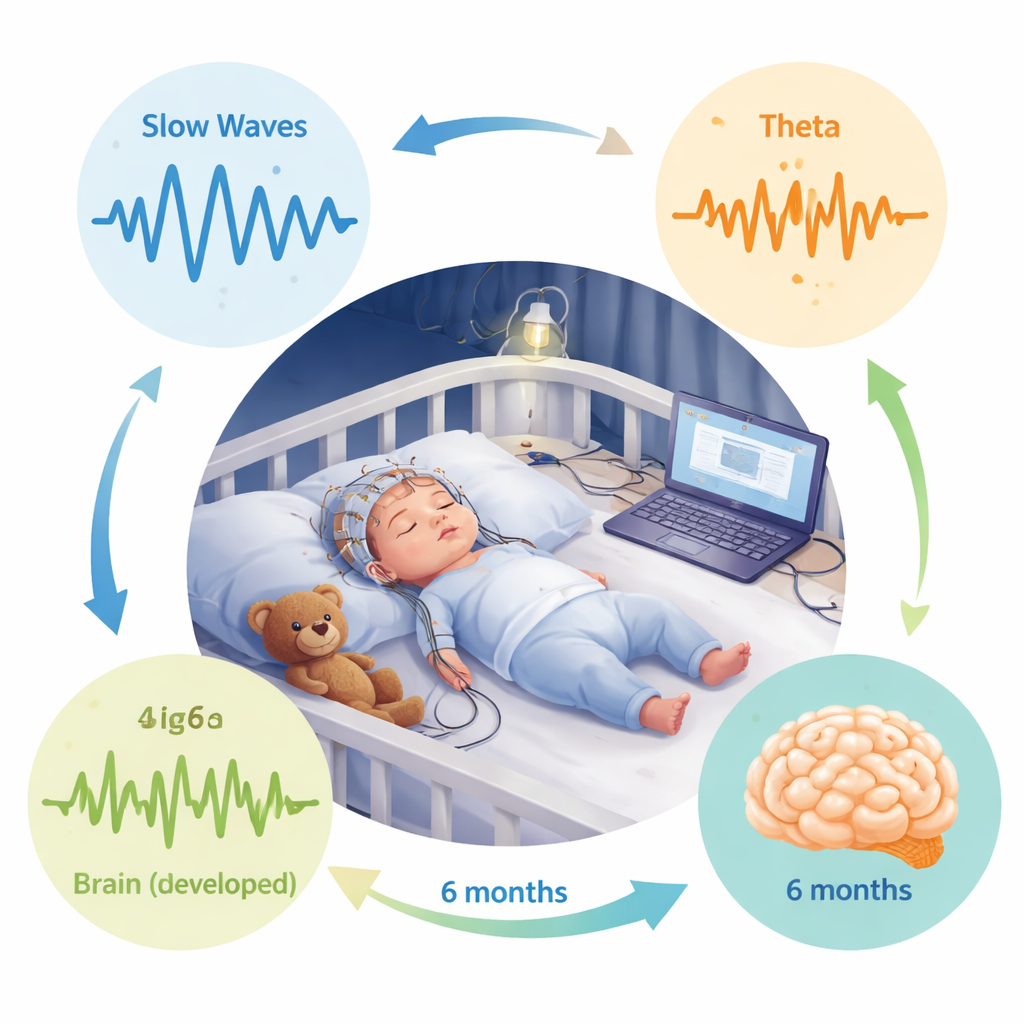
Looking at tiny brains during quiet sleep
The team recorded nighttime sleep from 11 full-term infants using high-density electroencephalography (EEG), which measures electrical activity on the scalp. They focused on the deepest and most restful phase of sleep, known as non-rapid eye movement (NREM) sleep, during the first hour of good-quality, artifact-free data. Within this sleep, three kinds of brain waves were of special interest: slow waves, which are linked to overall brain maturation and the strength of connections; theta waves, which reflect how sleep need builds up and is released; and sigma activity, which includes brief bursts called sleep spindles that are important for learning and memory. By mapping the strength of these waves across more than a hundred sensors, the researchers could see how activity shifted from the back to the front of the head as the babies grew.
How sleep waves change from 3 to 6 months
Between 3 and 6 months of age, brain activity during sleep became stronger overall, but not in a uniform way. Slow waves increased across much of the scalp, with the biggest jump at the back of the head, where visual areas of the brain develop quickly in early life. Theta activity rose even more broadly, nearly across the whole head, signaling widespread maturation of brain networks that support basic regulation of sleep. Sigma activity started out centered over the middle of the head at 3 months, then spread forward and backward by 6 months. Some central and parietal areas even showed small decreases, suggesting that spindle-related networks were reorganizing rather than simply growing everywhere at once. Together, these patterns suggest that in just three months, sleeping infant brains undergo both global strengthening and fine-tuned reshaping of their circuits.
Linking sleep patterns to early skills
To understand why these changes matter, the researchers compared shifts in sleep waves with parent-reported scores on standard developmental questionnaires at 6 months. Babies who showed bigger increases in power over frontal (forehead) regions tended to have better gross motor abilities, such as rolling and early sitting, and stronger personal-social skills, such as engaging with caregivers. This pattern held across different kinds of brain waves, especially theta for motor skills and sigma for social abilities. In contrast, when power in back-of-the-head regions increased more strongly, social scores tended to be lower. This suggests that a gradual shift of sleep-related activity from rear to front of the brain may be a marker of more advanced development, echoing the long-known trend that higher-level thinking areas in the front mature later and more slowly than sensory areas at the back.
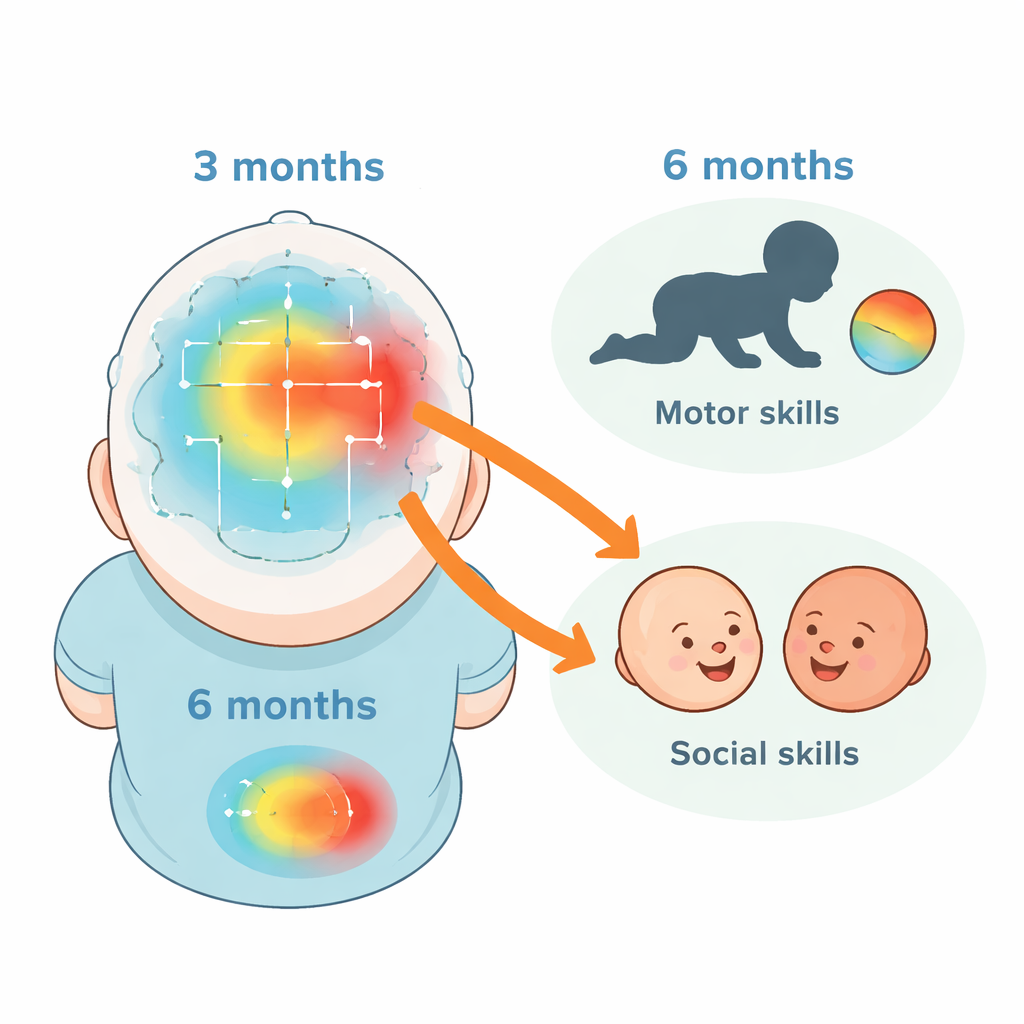
Toward early warning signs in baby sleep
These findings show that even before a baby can walk or talk, their sleeping brain carries clues about how their skills are emerging. By tracking how sleep waves move and strengthen between 3 and 6 months, scientists can outline what typical development looks like. Because many neurodevelopmental conditions, including attention and social difficulties, are tied to altered sleep and brain rhythms later in childhood, such early sleep signatures could eventually help identify children at risk long before problems are obvious in daily life. In simple terms, this study suggests that carefully listening to the sleeping infant brain may become a powerful, gentle tool for supporting healthy development from the very beginning.
Citation: Beaugrand, M., Jaramillo, V., Mühlematter, C. et al. Tracing infant sleep neurophysiology longitudinally from 3 to 6 months: EEG insights into brain development. npj Biol Timing Sleep 3, 9 (2026). https://doi.org/10.1038/s44323-026-00071-7
Keywords: infant sleep, brain development, EEG, motor skills, social development