Clear Sky Science · en
Control vs. salience: a new axis of circadian brain-body organization
Why your daily rhythms matter
Most of us feel that some days our bodies and brains are “in sync,” while other days feel out of tune. This study asks why, using smartwatches and brain scans to track how people’s daily activity and heart rhythms line up with their brain networks. The findings suggest that circadian health is not just about having strong body clocks, but about how well different systems coordinate—revealing two main styles of brain–body organization along a new “Control–Salience” spectrum.
Watching the body clock in everyday life
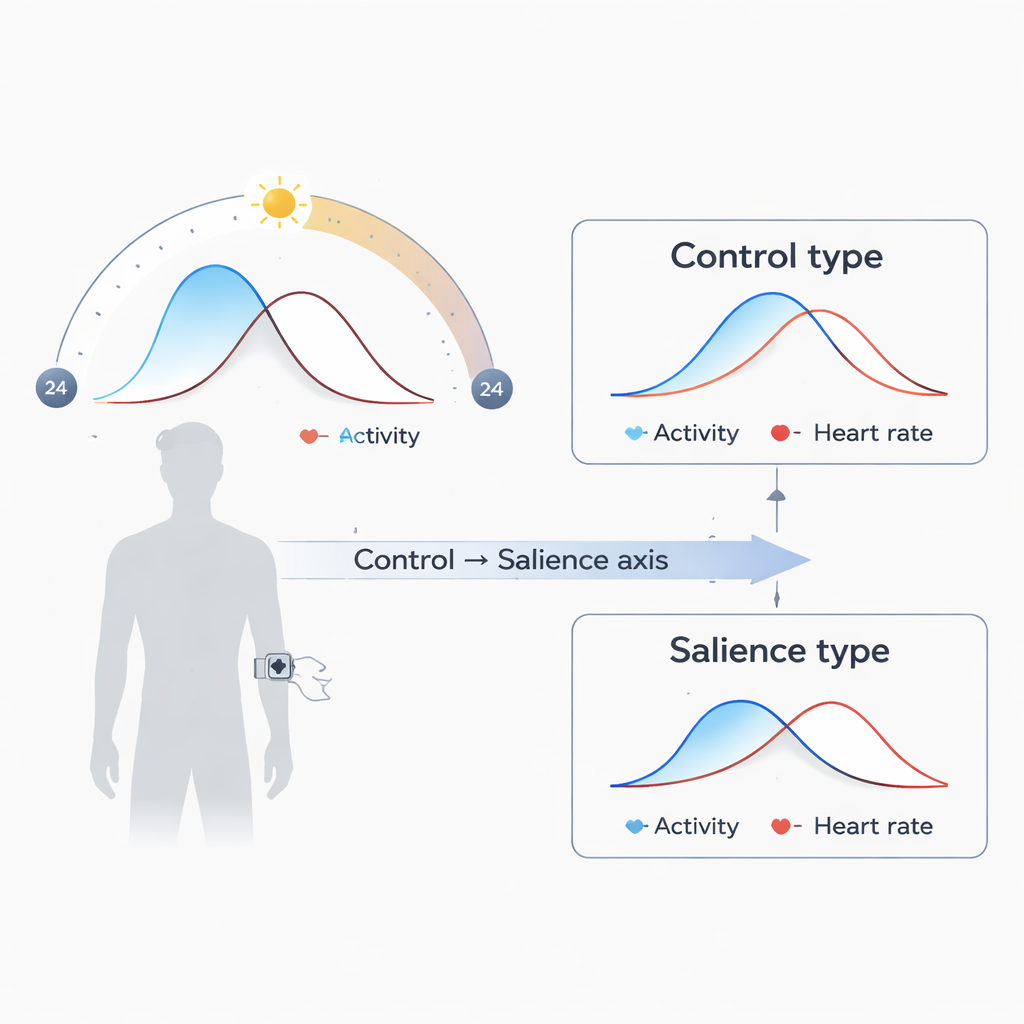
The researchers followed 52 healthy young adults for about a month. Each person wore a smartwatch that measured movement (through accelerometry) and heart activity. From these data, the team extracted classic circadian features: how strong daily cycles were (amplitude), how repeatable they were from day to day (stability), when peaks occurred (acrophase), and how closely movement and heart rhythms lined up or lagged behind each other. They also collected high-resolution brain scans, both structural MRI to look at the shape and thickness of the cortex, and resting-state fMRI to measure how strongly different brain networks communicate at rest.
Not just weak or strong, but who is leading whom
Traditionally, circadian health is described on a single line from weak to robust rhythms. Here, the data told a more nuanced story. When the researchers combined all of the movement and heart metrics for each person, they found that people clustered into two distinct “archetypes.” One group had more stable and higher-amplitude activity rhythms, with movement clearly leading changes in heart rate by several hours. The other group showed the opposite pattern: heart rhythms with larger swings and earlier peaks, and movement that closely followed autonomic signals with very little lag. In other words, for some people, behavior (locomotor activity) is in the driver’s seat; for others, the autonomic system, reflected in heart rate, takes the lead.
Brain networks that match your rhythm style
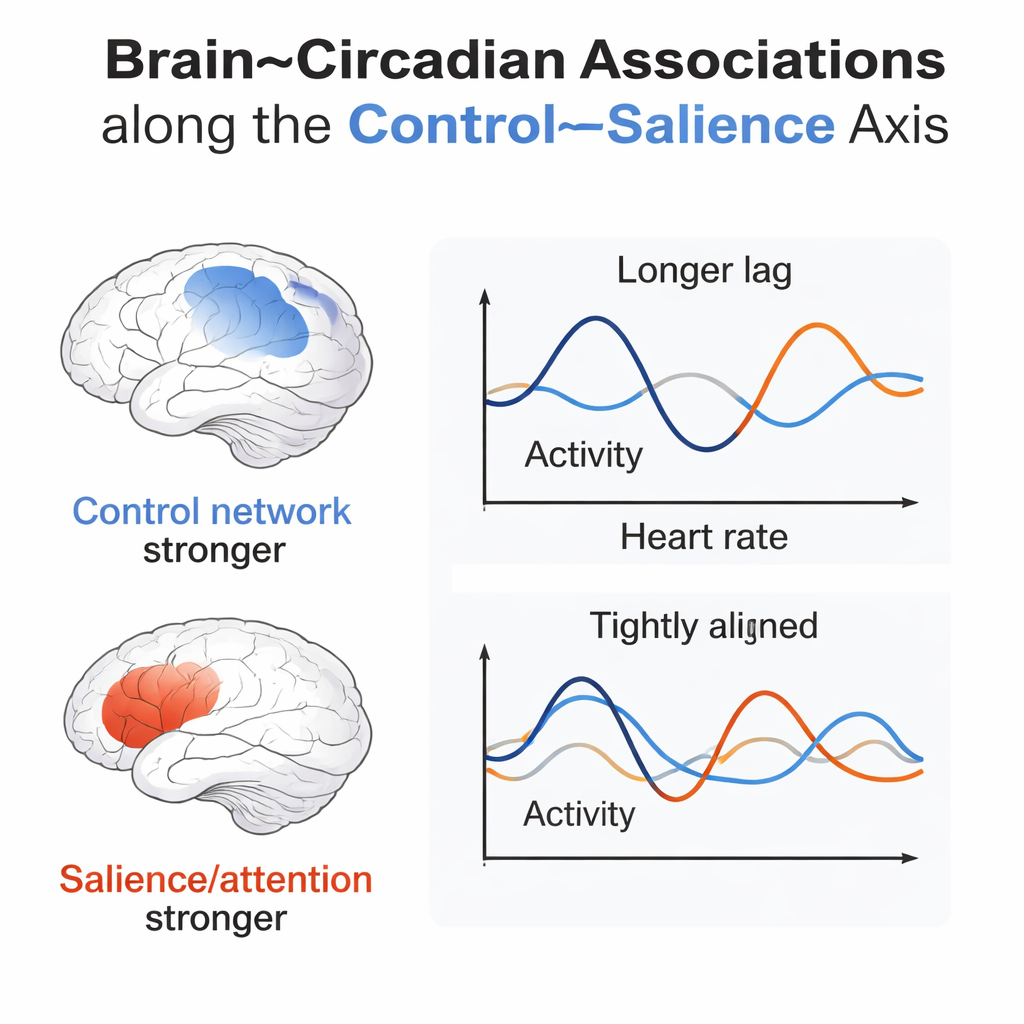
These rhythm styles mapped onto differences in brain organization. People whose activity cycles were dominant and somewhat misaligned from heart rhythms showed stronger connectivity in “control” networks—brain regions involved in planning, rules, and top–down regulation. Those with heart-led, tightly coupled rhythms showed stronger connectivity in “salience” and attention networks, which help the brain detect important internal and external events and shift focus accordingly. Subtle relationships also emerged between rhythm timing and brain structure: for instance, later heart-rate peaks were linked to differences in cortical curvature in default-mode regions, and more stable daily rhythms related to stronger visual-network structure and connectivity. Although many of these effects were modest and exploratory, together they suggest that how our body clocks are wired is reflected in the architecture and wiring of our brains.
Life context shapes, but does not define, rhythms
The study also explored simple demographic contrasts. Age and sex had only small effects on daily rhythm measures, aside from females having slightly higher heart rates, consistent with known physiology. However, international students tended to show later and weaker activity rhythms than domestic students, with lower day–night contrast in both movement and heart-rate signals. This likely reflects lifestyle factors—such as different schedules, stress, or light exposure—superimposed on underlying biological tendencies. Even so, the core finding held: across individuals, the key variation was not just how regular or strong rhythms were, but how movement and heart rhythms were aligned or out of step with one another.
What this means for circadian health
To a layperson, the study’s message is that circadian health is multi-dimensional. Some people achieve regularity through stable, high-amplitude activity patterns, even if their heart rhythms run on a slightly different schedule—these are “control-anchored” types whose brains lean on executive control networks. Others are “salience-anchored” types, whose activity and heart rhythms move in lockstep and whose brains emphasize networks that monitor bodily and environmental signals. Both styles have distinct brain signatures and may carry different risks for mood, cognition, and long-term brain health. Rather than asking simply whether a person’s body clock is weak or strong, the authors argue that we should also ask which system is leading, how tightly body systems are synchronized, and how that alignment interacts with brain networks—insight that could guide more personalized monitoring and interventions using everyday wearable devices.
Citation: Demers, O., Ghaffari, S., Li, C. et al. Control vs. salience: a new axis of circadian brain-body organization. npj Biol Timing Sleep 3, 7 (2026). https://doi.org/10.1038/s44323-025-00065-x
Keywords: circadian rhythms, brain networks, wearable sensors, heart rate and activity, sleep and cognition