Clear Sky Science · en
Reconfigurable spatial-mode generation and multiplexing on a scalable photonic chip
Light Patterns as Information Highways
Invisible patterns inside a beam of light are emerging as new highways for data and powerful tools for sensing and computing. Instead of using just brightness or color, engineers can encode information in the shape and polarization of light itself. This paper presents a tiny programmable silicon chip that can sculpt these intricate light patterns on demand, potentially reshaping how future communication networks, microscopes, and quantum devices handle information.
Why Shaping Light Matters
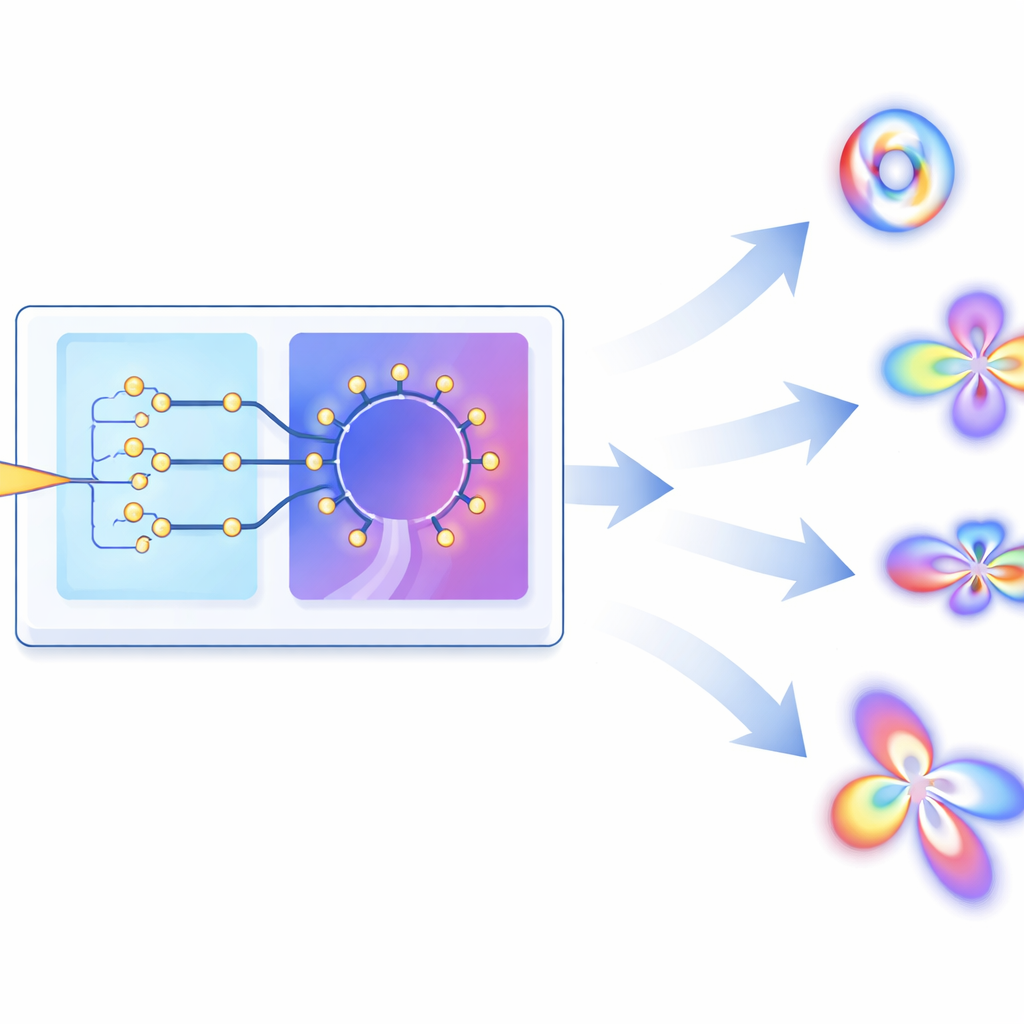
Light beams are not all the same: their energy can be arranged in different spatial patterns, known as modes. Some look like simple spots, others like rings with a dark center (“donuts”), or patterns with multiple bright lobes. These spatial modes can act like extra lanes in an optical fiber, allowing many data channels to travel together without interfering. They are also key tools in precision sensing and in experiments where individual particles of light carry quantum information. The catch is that current tools for making and switching between these modes are often bulky, delicate, and limited to fixed patterns.
Bringing Complex Light onto a Chip
The authors tackle this by moving spatial-mode generation onto a compact silicon photonic chip, similar in spirit to an electronic chip but guiding light instead of electrons. Their design combines two main building blocks. First, a programmable linear optical circuit splits an incoming beam into several paths and precisely adjusts their relative strength and phase—how the light waves line up in time. Second, an orbital-angular-momentum generator turns these carefully arranged paths into swirling, ring-shaped light beams using an array of tiny antennas. By treating these swirling beams as a flexible “basis set,” the chip can then mix and recombine them to form many different kinds of output modes.
From Swirls to Stripes and Beyond
The key idea is to use orbital angular momentum (OAM) modes—light beams whose wavefronts twist like a corkscrew—as universal building blocks. On the chip, different OAM modes with left- or right-handed circular polarization are produced and then combined in controlled ways. By choosing the right mix and timing between four such input modes of the same order, the device can recreate more familiar linearly polarized (LP) modes, which look like striped or lobed patterns, or more exotic cylindrical vector (CV) modes, where the direction of polarization changes across the beam. Simulations show that this strategy can, in principle, generate a large family of modes, with the number of accessible patterns growing linearly as higher-order OAM modes are supported.
What the Experiments Showed
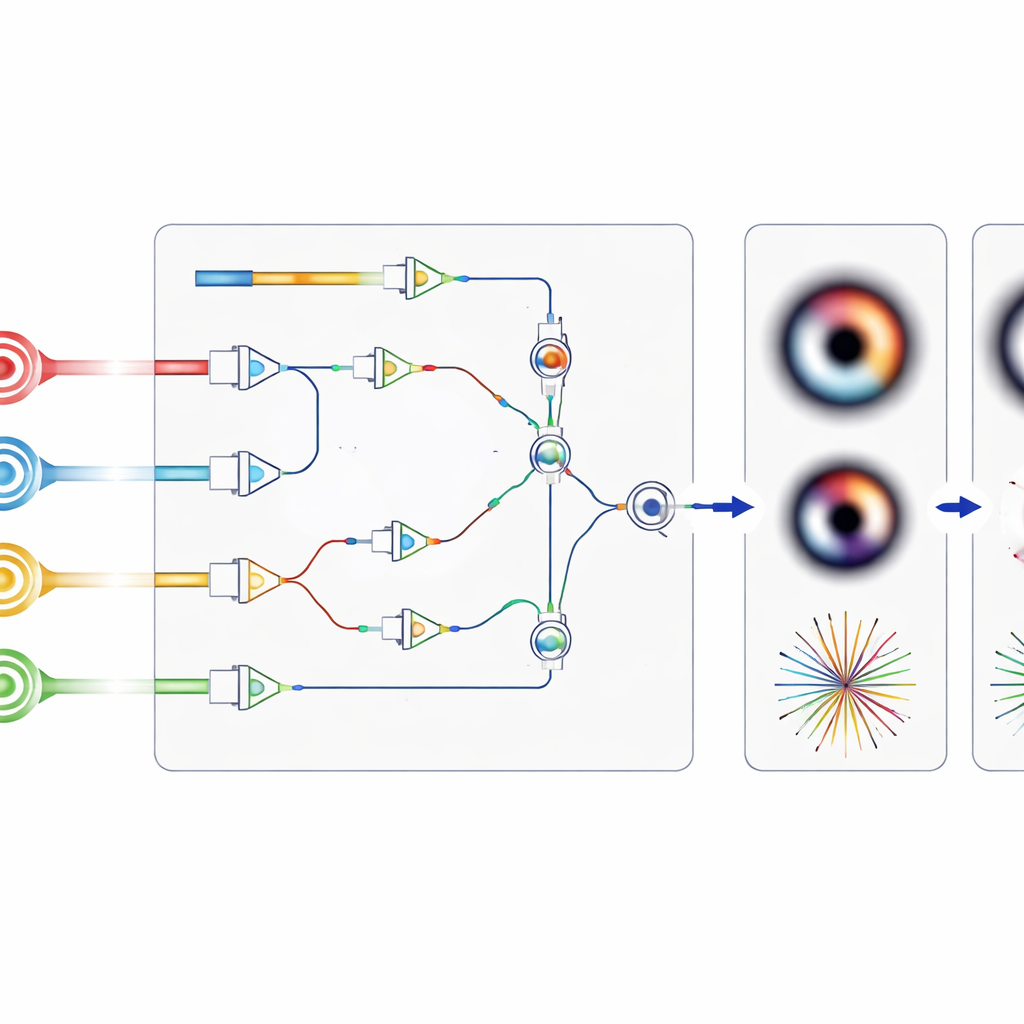
Using a proof-of-concept chip, the team experimentally generated ten distinct OAM modes and eight LP modes. They verified the twist of each OAM beam by interfering it with a simple reference beam and observing spiral fringes, and they confirmed the expected multi-lobed patterns and polarization directions for the LP modes. Because real devices are never perfect, the authors carefully calibrated on-chip phase shifters and attenuators to reduce “crosstalk,” where one mode leaks into another. After tuning, the worst unwanted leakage for a key mode was reduced to around one-tenth of the signal power, and the overall “purity” of the generated modes was quantified. They also analyzed how imperfections in the tiny antennas and waveguides limit performance, and outlined straightforward design tweaks—such as closer-packed antennas and additional control elements—that could further clean up the modes and enable high-quality CV beams.
Toward Flexible Light-Based Systems
In simple terms, this work shows that a single, programmable chip can act as a universal sculptor of light patterns, switching between different mode families without redesigning the hardware. Although the current device demonstrates a subset of what is theoretically possible, its architecture scales well and could support much higher-order patterns with modest extensions. Such reconfigurable spatial-mode generators and receivers could become essential pieces of future optical networks that dynamically adapt to changing traffic, as well as platforms for quantum information processing, advanced imaging, and on-chip machine learning systems that compute directly with structured light.
Citation: Xiao, X., Chen, Y., Bhandari, B. et al. Reconfigurable spatial-mode generation and multiplexing on a scalable photonic chip. npj Nanophoton. 3, 19 (2026). https://doi.org/10.1038/s44310-026-00115-7
Keywords: structured light, silicon photonics, spatial modes, orbital angular momentum, mode multiplexing