Clear Sky Science · en
Recent progress towards large-scale integrated photonic quantum computation
Why tiny chips of light matter
Computers that harness the strange rules of quantum physics promise to solve certain problems that overwhelm today’s machines, from simulating molecules to securing global communications. But most prototypes are room‑sized and fragile. This article explains how researchers are shrinking quantum hardware onto photonic chips—tiny circuits that guide individual particles of light—and how this approach could make powerful quantum computers and even a “quantum internet” practical. It walks through the materials, key building blocks, current uses, and the remaining hurdles in clear, real‑world terms.
Light as a carrier of quantum information
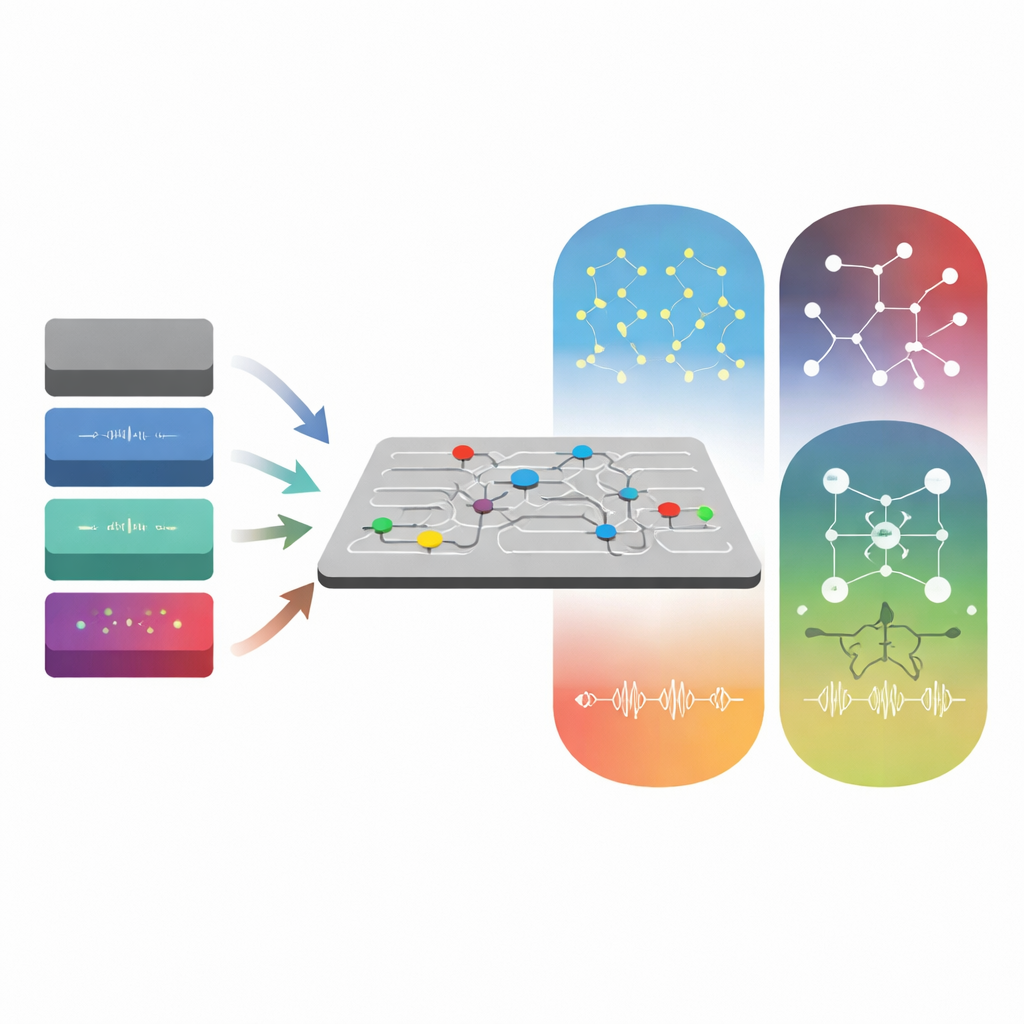
Many quantum devices rely on atoms or superconducting loops, but this review focuses on photons—single particles of light—as the workhorses of quantum computing. Photons are naturally resistant to many types of noise and already travel long distances through fiber‑optic cables, which makes them attractive for both computing and communication. The authors describe how photonic quantum computers represent information using “qubits” or “qumodes” encoded in different properties of light, such as which path a photon takes on a chip, when it arrives, its color (frequency), or its polarization. By steering and combining photons in carefully designed circuits, these chips can create quantum superposition and entanglement—the key ingredients behind quantum speed‑ups.
The materials behind quantum light chips
Building a useful photonic quantum chip starts with the right platform. The article compares several leading materials, each with trade‑offs. Silicon, the backbone of conventional electronics, offers strong optical effects and compatibility with advanced chip factories, but it tends to absorb light and introduce loss. Silicon nitride is gentler on light and allows ultra‑low‑loss waveguides, making it excellent for producing special light states, though its nonlinear effects are weaker. Lithium niobate and its thin‑film version provide powerful control over light using electrical signals, ideal for fast modulators and generating squeezed light, a resource for continuous‑variable quantum computing. Other semiconductors, such as gallium arsenide and indium phosphide, host quantum dots that act as on‑demand single‑photon emitters. No single material does everything, so researchers are increasingly turning to hybrid and modular designs that combine chips made from different substances into one working system.
Making and shaping single particles of light
For any photonic quantum computer, reliable sources of nonclassical light are essential. The review outlines two major families. Probabilistic sources use nonlinear optical processes: intense laser light passing through tiny waveguides or ring resonators occasionally splits into paired photons, which can serve as “heralded” single photons when one partner announces the presence of the other. Engineers tune these structures to boost brightness and purity while managing a fundamental trade‑off between getting many photons and keeping them cleanly quantum. Deterministic sources rely on quantum dots—nano‑scale “artificial atoms” in semiconductors that can emit one photon per laser pulse with extremely high quality. Integrating these dots directly with waveguides and other on‑chip elements is an active area of research, complicated by the need for cryogenic temperatures and precise alignment. The authors also cover squeezed‑light sources, which manipulate the random fluctuations of light to create continuous‑variable quantum resources on chip.
Circuits that perform quantum tricks
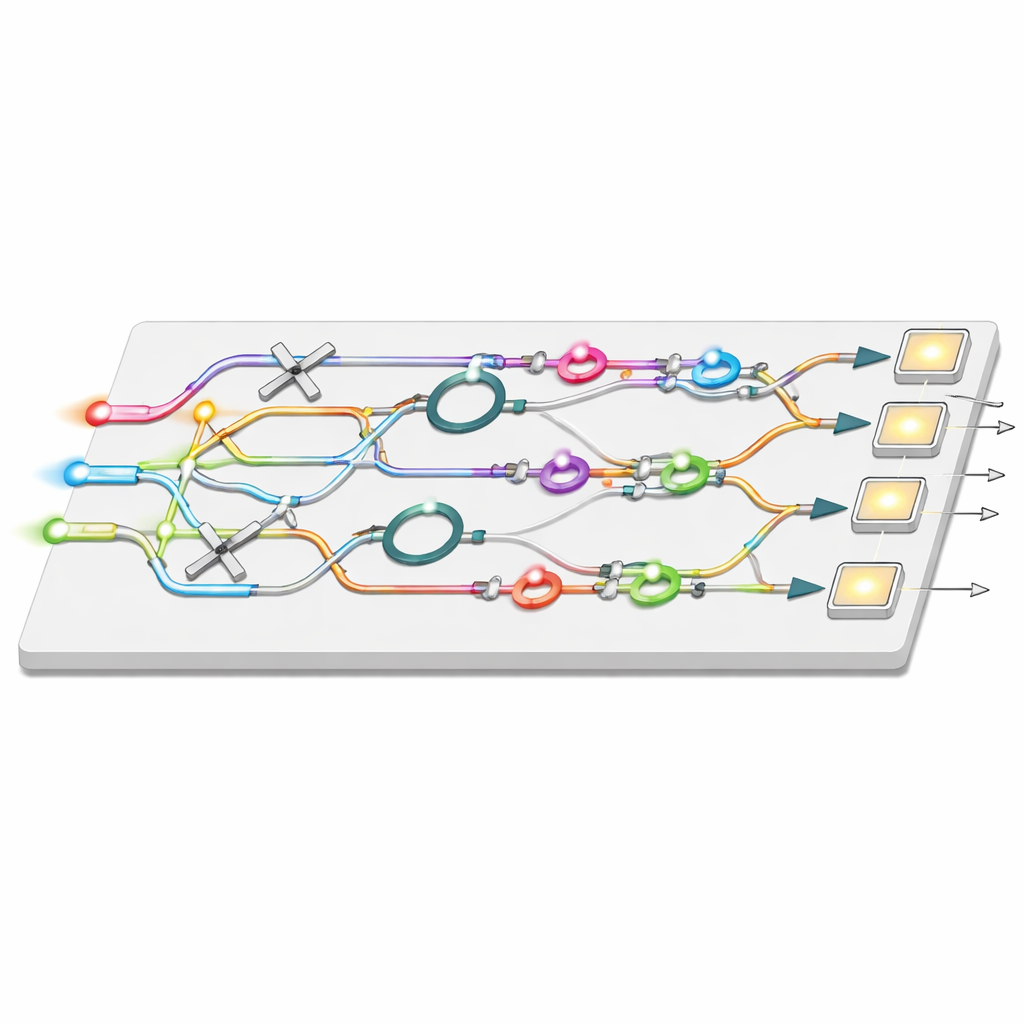
Once quantum light is available, it must be routed, mixed, and measured with great precision. Photonic chips achieve this using a toolbox of components: beam splitters, tunable phase shifters, tiny ring resonators, fast modulators, and on‑chip single‑photon detectors. By combining these parts, researchers have demonstrated basic quantum logic gates, larger programmable circuits, and highly entangled “cluster” and “graph” states used in measurement‑based computing. The review shows how different ways of encoding information—in paths, arrival times, colors, or spatial modes—each offer advantages for particular tasks, such as robust long‑distance communication or compact, high‑dimensional processing. It also describes early quantum networks where separate chips share entanglement and even teleport quantum states between each other through optical fibers, hinting at future distributed quantum processors.
From noisy prototypes to useful machines
Today’s photonic quantum chips operate in the so‑called “noisy intermediate‑scale” regime, where devices have tens of modes or qubits and errors still limit performance. Even so, they are already tackling meaningful problems. The article surveys experiments in quantum simulation (such as boson sampling and quantum walks for modeling complex systems), hybrid algorithms that combine a quantum chip with a classical optimizer, and quantum versions of machine‑learning tools like kernels, neural networks, and generative models. These demonstrations point toward practical applications in chemistry, finance, and data analysis, even before fault‑tolerant quantum computers arrive.
Road to large‑scale quantum light processors
Looking ahead, the authors highlight the engineering steps needed to turn photonic prototypes into large‑scale, reliable machines. Optical packaging must couple chips to fibers with minimal loss; electrical packaging must control hundreds of tunable elements without overheating; and multi‑chip architectures must allow separate modules for sources, processors, and detectors to work together seamlessly. Companies and labs are pursuing two main routes to full fault tolerance: fusion‑based schemes that stitch together many small entangled states, and continuous‑variable schemes that encode information in special “grid” states of light. Both demand dramatic reductions in photon loss and higher quality quantum states than currently available. If these challenges are met, integrated photonic chips could underpin not only universal quantum computers but also a future quantum internet, where distant processors exchange entanglement over optical networks for ultra‑secure communication and shared computing power.
Citation: Zhu, H., Chen, T., Ma, H. et al. Recent progress towards large-scale integrated photonic quantum computation. npj Nanophoton. 3, 20 (2026). https://doi.org/10.1038/s44310-026-00114-8
Keywords: integrated quantum photonics, photonic quantum computing, single-photon sources, quantum machine learning, quantum networks