Clear Sky Science · en
Highly-accurate manipulation of focal length for circular Airy beams
Sharper Light for Delicate Jobs
From eye surgery to nanoscale 3D printing, many modern technologies rely on laser beams that must be focused with hair‑splitting precision. Even a tiny mismatch between where the beam is supposed to concentrate and where it actually does can mean damaged healthy tissue, blurred images, or misshapen micro‑parts. This paper tackles that problem for a special class of laser beams, called circular Airy beams, and shows how to control their focal point with far greater accuracy than before.
A Curious Kind of Light Beam
Unlike the familiar laser pointer, which forms a simple bright spot, an Airy beam is a structured pattern of light that can curve as it travels and heal itself after encountering obstacles. When this pattern is wrapped into a ring, it becomes a circular Airy beam. Such beams stay dim along their path and then suddenly concentrate their energy in a tight region, like a camera flash that only goes off at a chosen distance. This peculiar behavior makes them appealing for medical procedures that must spare surrounding tissue, precision drilling and cutting, high‑resolution microscopes, and even the gentle trapping and steering of tiny particles.
Why the Focus Keeps Shifting
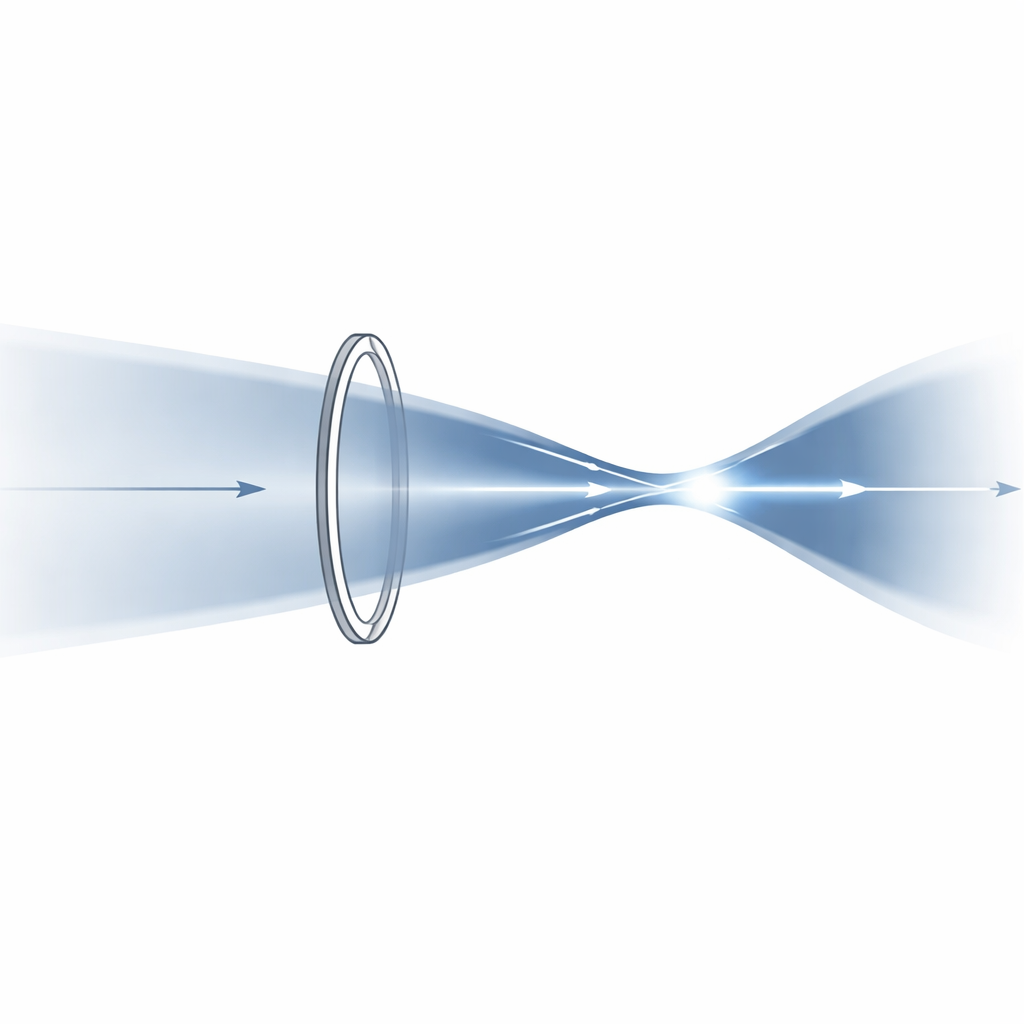
Designers usually describe circular Airy beams using geometric rules that treat light as straight rays following a perfect parabolic path. In that picture, the focus is simply where the curved path meets the beam axis. But real light is a wave, and as it diffracts—spreads and bends—its true focal point shifts away from this geometric crossing. Earlier work tried to include diffraction, yet still left a systematic error: the designed focal length could differ from the actual one by several percent. For applications that work at the scale of human cells or micrometer‑sized features, such an error is far from acceptable.
Building a More Honest Model of the Beam
The authors revisit the focusing problem using Fresnel diffraction, a wave‑based description of how light spreads after passing through a patterned plate. They derive how the phase pattern—the way the plate delays the peaks and troughs of the light wave—shapes the beam’s path and final focus. A key insight is that both the inner and outer edges of the circular phase region strongly influence where the energy actually concentrates. By expanding the wave’s phase mathematically and analyzing how small shifts around the expected focus change the field, they obtain a corrected expression for the true focal distance. They then translate this into simple design rules: a limit on how large the correction term is allowed to be, and a minimum size that the outer radius of the phase region must exceed to ensure enough light rays combine at the desired point.
From Equations to a Real Nano‑Engineered Lens
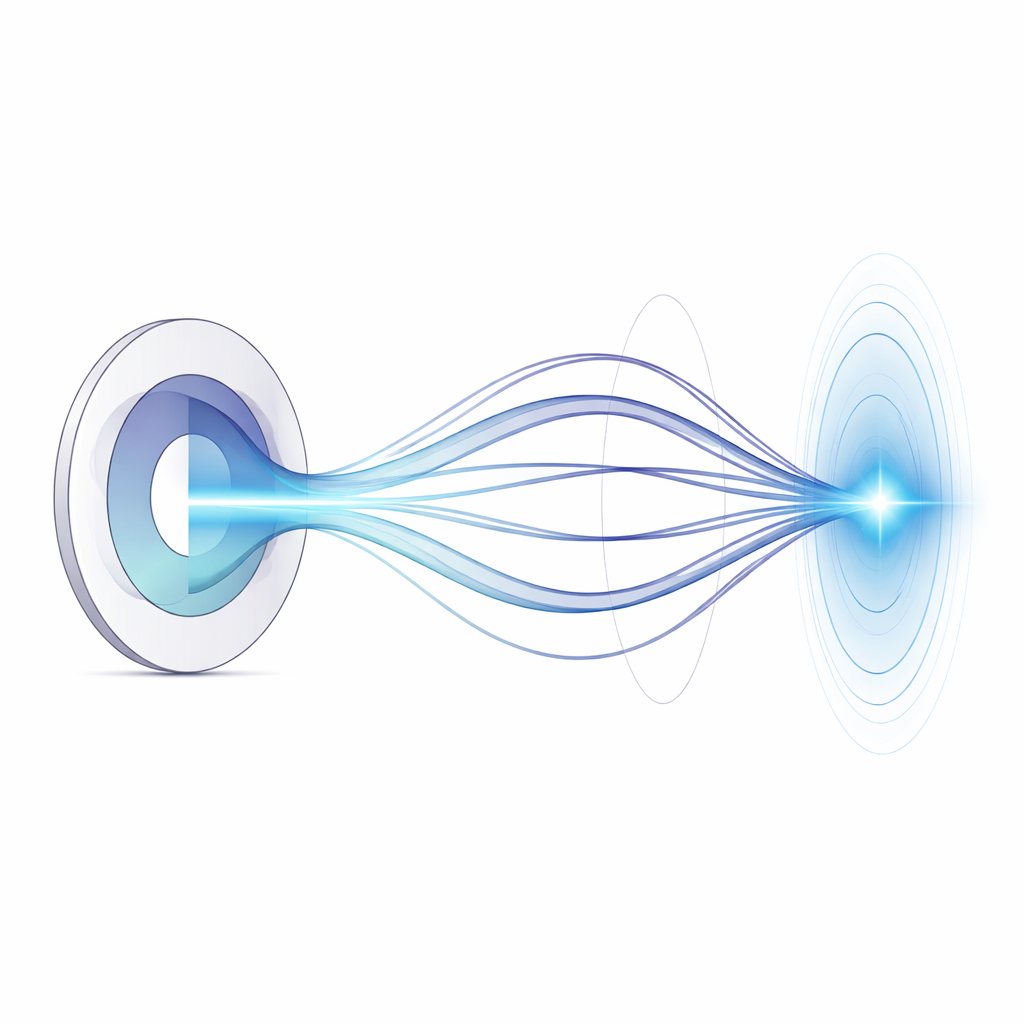
Armed with these criteria, the team sets out to design a circular Airy beam that focuses exactly 10 centimeters away. They co‑optimize several parameters, such as the beam’s trajectory and the inner and outer radii of the phase plate, to satisfy both the new constraints and the target focal length. The desired phase pattern is then encoded onto a metasurface—a flat, nanostructured layer of silicon on glass—built from tiny rectangular pillars that act like miniature antennas for light. By rotating each pillar at a carefully chosen angle, the researchers imprint the required phase shifts across the surface while maintaining high efficiency.
Testing How Well the Beam Behaves
The authors first simulate the beam’s propagation using a numerical method that tracks how its spectrum of spatial frequencies evolves in space. These calculations show the circular Airy beam following its characteristic parabolic path and reaching peak intensity at 10.034 centimeters, only 0.34 percent away from the 10‑centimeter goal. They then fabricate the metasurface and measure the beam in the lab with a microscope‑based imaging system and a precisely moving translation stage. Over twenty repeated measurements, the focal position consistently lands at 10.04 centimeters, a 0.4 percent deviation from the design. For comparison, if they relied only on the older geometric approach, the apparent focus would sit at 9.553 centimeters, missing the mark by 4.47 percent—more than ten times worse.
What This Means for Real‑World Uses
In plain terms, the study shows how to “dial in” the focusing distance of circular Airy beams with sub‑percent accuracy by respecting the wave nature of light and the finite size of the phase plate. Instead of treating the focus as a simple geometric crossing, the new model acknowledges that the edges of the beam shaper matter and turns that insight into clear design rules. This improved control can translate into more reliable laser surgery that spares healthy tissue, cleaner and deeper micro‑machining cuts, crisper images in advanced microscopes, and steadier optical traps for tiny particles. By shrinking the focusing error from several percent to less than half a percent, the work pushes circular Airy beams closer to practical, everyday tools in high‑precision science and technology.
Citation: Zhang, J., Zhang, W., Li, W. et al. Highly-accurate manipulation of focal length for circular Airy beams. npj Nanophoton. 3, 17 (2026). https://doi.org/10.1038/s44310-026-00112-w
Keywords: circular Airy beams, precise laser focusing, metasurfaces, diffraction modeling, high-precision optics