Clear Sky Science · en
Deeply subwavelength blue-range nanolaser
Light from Tiny Building Blocks
Smartphones, virtual‑reality headsets, and future quantum devices all need light sources that are smaller, brighter, and more colorful than today’s technology can easily deliver. This paper reports a major step in that direction: a blue‑emitting laser so small that it is much tinier than the very light waves it produces, built from a single crystal block of a modern semiconductor material.
Why Shrinking Lasers Matters
Conventional lasers rely on optical cavities whose size is tied to the wavelength of light, which makes it hard to push them down to true nanoscale dimensions. Yet ultra‑compact blue lasers are especially attractive for dense display pixels, high‑capacity optical data storage, microscopy, and secure communication, all of which benefit from short‑wavelength, tightly confined light. Earlier work had produced red, green, and even ultraviolet nanolasers, and there were perovskite‑based devices emitting in the blue. However, none of the demonstrated blue lasers were smaller than the wavelength of their own light in all three dimensions, leaving a gap between what applications demand and what physics allowed—until now.
Building the Smallest Blue Nanolaser
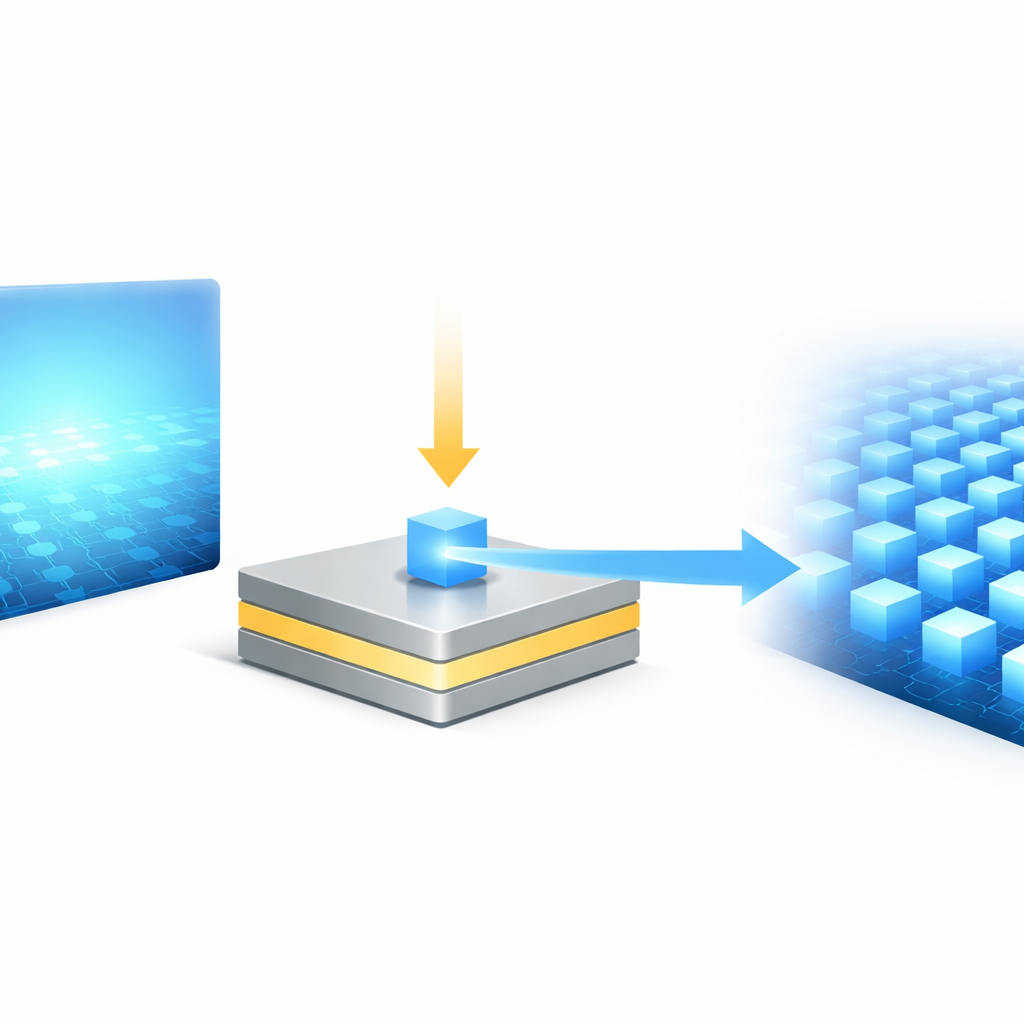
The authors fabricate tiny cube‑like crystals made of an all‑inorganic halide perovskite called CsPbCl3 using a solution‑based “hot injection” method. These nanocuboids, typically 100–500 nanometers across, are then deposited on top of a carefully designed chip: a thin insulating spacer layer sitting on a silver film, which itself lies on a silicon substrate. Among the many particles formed, one especially small nanocuboid measures roughly 0.145 by 0.195 by 0.19 micrometers, corresponding to a volume of only about one‑thirteenth of the cube of the emitted wavelength. This makes it, at the time of publication, the smallest known laser working in the blue part of the spectrum, around 415 nanometers.
How the Tiny Laser Behaves with Temperature
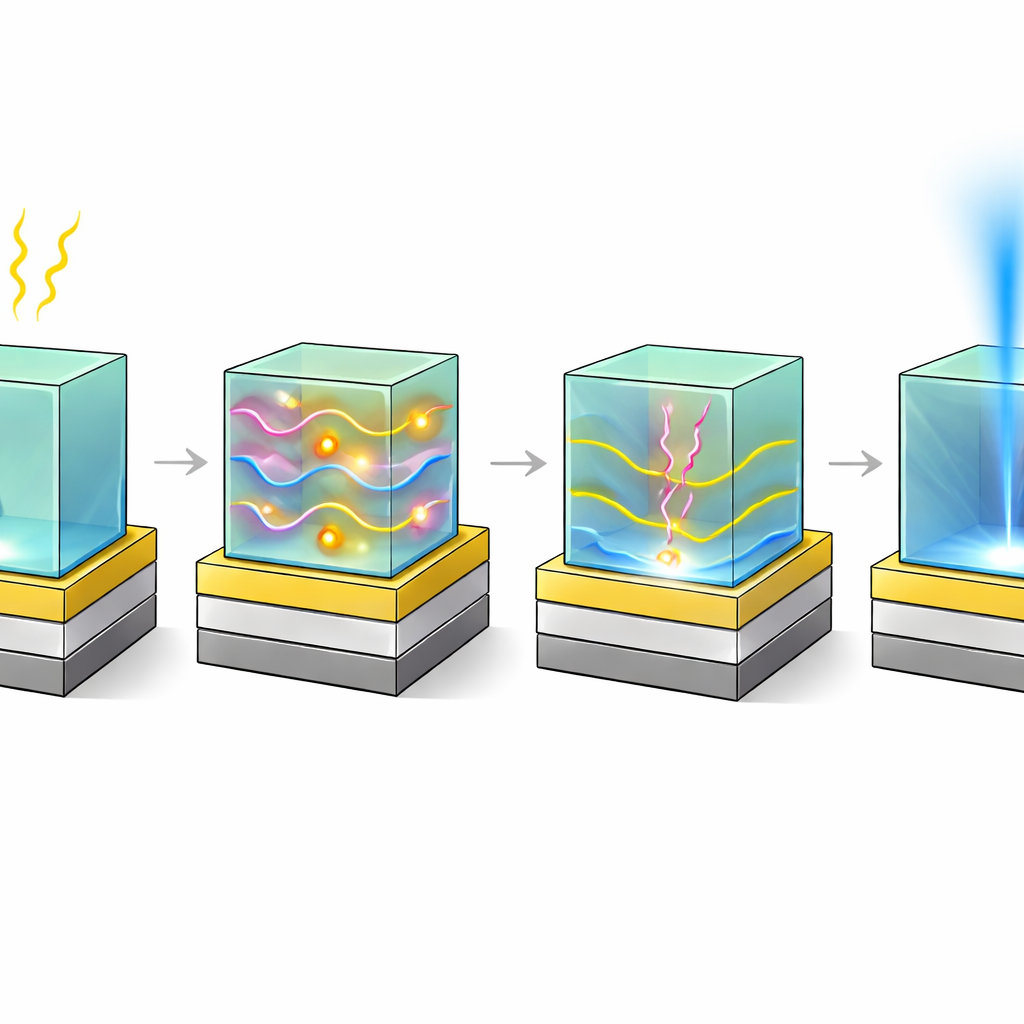
To understand how these nanocuboids emit light, the team cools them down in a nitrogen cryostat and excites them with ultrashort laser pulses at 395 nanometers. At higher temperatures the crystals show a single, smooth glow peak near 413 nanometers, in line with earlier studies. As the temperature drops below about 140 kelvin, this simple peak splits into several narrower features. This fingerprint reveals that the material’s bound electron–hole pairs, known as excitons, are interacting strongly with optical resonances trapped inside the tiny crystal, a family of patterns called Mie modes. The strong interaction creates mixed light–matter states called polaritons, and the emission pattern reflects these new states rather than a simple exciton line.
From Glow to Polaritonic Lasing
The researchers then increase the excitation power and track how the emission evolves. For larger nanocuboids, the glow redistributes toward certain lower‑energy polariton states, and sharp peaks emerge, indicating that some modes begin to dominate. The smallest nanocuboid shows a particularly clean behavior: above a pump level a bit over 10 microjoules per square centimeter at 80 kelvin, a single spectral peak suddenly intensifies and narrows to a very small linewidth, signaling the onset of lasing. Detailed analysis using a theoretical framework based on quasinormal optical modes and rate equations shows that this lasing does not require ordinary population inversion. Instead, excitons feed a ladder of discrete polariton states, which preferentially funnel into the lowest state through scattering with lattice vibrations, leading to a coherent burst of blue light from a mode with relatively modest intrinsic quality but extremely tight spatial confinement.
What This Means for Future Devices
In plain terms, the study demonstrates a nanolaser that is both deeply subwavelength and capable of blue emission, operating through a polariton‑based mechanism enhanced by a metallic mirror beneath the crystal. Although the devices currently work at low temperature because excitons in this material break apart more easily when heated, the concept points toward on‑chip light sources that are smaller than ever before and that bypass some of the usual limits of laser physics. With further improvements in perovskite materials and stronger light–matter coupling, similar designs could help power ultra‑dense displays, integrated photonic circuits, and quantum technologies that rely on compact, coherent sources of visible light.
Citation: Khmelevskaia, D., Solodovchenko, N., Sapozhnikova, E. et al. Deeply subwavelength blue-range nanolaser. npj Nanophoton. 3, 21 (2026). https://doi.org/10.1038/s44310-026-00111-x
Keywords: blue nanolasers, perovskite nanophotonics, exciton polaritons, subwavelength lasers, photonic chips