Clear Sky Science · en
Fano resonance and photoluminescence enhancement in WS2-integrated topological insulator metasurfaces
Lighting Up the Smallest Spaces
Modern technologies from ultrafast communications to quantum computers rely on controlling light in spaces far smaller than the width of a human hair. This study shows how a special combination of two advanced materials can dramatically boost light emission on such tiny scales, hinting at more efficient light sources and compact optical chips for future devices.
Two Unusual Materials Working Together
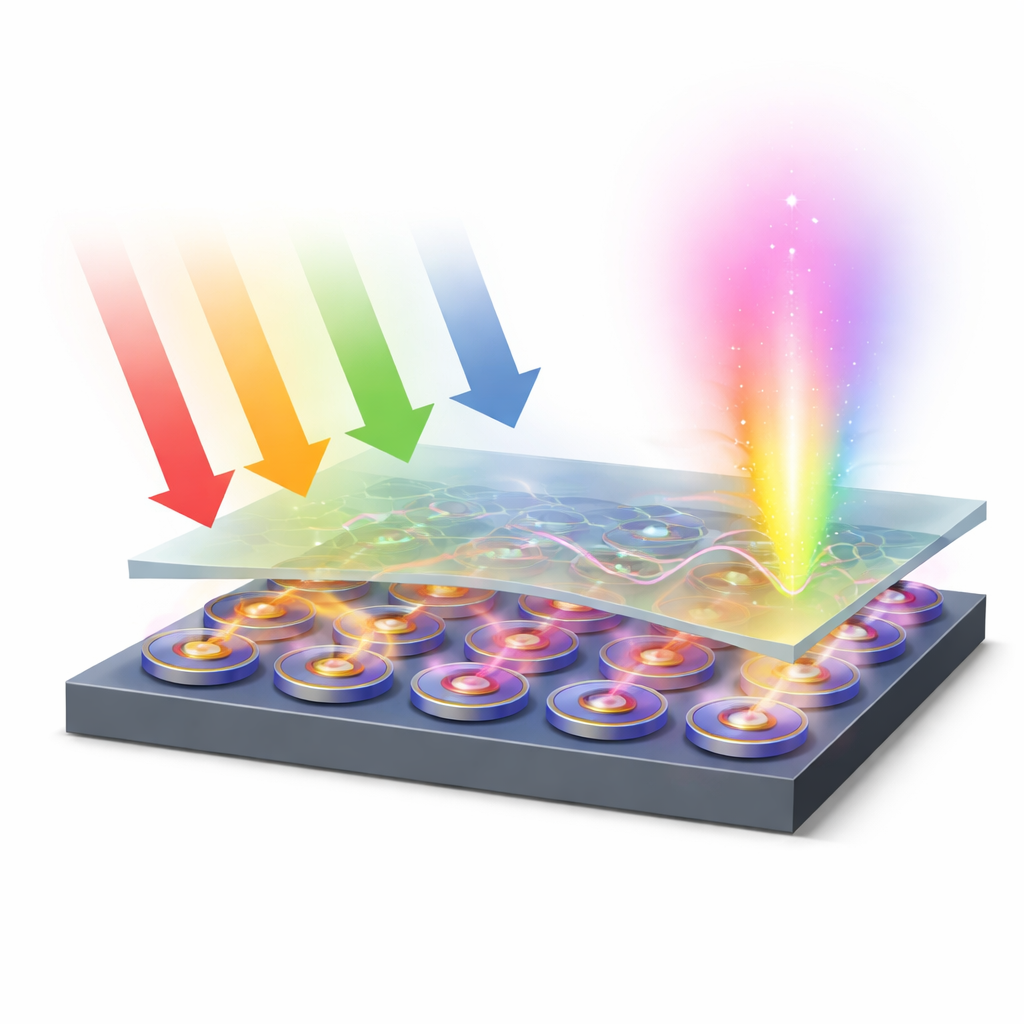
The researchers combine two kinds of cutting-edge materials. The first is a topological insulator made of antimony telluride (Sb2Te3). Although it behaves like an electrical insulator inside, its surface can conduct and support ripples of electrons driven by light, known as surface plasmons. The second material is tungsten disulfide (WS2), a sheet only a few atoms thick that strongly absorbs and emits visible light through particles called excitons, which are bound pairs of electrons and holes. By stacking WS2 on top of carefully patterned Sb2Te3, the team aims to make the light waves in one talk to the excitons in the other.
Carving Nanoscale Wells to Catch Light
To control how light behaves on the topological insulator, the team uses a focused ion beam to carve a regular grid of tiny cylindrical wells into a thin Sb2Te3 flake, creating what is known as a metasurface. Each well is only hundreds of nanometers across, much smaller than the wavelength of visible light. When the structure is illuminated, these wells trap and scatter light in a way that excites surface plasmons. Measurements show clear resonance peaks in the scattered light, and by changing the depth and spacing of the wells, the team can slide these resonances toward longer wavelengths. This tunability allows them to align the plasmon response with the natural color at which WS2 excitons absorb and emit.
Watching Plasmons and Excitons Interfere
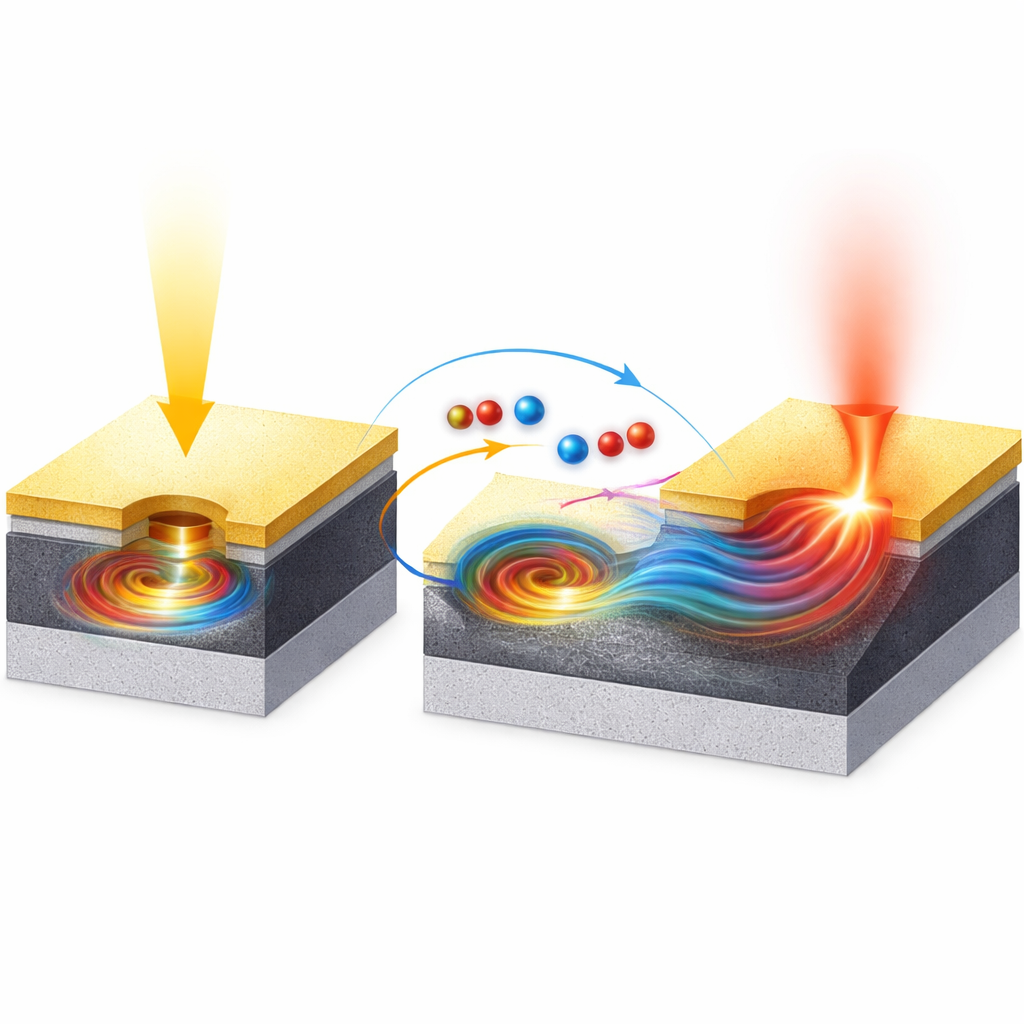
Next, the researchers transfer atomically thin WS2 layers onto the patterned Sb2Te3 surface so that the excitons in WS2 sit directly above the plasmonic wells. When they probe the combined structure, the scattered light no longer shows a simple peaked curve. Instead, it develops an asymmetric shape called a Fano resonance, a hallmark of interference between a broad background (the plasmons in the wells) and a sharp feature (the WS2 excitons). By modeling the system as two coupled oscillators—much like two pendulums linked by a spring—they extract how strongly the plasmons and excitons interact. For a single WS2 layer, the coupling strength is modest, placing the system in a so-called weak-coupling regime; for three WS2 layers, the interaction grows stronger but still remains below the threshold for fully hybrid light–matter states.
Making Atom-Thin Layers Glow Brighter
Even in this weak-coupling regime, the metasurface has a powerful effect on how brightly WS2 glows. When the team measures the photoluminescence—the light re-emitted after laser excitation—they find that WS2 on the patterned Sb2Te3 is vastly brighter than WS2 on a flat Sb2Te3 film. A monolayer shows about 15 times stronger emission, while a three-layer sample glows roughly 25 times more intensely. The emission color also shifts slightly toward the red, which the authors attribute to extra electrons supplied by the plasmonic structure and to tiny strains in the WS2 film. These changes increase the share of charged exciton species that emit at longer wavelengths.
Steps Toward Smarter Light Chips
In simple terms, this work shows that topological insulators, once known mainly for exotic electronic behavior, can act as effective, tunable platforms for boosting light emission when paired with ultrathin semiconductors. By proving that plasmon–exciton coupling and Fano resonances can be engineered in a fully nonmetallic system, and that this coupling can greatly enhance the glow from atom-thin WS2, the study points toward compact, energy-efficient light sources and sensors that could be built directly onto photonic chips.
Citation: Lu, H., Li, D., Li, Y. et al. Fano resonance and photoluminescence enhancement in WS2-integrated topological insulator metasurfaces. npj Nanophoton. 3, 16 (2026). https://doi.org/10.1038/s44310-026-00110-y
Keywords: plasmon-exciton coupling, topological insulator, WS2 monolayer, nanophotonics, photoluminescence enhancement