Clear Sky Science · en
Electro-optic frequency comb generation in lithium niobate photonic crystal Fabry–Pérot micro-resonator
Light Rulers on a Tiny Chip
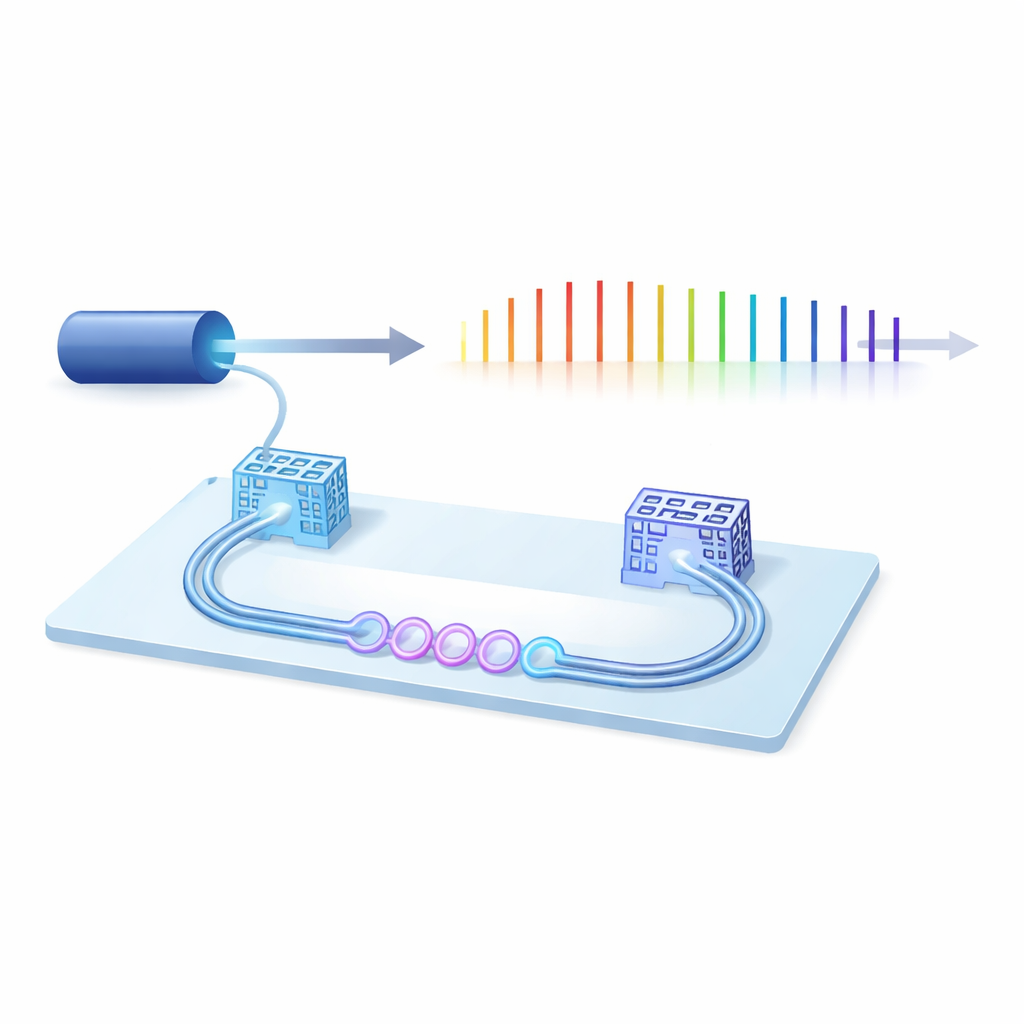
Modern technologies like high-speed internet, laser ranging, and ultra-precise clocks all rely on “light rulers” that divide a laser’s color into many evenly spaced lines, known as optical frequency combs. This paper reports a new way to build such combs on a chip using a specially sculpted piece of lithium niobate, creating a compact, stable, and tunable light source that avoids a common form of noise and power loss. For non-specialists, this work matters because it helps shrink lab-grade precision tools into devices that could one day live in communication networks, sensors, and even consumer electronics.
Why We Need Better Light Combs
Optical frequency combs act like finely spaced tick marks along the spectrum of light, allowing scientists and engineers to measure colors and signals with extraordinary accuracy. Traditional combs often rely on bulky lasers or nonlinear optical effects that can be finicky and sensitive to temperature. Electro-optic combs, which use an electrical signal to carve sidebands around a laser, promise simpler control, low noise, and direct connection to microwave electronics. However, when these combs are built on chips, they run into major hurdles: the electrical modulation can be too weak, unwanted scattering processes can steal energy, and it is hard to cover a wide range of colors without making the device large and complicated.
Sculpting Light Paths with Tiny Mirrors
The authors tackle these issues using a structure called a photonic crystal Fabry–Pérot micro-resonator made from thin-film lithium niobate. In simple terms, they etch a U-shaped waveguide on a chip and place finely patterned “crystal-like” mirrors at its ends. Light from a continuous-wave laser enters through one mirror, bounces back and forth between the two, and forms standing waves along the path. By shaping the microscopic pattern of these mirrors, the team defines a narrow “safe window” of wavelengths where light is strongly trapped and cleanly reflected, while colors outside this window quickly leak out. This controlled window forms a band where hundreds of resonant modes exist with extremely low loss, all within a compact footprint.
Turning Microwaves into a Comb of Colors
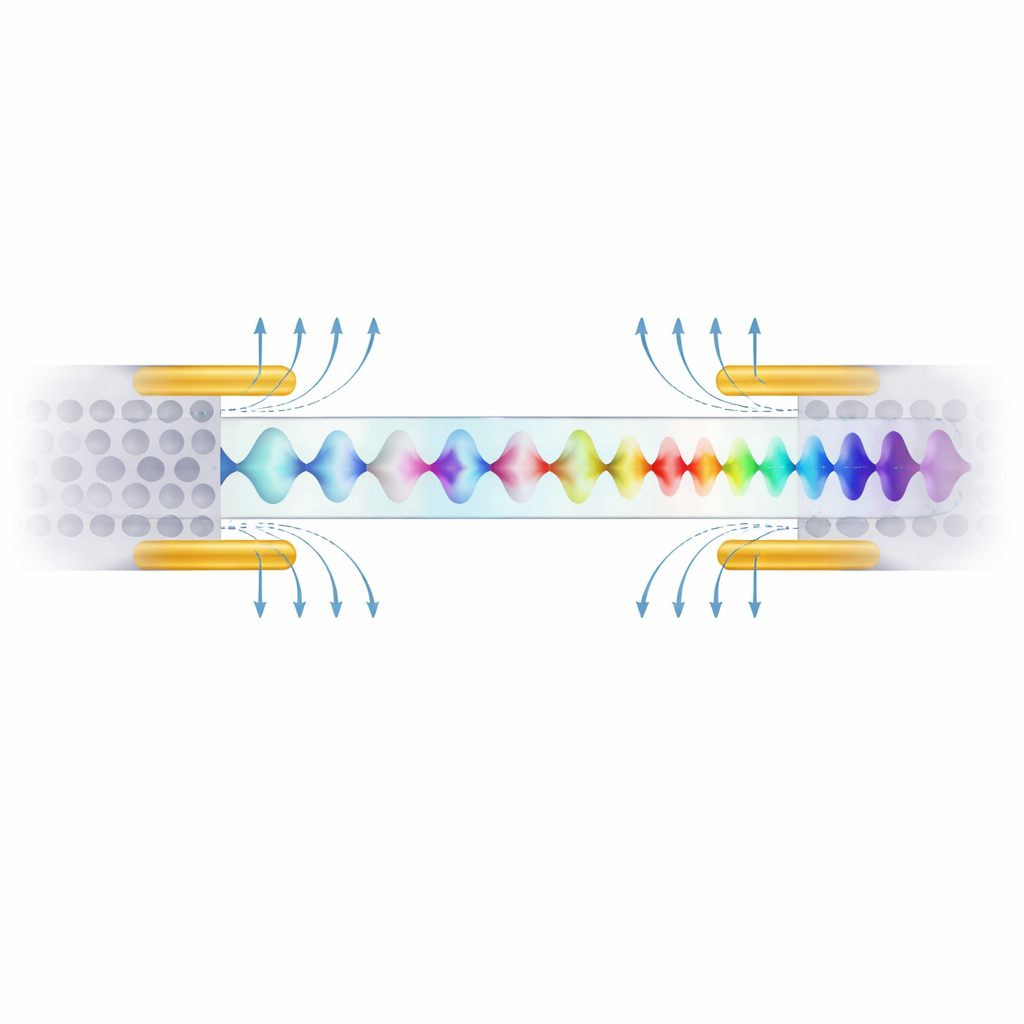
Next, the researchers place electrodes near the waveguide so that a microwave signal can modulate the trapped light. When the microwave frequency is carefully matched to the spacing between the resonant modes, the modulation causes light to hop step-by-step from one mode to the next, building up a regularly spaced frequency comb. The mirror design does more than just reflect: it also subtly adjusts how the spacing between modes changes with wavelength. This shaping naturally creates a “sweet spot” where the mode spacing is nearly uniform, allowing the comb to grow broadly and efficiently without extra compensation structures. Experiments show that by tuning the microwave power, microwave frequency, and laser wavelength, the comb’s width and shape can be actively reconfigured, in good agreement with theoretical models.
Blocking a Hidden Thief of Power
A major innovation of this work is how it suppresses stimulated Raman scattering, a process where intense light inside the cavity can be converted into a different color and random noise vibrations, degrading the comb’s quality. Instead of trying to fight this effect with delicate tuning tricks, the team simply designs their photonic crystal mirrors so that the troublesome Raman wavelengths never see a high-quality cavity in the first place. Within the chosen band, the resonator quality factor is above a million, but it drops sharply for wavelengths where Raman scattering would normally grow. Even when the on-chip laser power is increased to 200 milliwatts—high for such a device—no Raman peak appears, meaning this “light thief” is effectively locked out.
What This Means Going Forward
In everyday terms, the researchers have built a tiny, programmable light ruler on a chip that uses electricity to split a laser into many evenly spaced colors, while cleverly walling off a major source of noise. Their design shows that by sculpting how light is reflected and slowed inside the chip, it is possible to get high power, good stability, and clean operation all at once. Looking ahead, the same design rules—improving the mirror and waveguide quality, strengthening the electrical interaction, and placing the “sweet spot” at different wavelengths—could yield broader, quieter combs. Such sources are promising building blocks for future communication systems, precision measurement tools, and quantum photonic circuits, all in a form factor small enough to integrate with other chip-based technologies.
Citation: Hwang, H., Go, S., Kim, G. et al. Electro-optic frequency comb generation in lithium niobate photonic crystal Fabry–Pérot micro-resonator. npj Nanophoton. 3, 15 (2026). https://doi.org/10.1038/s44310-026-00109-5
Keywords: optical frequency combs, lithium niobate photonics, electro-optic modulation, photonic crystal resonators, integrated photonics