Clear Sky Science · en
Observation of Goos-Hänchen Shift under Normal Incidence in Slanted TiO2 Nanogratings
Light That Slides Sideways
When a flashlight beam hits a mirror or a window, we expect it to bounce straight back or pass straight through. But at very small scales, light can behave in subtler ways: a reflected or transmitted beam can actually slide sideways by many wavelengths before emerging. This study shows how to make that sideways slip happen in a dramatic way, even when light hits a surface head-on, using carefully sculpted rows of titanium dioxide at the nanoscale. Such control over tiny beam shifts could be useful for building compact optical switches and sensors inside future chips.
Why Light Can Miss the Spot
The sideways displacement of a light beam at a surface is called the Goos–Hänchen shift, named after the scientists who first measured it. In everyday materials, this shift is tiny—about the size of a wavelength of light—so it is hard to detect and not very practical. Earlier work showed that special “metasurfaces,” which are engineered patterns smaller than the wavelength, can amplify this effect by forcing light to resonate strongly as it reflects or passes through. However, almost all previous demonstrations needed the light to arrive at a slant, not straight on, because a tilted beam naturally breaks the mirror symmetry of the surface and allows the shift to appear.
Tilting the Structure, Not the Beam
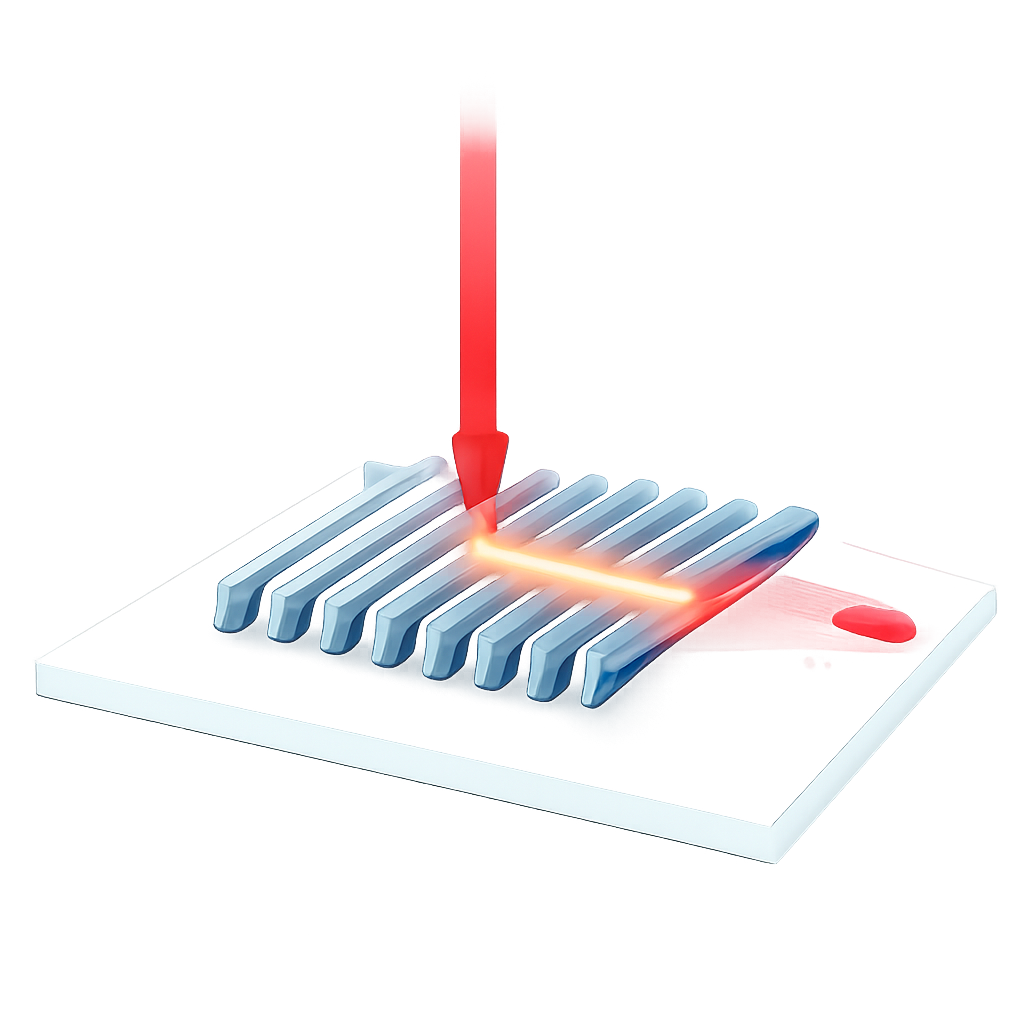
The authors of this paper turned the problem around: instead of tilting the incoming beam, they tilted the structure itself. They designed a one-dimensional grating made of titanium dioxide, a transparent, high-index material widely used in optics. The grating consists of parallel ridges with a period slightly smaller than the wavelength of red light. When the ridges are perfectly vertical, the pattern is mirror-symmetric and can trap certain light waves in special “bound” modes that do not radiate out. By introducing a small slant to the ridges, they gently break this symmetry. The trapped modes then leak just enough to interact strongly with passing light, producing an extremely sharp resonance where the transmission almost reaches 100 percent while the phase of the light changes very steeply with direction.
From Hidden Energy Flows to Giant Shifts
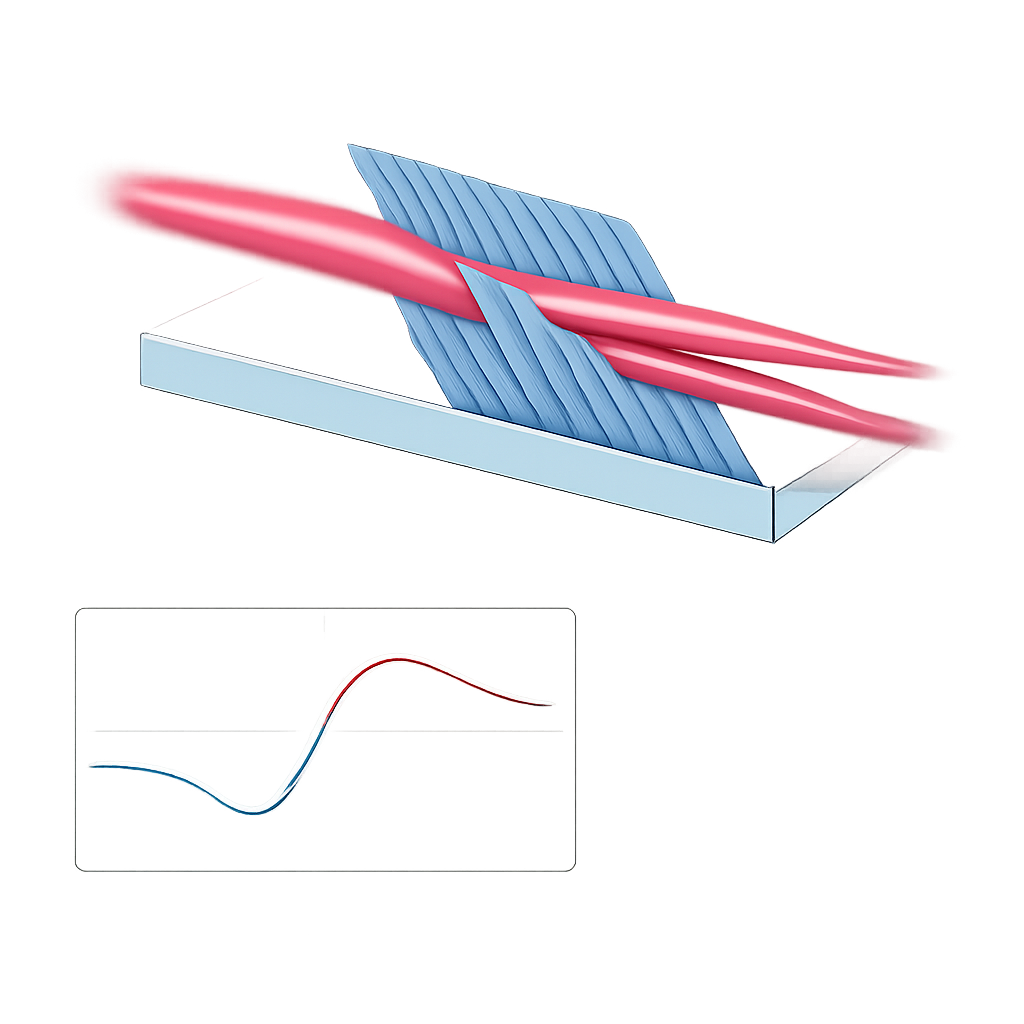
Through detailed computer simulations, the team showed that this symmetry breaking creates strong sideways energy flows inside the grating, even when the incoming beam points straight at it. At wavelengths near a resonance around 780 nanometers, the lateral energy flow becomes dominant and the calculated Goos–Hänchen shift can reach hundreds of wavelengths—far larger than in ordinary interfaces. Simulating a realistic light beam with a finite width, they found that the transmitted beam could split or flip its shift direction over fractions of a nanometer in wavelength, a direct signature of the sharp underlying resonance created by the slanted nanogratings.
Carving Nanoscopic Ramps
To turn the design into reality, the researchers developed a precise fabrication process based on reactive ion beam etching. Starting from a flat quartz wafer coated with a thin titanium dioxide film and a metal mask, they used electron-beam lithography to define the grating pattern and then etched the ridges while the sample was held at a controlled angle. By carefully balancing chemical and physical etching, they achieved smooth, uniformly slanted sidewalls without resorting to custom molds for each angle. Measurements on many points across the sample showed that the period, width, height, and slant angle matched the design to within about one percent, indicating highly reproducible nanostructures over large areas.
Seeing the Beam Slide
To observe the sideways shift experimentally, the team first confirmed, via angle-resolved reflection measurements, that the slanted gratings support the predicted sharp resonances that appear only when the ridges are tilted. They then built a light-field setup in which arrays of small holes produced narrow, nearly parallel beams that passed through either a plain titanium dioxide film or the patterned, slanted grating. At off-resonant wavelengths, the output spots from both samples coincided. But when a bandpass filter singled out light near 780 nanometers, the spot emerging from the slanted grating was displaced sideways by about five micrometers relative to the reference film—clear evidence of a normal-incidence Goos–Hänchen shift. The measured shift was smaller than idealized simulations predicted, likely because the light source had a finite spectral width and the real structures deviated slightly from perfect geometry.
New Ways to Steer Light on a Chip
In simple terms, this work shows that you can steer a beam of light sideways without tilting the beam itself—just by sculpting the surface it passes through into tiny, slanted ridges. The authors demonstrate both the design principles and a practical manufacturing route for such structures, and they directly measure the resulting beam shift. This kind of control opens up new possibilities for building flat, alignment-free optical elements that nudge light beams by controlled amounts, enabling compact beam-steering devices, on-chip sensors, and more versatile nanophotonic circuits.
Citation: Ji, X., Wang, B., Pan, R. et al. Observation of Goos-Hänchen Shift under Normal Incidence in Slanted TiO2 Nanogratings. npj Nanophoton. 3, 12 (2026). https://doi.org/10.1038/s44310-026-00108-6
Keywords: Goos-Hänchen shift, slanted nanogratings, metasurfaces, beam steering, nanophotonics