Clear Sky Science · en
Simplified aluminum nitride processing for low-loss integrated photonics and nonlinear optics
Light on a Chip Made Easier
Our phones, the internet, and even future quantum computers increasingly rely on tiny circuits that guide light instead of electricity. This article describes a new, simpler way to build such light-guiding circuits from aluminum nitride, a tough, crystal-clear material that can bend, mix, and multiply colors of light in powerful ways. By streamlining how these structures are made, the work brings advanced optical technologies closer to real-world devices that are cheaper, more reliable, and easier to scale up.
Why This Crystal Matters
Aluminum nitride is attractive for photonic chips because it combines several useful traits in one material. It is transparent over a wide range of colors, from ultraviolet to infrared, conducts heat well, and responds strongly when light or electric fields pass through it. These properties let it convert one color of light into another, rapidly modulate light for data transmission, and even detect infrared radiation. Until now, however, taking full advantage of aluminum nitride on chips has required complicated and delicate fabrication steps, which slow research and increase cost.
A Simpler Way to Carve Light Paths
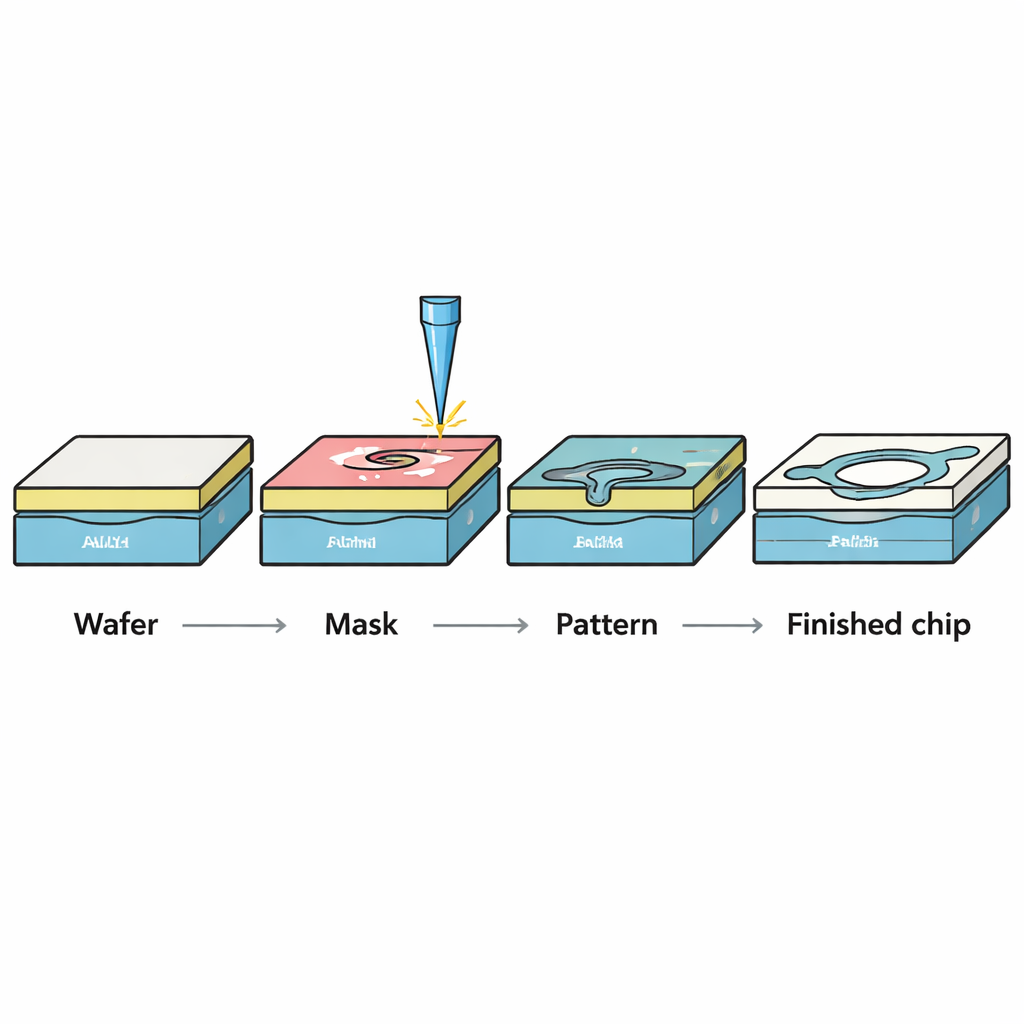
The researchers developed a cleaner and more compact recipe for carving tiny ring-shaped light circuits, called microresonators, into aluminum nitride. Traditional methods needed several hard protective layers and a metal coating to handle the harsh etching process and to prevent electrical charging during pattern writing. In contrast, the new approach relies on only one thin layer of silicon nitride as a hard mask, plus a temporary, electrically conductive polymer on top of the photoresist. This polymer quietly does its job during pattern exposure and then dissolves away in the standard development step, so no extra removal process is necessary.
From Flat Wafer to Precision Ring
Starting from a commercially grown aluminum nitride film on a sapphire crystal, the team first coats the surface with the silicon nitride mask, then the photoresist and conductive layer. Using a focused electron beam, they write the desired ring and waveguide shapes, transfer this pattern into the mask, and then use a carefully tuned plasma of chlorine-based gases to etch deeply into the aluminum nitride. Thanks to the strong resistance of the mask, they can remove about 800 nanometers of material while consuming only a fraction of the mask thickness, achieving an etch selectivity of about four to one. Microscopic images show smooth, well-defined sidewalls, and simulations confirm that any ultra-thin silicon nitride left on top does not disturb how light is confined or dispersed inside the rings.
Testing How Well Light Circulates
To judge how good these tiny racetracks for light really are, the authors send a carefully controlled laser beam through a bus waveguide that couples to the rings and measure how sharply the resonances appear. From these measurements they derive the quality factor, a number that indicates how long light can circulate before fading away. Their devices reach intrinsic quality factors of about one million, corresponding to very low loss as light travels around the ring. They also confirm that the rings operate in a dispersion regime that is favorable for forming ultra-short light pulses, called solitons, an important condition for many advanced optical functions.
Turning One Color into a Whole Spectrum
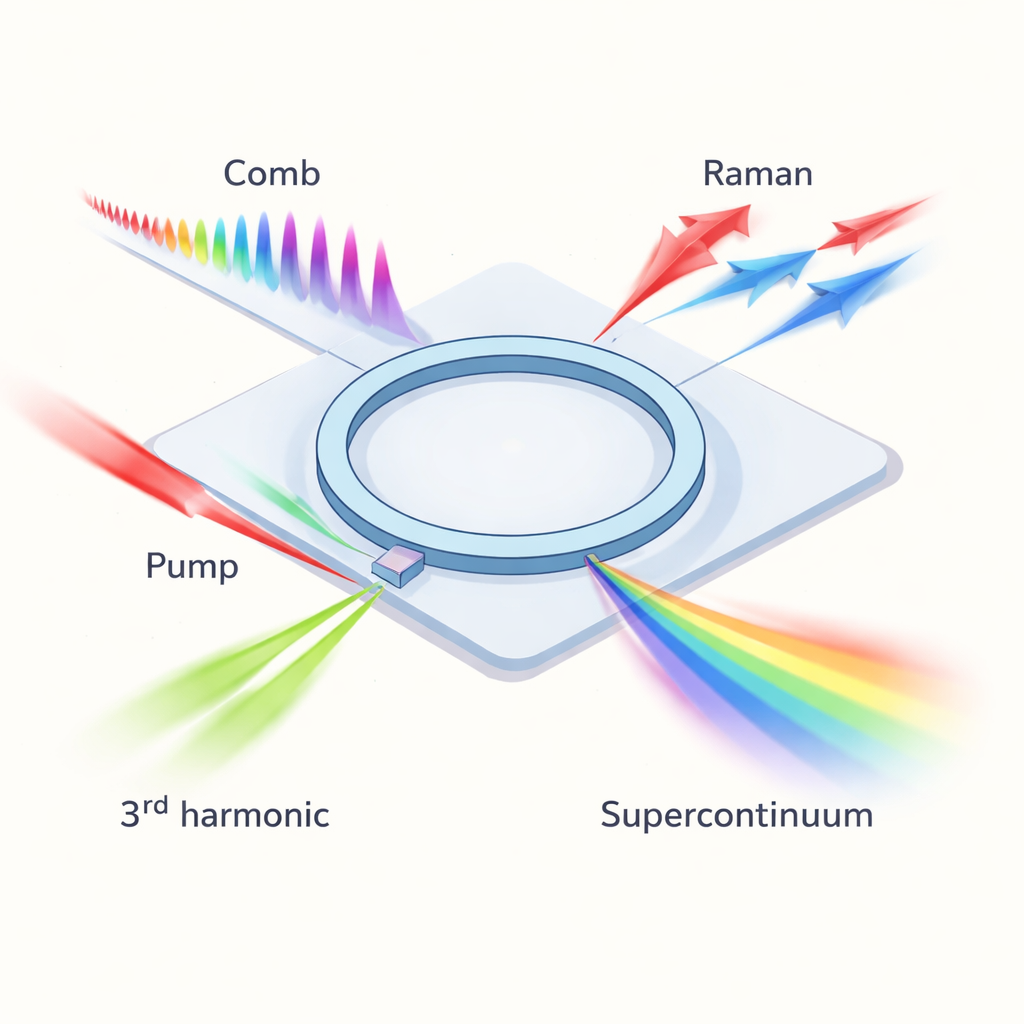
With low loss and the right dispersion, the same chip can host a variety of nonlinear optical effects, where intense light reshapes itself and generates new colors. When the team pumps a ring with strong infrared light, it produces an evenly spaced "comb" of new frequencies suitable for precision timing and spectroscopy. They also observe Raman lasing, where light interacts with vibrations in the crystal to generate shifted colors; third-harmonic generation, which converts infrared light into bright green; and supercontinuum generation, where ultrashort pulses expand into a smooth spectrum stretching from visible to mid-infrared wavelengths. These demonstrations show that the simplified process does not sacrifice performance; instead, it unlocks a highly versatile light toolbox on a single chip.
What This Means Going Forward
In everyday terms, the researchers have found a way to machine aluminum nitride chips that is both simpler and gentler, while still producing exceptionally clean optical circuits. This method avoids metal masks and extra heating steps, yet delivers long-lived light storage and a rich set of color-converting effects. Because the same recipe can be extended to thicker structures for mid-infrared light, it paves the way for compact devices that handle everything from high-speed communications and precision clocks to chemical sensing and quantum technologies, all built on a robust and scalable platform.
Citation: Yan, H., Zhang, S., Pal, A. et al. Simplified aluminum nitride processing for low-loss integrated photonics and nonlinear optics. npj Nanophoton. 3, 13 (2026). https://doi.org/10.1038/s44310-026-00107-7
Keywords: integrated photonics, aluminum nitride, nonlinear optics, frequency combs, photonic chips