Clear Sky Science · en
Maximum Shannon capacity of photonic structures
Why shaping light pathways matters
Every phone call, streamed movie, and cloud computation depends on how efficiently we can push information through electromagnetic waves—light and radio. Engineers usually treat the environment those waves travel through as fixed: air, fiber, or a simple antenna. This article asks a deeper question: if we are free not only to design transmitters and receivers, but also to sculpt the entire electromagnetic landscape around them, how much more information can we squeeze through a given patch of space and frequency band? The answer could guide future designs of ultra-fast wireless links, on-chip optical interconnects, and smart imaging systems.
From Morse code to modern information limits
The story begins with Claude Shannon’s mid-20th-century theory, which showed how to calculate the maximum error-free data rate—now called Shannon capacity—through a noisy communication channel. Classic formulas work well for simple situations, like a single radio link or a fiber optic cable, where the channel is already defined. They also extend to more complex multiple-antenna (MIMO) systems that send several data streams at once using spatial patterns of waves. In all of these cases, however, the environment that shapes the waves is largely taken as given, and the task is to allocate power across pre-existing channels. The new work instead treats the environment itself as something we can engineer for optimal information flow.
Recasting communication in terms of fields and materials
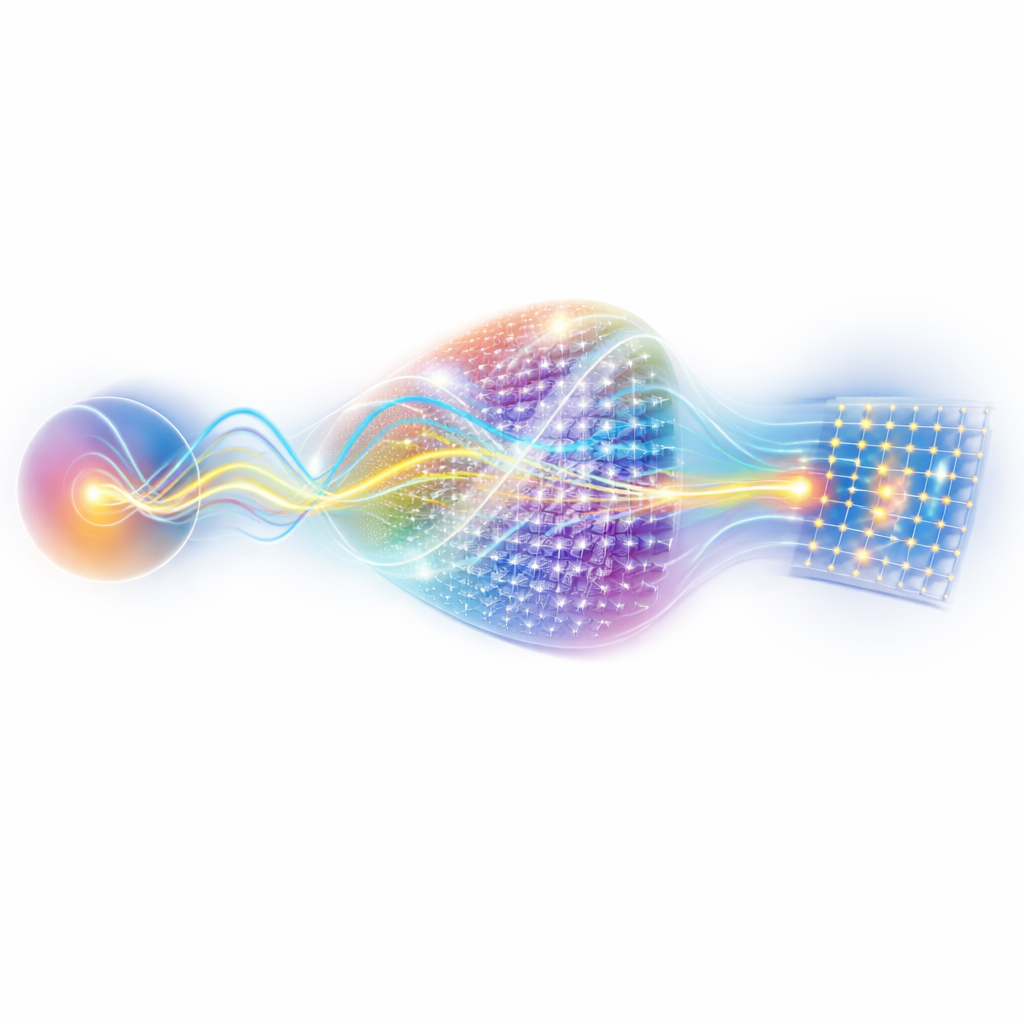
The authors build a bridge between information theory and Maxwell’s equations, which govern electromagnetic waves. In their framework, an input “signal” is a pattern of electric current in a sender region, and the output is the electric field measured in a receiver region. Between them lies a photonic structure—anything from a flat metasurface to a network of waveguides—described by its spatially varying permittivity. The central question becomes: over all possible patterns of material and all allowed input signals (subject to a power budget), what design yields the highest Shannon capacity? Mathematically this gives a highly non-linear optimization problem, because altering the structure changes the wave propagation in a complicated way.
Turning a hard physics problem into manageable optimization
Solving this problem directly would be intractable for realistic devices. The authors therefore introduce clever relaxations that preserve the essential physics while making the math workable. One strategy rewrites the problem as an optimization over joint probability distributions of source currents and the currents induced inside the structure. Instead of enforcing Maxwell’s equations exactly at every point, they impose averaged energy-conservation constraints derived from Poynting’s theorem—essentially, statements that energy cannot magically appear or disappear in each region. This step transforms the original problem into a convex program, which has a single global optimum and can be attacked with modern numerical tools, yielding rigorous upper bounds on capacity that hold for any possible structure consistent with basic physics.

Insights on where and how to engineer the hardware
With this machinery in place, the authors explore simplified two-dimensional setups that mimic real devices. They study arrangements with a sender, a receiver, and an intermediate “mediator” region that can be filled with engineered material. The bounds reveal several practical lessons. First, shaping the receiver region often matters far more than shaping the sender: intelligently concentrating fields at the detector can boost capacity by more than an order of magnitude. Second, they identify a class of non-radiating “dark currents” that create strong, localized (evanescent) fields. These currents do not cost radiated power but can still be picked up at close range, leading to a slow, logarithmic growth of capacity as the internal resistance of the drive circuitry shrinks. Third, in regimes where drive power is dominated by this internal cost rather than by radiation, the problem simplifies to distributing power among a finite number of effective channels. The authors derive closed-form formulas that say how many channels should be used and how strongly, as a function of signal-to-noise ratio.
What this means for future light-based technologies
In everyday terms, this work establishes theoretical speed limits for any device that moves information with light or radio waves, once we are allowed to design the surrounding structure as cleverly as possible. It shows that there is a finite, physics-enforced ceiling on how much capacity we can gain by nanostructuring materials, but also that well-designed receivers and mediators can come surprisingly close to those limits. The framework can inform the design of next-generation antennas, on-chip optical links, and metasurface imagers, and it suggests new inverse-design algorithms that optimize for information throughput rather than just field strength. Although the paper focuses on single frequencies and simplified geometries, its methods can be extended to three dimensions, broadband operation, and even quantum communication, offering a roadmap for engineering photonic hardware that approaches the ultimate information-carrying potential of light.
Citation: Amaolo, A., Chao, P., Strekha, B. et al. Maximum Shannon capacity of photonic structures. npj Nanophoton. 3, 14 (2026). https://doi.org/10.1038/s44310-025-00104-2
Keywords: Shannon capacity, nanophotonics, MIMO, metasurfaces, optical communication