Clear Sky Science · en
Skyrmion quantum diode prototype: bridging micromagnetic simulations and quantum models
Why tiny magnetic whirlpools matter for future computers
Quantum computers promise breathtaking speedups, but today’s devices are fragile and hard to scale. Signals can leak backward, disturb neighboring qubits, and demand bulky hardware just to keep noise at bay. This paper explores an unusual solution: using nanoscopic magnetic whirlpools, called skyrmions, to act as one-way valves for quantum information. By combining detailed simulations of these magnetic structures with simplified quantum models, the authors sketch a blueprint for “skyrmion quantum diodes” that could help make quantum machines more robust, compact, and energy‑efficient.
Tiny whirlpools that carry information
Skyrmions are swirling patterns of magnetization in a solid—tiny whirlpools of spins that behave like particles. Because of their special topology, they are remarkably hard to destroy or distort, even when defects or noise are present. That robustness makes them attractive as information carriers. Experiments have already seen skyrmions as small as a few nanometers across, and theory suggests that some internal features of a skyrmion can behave like a quantum two-level system, similar to a qubit. In particular, the way spins wind around the core—their “twist angle,” or helicity—can form a pair of quantum states that can be controlled by electric and magnetic fields.
Building a one-way magnetic highway
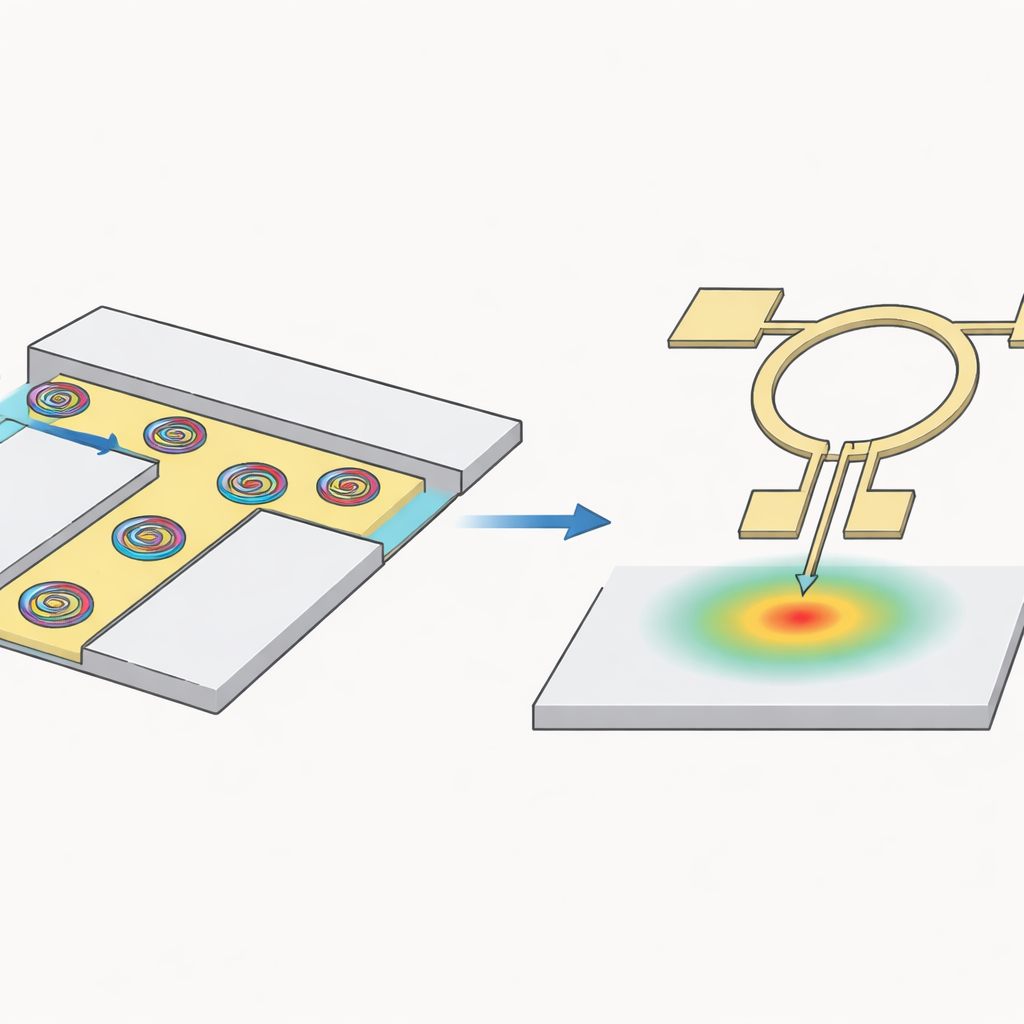
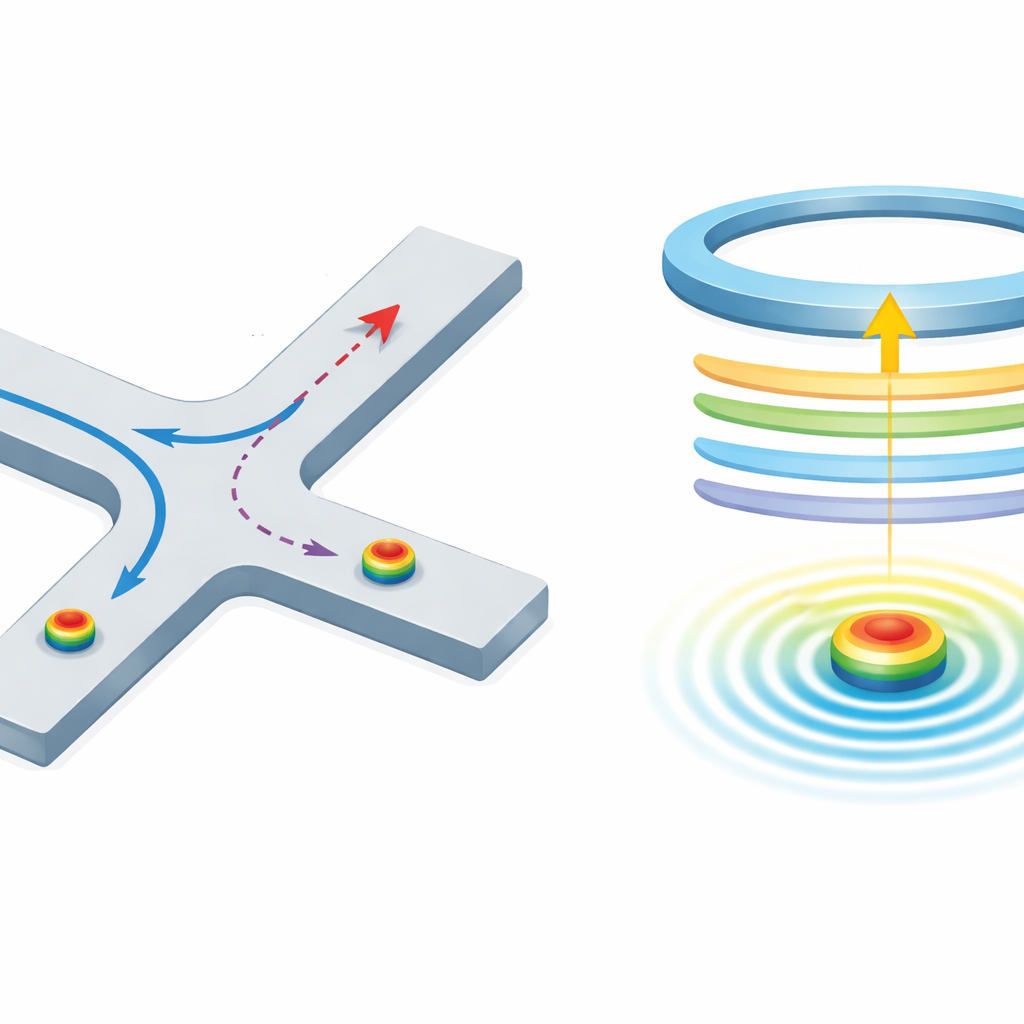
The authors first treat skyrmions in a purely classical way and ask: can we make a nanoscale structure that lets them pass only in one direction, like an electrical diode does for current? Using micromagnetic simulations, they design an asymmetric T-shaped track on a thin magnetic film. When a current drives a skyrmion along this track, a sideways push known as the skyrmion Hall effect bends its path. Thanks to the track’s shape, skyrmions entering from the “forward” side are guided smoothly through the junction, while those approaching from the opposite side are deflected into a narrow region and bounced back. This one-way behavior persists as the skyrmion size is shrunk from about 20 nanometers down to roughly 3 nanometers, with the “yes or no” decision happening in less than a billionth of a second.
From classical motion to quantum behavior
Of course, a quantum diode must do more than steer classical particles; it must shape the evolution of a qubit. To connect the device to quantum information, the authors model a skyrmion qubit as a simple two-level system whose state can lose energy in a directional way, mimicking the one-way transport in the track. In this picture, a tunable parameter captures how strongly the diode favors relaxation in one direction. Simulations based on open quantum system theory show how increasing this “diode efficiency” damps out unwanted oscillations and makes forward and reverse behavior sharply different. Crucially, this asymmetry does not represent a skyrmion being half‑transmitted; instead, it describes mixing between two internal quantum states tied to the skyrmion’s twist, driven by the same underlying chiral features that cause the classical Hall bending.
Sharpening the quantum levels
Another key task for any qubit platform is to keep its main transition well separated from higher energy levels, so that control pulses do not accidentally excite the wrong state. The authors show that the skyrmion diode can help here as well. In a more detailed model, the helicity of a skyrmion behaves like a quantum rotor moving in a periodic landscape with two valleys. The spacing between the lowest few energy levels in this landscape sets how “anharmonic” the qubit is—that is, how easy it is to address one transition without leaking to others. By letting the diode’s efficiency deepen and sharpen the valleys in this landscape, the scheme increases the mismatch between the first and second level spacings. That stronger anharmonicity should improve gate selectivity, readout contrast, and resilience to noise, much like carefully engineered nonlinearity does in today’s superconducting qubits.
Linking magnetic diodes to superconducting chips
To make these ideas practical, the team proposes a concrete hybrid device that marries the skyrmion diode to a widely used superconducting qubit called a transmon. In their design, the diode’s output arm sits directly beneath a small superconducting loop that controls the qubit’s frequency. As a skyrmion moves and gyrates near this loop, its highly localized magnetic field threads a tiny, oscillating flux through the superconducting circuit, gently shifting the qubit’s energy levels or driving controlled interactions. Because the track blocks skyrmions traveling the wrong way, noise and reflections are naturally suppressed. At the same time, the transmon’s frequency can be tuned by external flux to match or detune from the skyrmion’s motion, enabling either strong coupling or quiet, dispersive sensing—all on a compact, chip-scale platform.
What this means for tomorrow’s quantum machines
Taken together, this work does not yet deliver a working quantum component, but it maps out how skyrmions could serve as robust, one-way links between quantum devices. The simulations show that directional skyrmion motion can be engineered down to just a few nanometers and translated into quantum models that enhance level spacing and control over qubit dynamics. By coupling such magnetic diodes to superconducting loops, future processors might route quantum signals without bulky circulators, cut down on wiring and cooling demands, and protect delicate qubits from back‑action. In short, these tiny magnetic whirlpools could become quiet traffic controllers for quantum information, guiding it cleanly through increasingly complex chips.
Citation: Yang, H., Bissell, G., Zhong, H. et al. Skyrmion quantum diode prototype: bridging micromagnetic simulations and quantum models. npj Spintronics 4, 15 (2026). https://doi.org/10.1038/s44306-026-00134-2
Keywords: magnetic skyrmions, quantum diode, superconducting qubits, spintronics, hybrid quantum systems