Clear Sky Science · en
Bound states in the continuum and near-exceptional points in a reflection-based cavity-magnonic system
Turning Microwaves into Well-Behaved Waves
From wireless communication to quantum technologies, many modern devices depend on steering electromagnetic waves with exquisite precision. This paper shows how a tiny, flat microwave circuit can be engineered so that incoming waves are either perfectly trapped, cleanly transmitted, or almost completely absorbed on demand—without using any active amplifiers or bulky three-dimensional cavities. By exploiting subtle interference between light-like waves in a circuit and collective magnetic vibrations in a film, the authors create a compact platform for advanced wave control that could underpin future low-power signal-processing and spin-based computing hardware.
A Flat Lab for Taming Waves
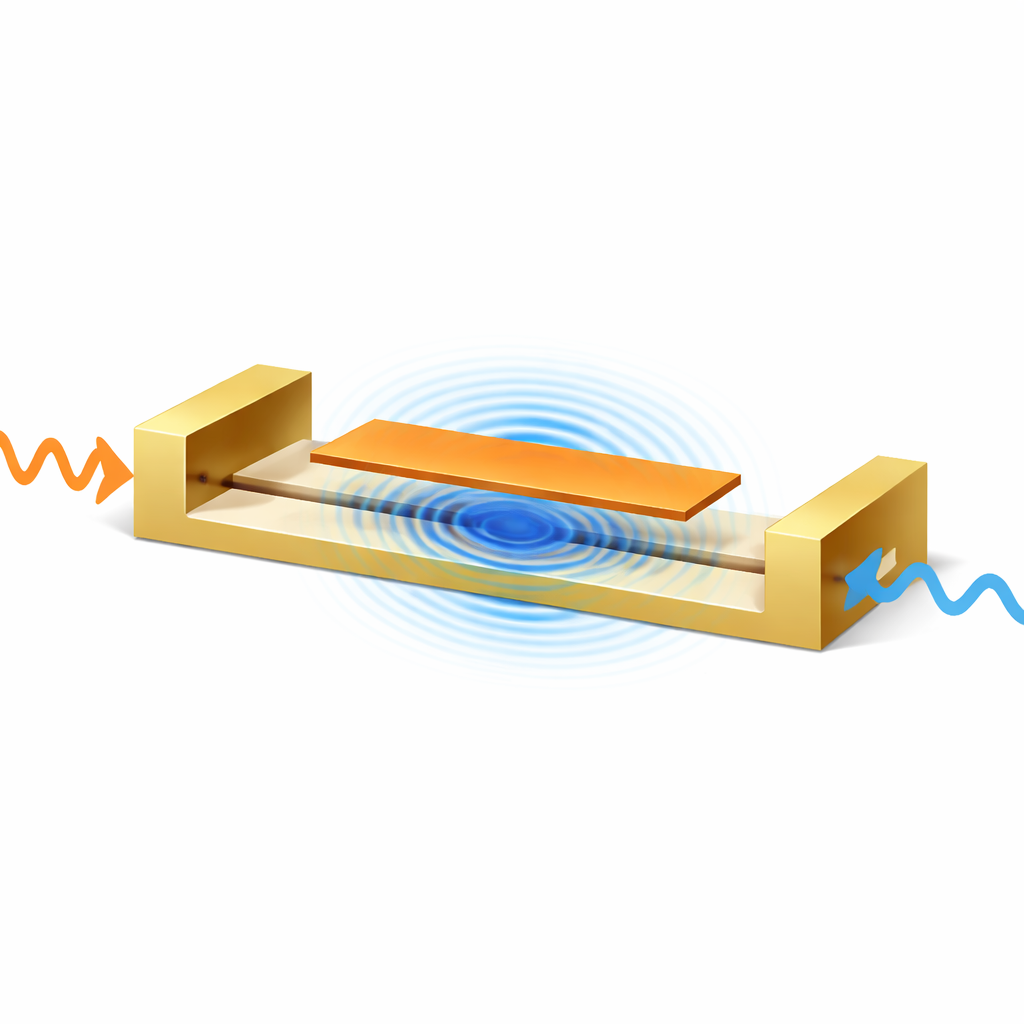
The researchers build a chip-scale structure that acts like a miniature echo chamber for microwaves. Two carefully shaped metallic loops on a flat transmission line serve as partially reflecting mirrors, forming a Fabry–Perot–like cavity where microwaves bounce back and forth. Between these mirrors they place a thin film of yttrium iron garnet (YIG), a magnetic material famous for supporting magnons—ripples in the collective orientation of spins. When microwaves pass through the cavity, they can exchange energy with magnons in the YIG film. By applying an external magnetic field, the team tunes the magnon frequency so that these spin waves interact more or less strongly with the cavity’s photon-like mode.
Hiding Waves in Plain Sight
Under special conditions, the cavity and the magnon system cooperate to create what physicists call a “bound state in the continuum.” In everyday terms, this means that even though the system is connected to open channels where waves could freely escape, a particular hybrid wave pattern remains trapped instead of radiating away. Experimentally, this shows up as a deep dip in the reflected signal—almost no wave bounces back—while the delay experienced by the microwave pulse spikes sharply, indicating that energy lingers inside the device. Using a theoretical framework that treats the cavity and magnon as coupled oscillators with loss and gain-like behavior, the authors show that these special points correspond to modes whose effective damping vanishes: energy circulates without leaking out through reflection.
Balancing Loss and Coupling
A key ingredient is that the two ends of the cavity do not behave identically. Because the mirrors and traveling waves are arranged asymmetrically, microwaves entering from one side “load” the cavity differently than those entering from the other. This creates direction-dependent effective damping and coupling strengths. In this non-uniform environment, the photonic mode in the cavity and the magnon mode in the YIG film can act like a paired system where one side effectively supplies energy and the other removes it, even though the overall device is entirely passive. By carefully choosing the geometry and magnetic tuning, the researchers bring this pair close to a special balance point where the hybrid modes share the same frequency and their loss properties coalesce—a situation known as approaching an exceptional point.
One-Way Perfect Absorption
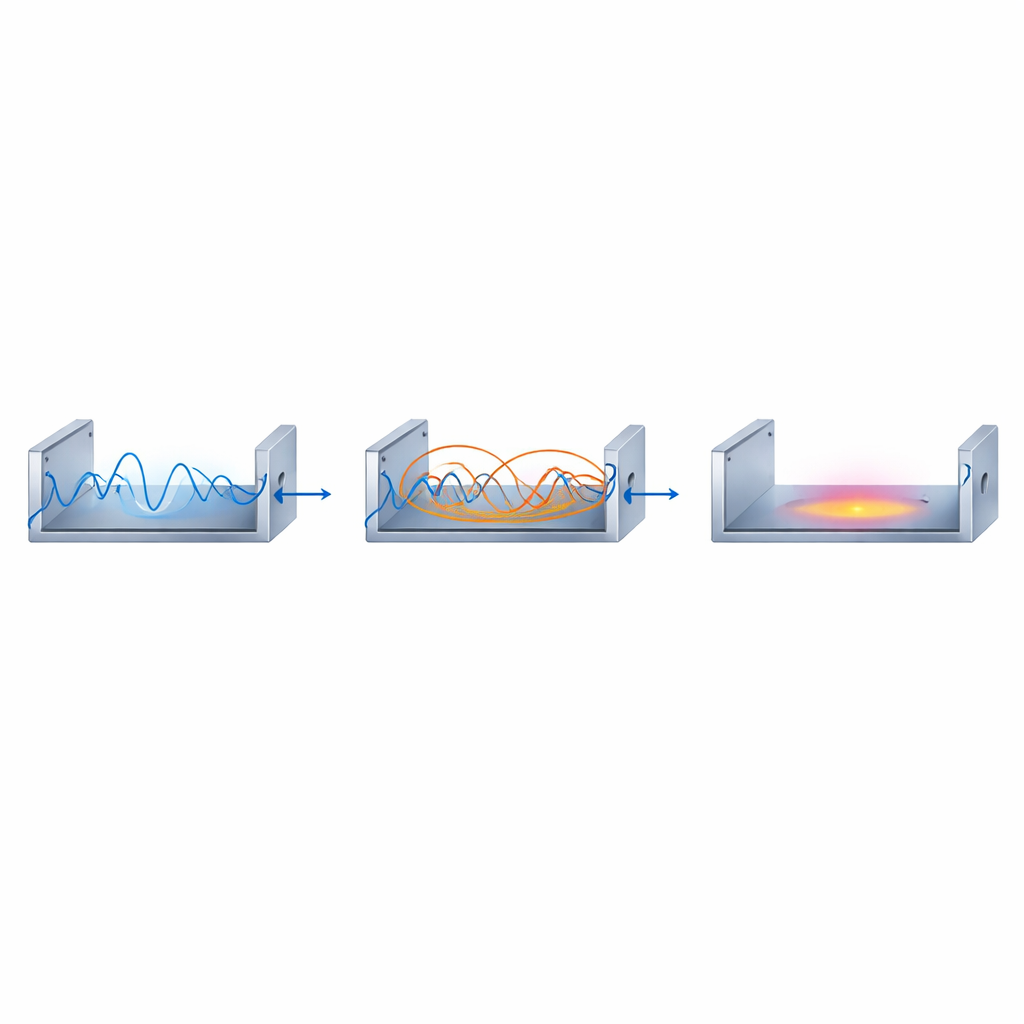
Operating near this balance point unlocks a striking effect: the device can almost completely absorb microwaves coming from one direction, while allowing those from the opposite direction to pass with much less loss. The team measures absorption levels above 99.5 percent for waves incident from one side, a phenomenon called coherent perfect absorption. Importantly, this direction selectivity arises purely from interference and geometry; the underlying transmission pathways remain fundamentally reciprocal, meaning the device does not violate basic constraints of passive circuits. What changes is how the incoming wave decomposes into the hybrid modes of the cavity–magnon system and how interference routes its energy into loss channels.
Why This Matters for Future Technologies
By demonstrating bound states in the continuum, near-exceptional-point behavior, and nearly one-way perfect absorption in a single, fully planar device, the authors introduce a powerful new toolbox for microwave engineering. Rather than relying on complex materials with built-in gain or finely tuned dissipation, they achieve advanced control simply by shaping the circuit and positioning a magnetic film. This geometry-first strategy could lead to compact components that route signals without reflection, store and release microwave energy on demand, or enforce direction-selective absorption—all critical functions for next-generation communication systems and spintronic information processors.
Citation: Kim, B., Kim, SK. Bound states in the continuum and near-exceptional points in a reflection-based cavity-magnonic system. npj Spintronics 4, 14 (2026). https://doi.org/10.1038/s44306-026-00133-3
Keywords: cavity magnonics, microwave wave control, bound states in the continuum, coherent perfect absorption, non-Hermitian physics