Clear Sky Science · en
Magnetically programmable surface acoustic wave filters: device concept and predictive modeling
Turning Sound Waves into Smart Filters
Modern wireless gadgets—from smartphones to Wi‑Fi routers—rely on tiny filters that let just the right radio frequencies pass while blocking the rest. This study introduces a new way to build such filters using ripples of sound that skim along a chip’s surface and tiny magnetic “tiles” that can be reprogrammed. Instead of constantly supplying power to a large magnet to tune the filter, the device can be set once into different internal states that dramatically change how it treats certain signals.
Why Surface Ripples Matter
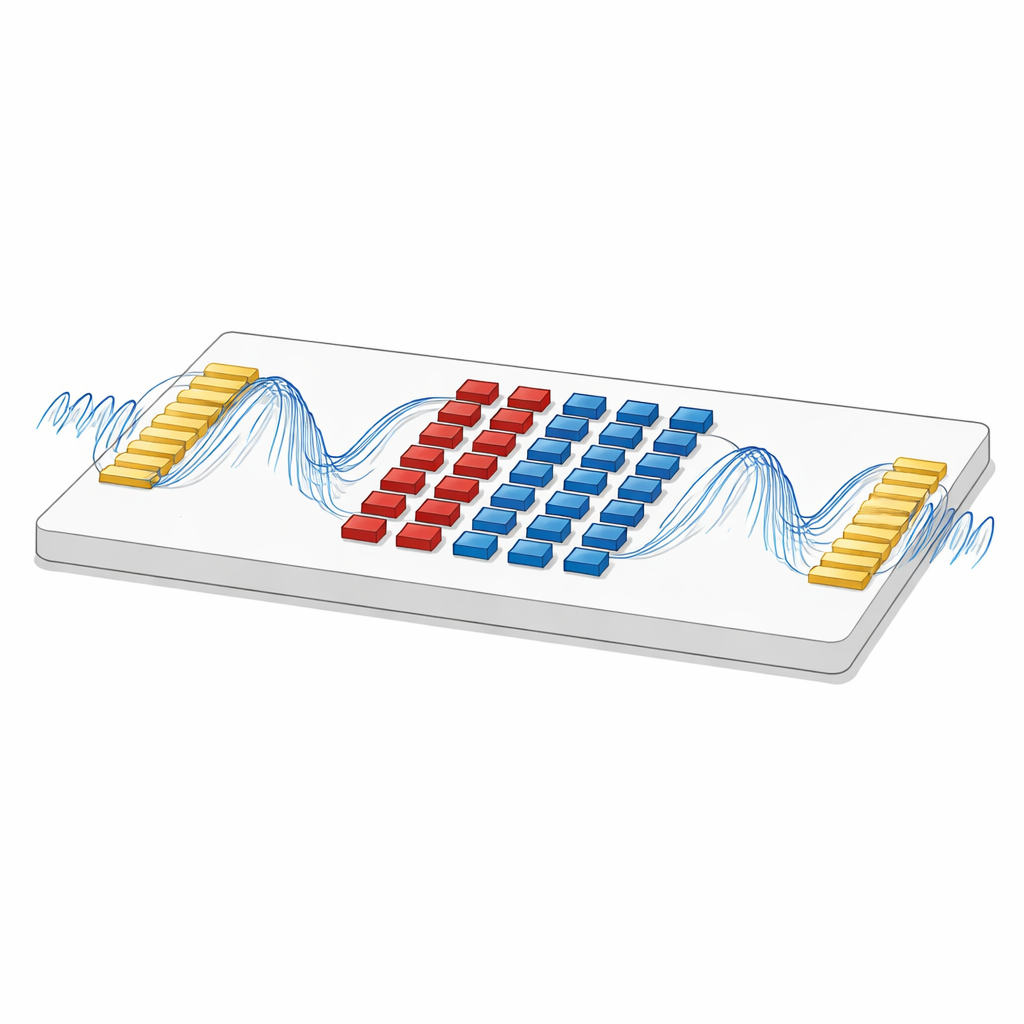
Many radio-frequency filters use surface acoustic waves, which are nanometer‑scale ripples travelling along a piezoelectric crystal. Metal finger electrodes at one end convert an electrical signal into these ripples, which then glide across the surface and are turned back into electricity at the other end. Because the spacing of the fingers matches a specific wavelength, only a narrow band of frequencies is efficiently converted, making these devices ideal as compact, precise filters in communication hardware.
Adding Tiny Magnets to Control the Wave
Engineers have learned that surface waves can exchange energy with magnetism in thin films: at special combinations of frequency and magnetic field, the sound wave can hand its energy to collective magnetic oscillations called spin waves and be strongly damped. Traditionally, tuning this interaction requires a variable external magnet, which is bulky and power‑hungry. The authors propose a different strategy. They place a regular array of nanoscale magnetic islets made of cobalt–nickel multilayers on top of a lithium tantalate crystal that carries the surface waves. Each islet’s magnetization points either up or down out of the surface, and neighboring islets influence one another through their stray magnetic fields, subtly shifting the frequencies at which spin waves are excited.
Programming the Pattern Instead of the Field
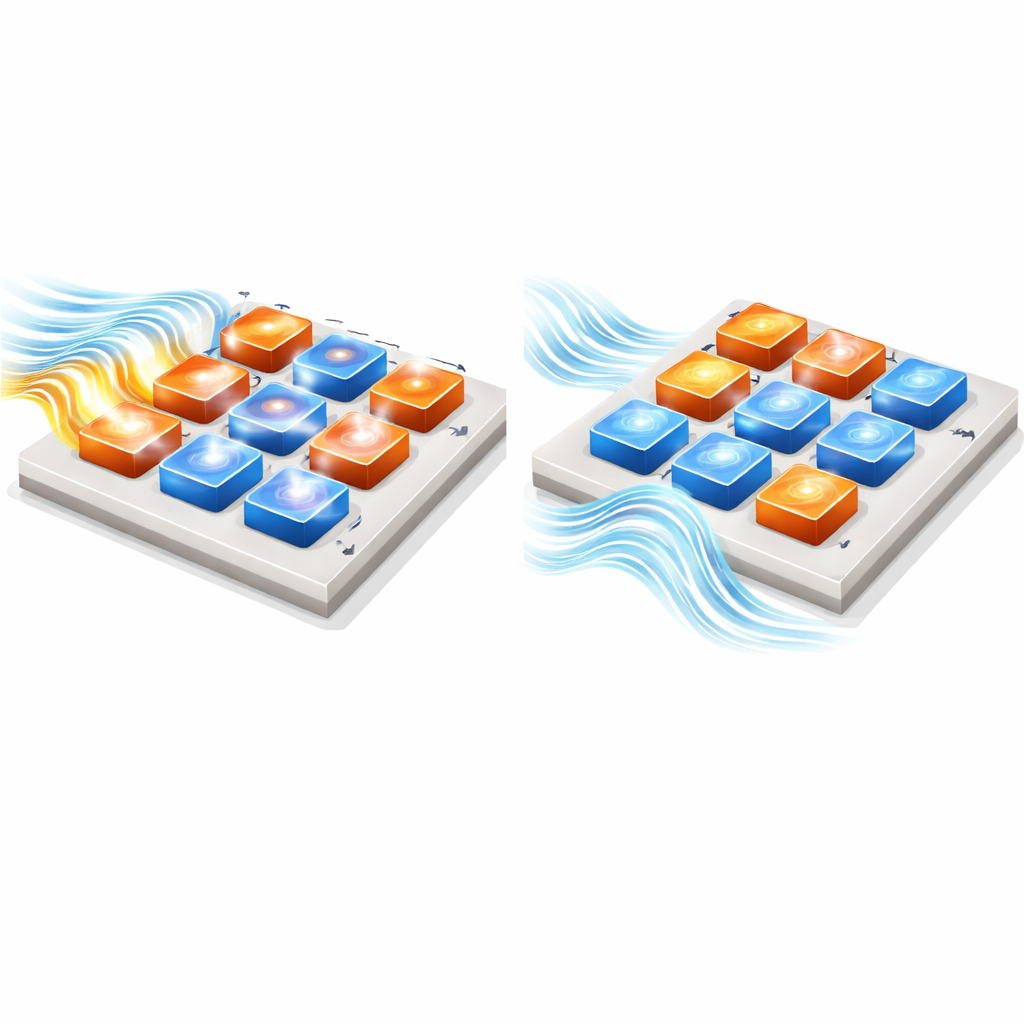
The key idea is that the overall magnetic pattern of the islets—rather than a continuously adjusted external magnet—controls how strongly specific sound frequencies are absorbed. The team compares two extreme states. In the “parallel” state, all islets point the same way, so their fields repel and the internal magnetic stiffness is relatively low. In the “antiparallel” state, neighboring islets alternate up and down, forming flux‑closure loops that stiffen the system and push its resonant frequencies higher. Using detailed micromagnetic simulations, they compute how these patterns alter the spin‑wave dispersion and where it crosses the straight‑line dispersion of the surface acoustic wave, the crossover points where energy transfer and thus damping are strongest.
Simulating How Much the Wave is Dimmed
To predict real device performance without simulating an entire bulky crystal, the authors build a hybrid model. They describe the magnetic dynamics at the nanoscale using the standard Landau–Lifshitz–Gilbert framework, coupled to the strain produced by a known surface wave pattern. By tracking how fast energy flows from the mechanical motion into the magnetic system and comparing it with the total energy stored in the wave, they can estimate how quickly the wave amplitude decays along the device. This uni‑directional model, validated against earlier experiments on simple nickel films, lets them rapidly sweep through many frequencies and magnetic states while retaining realistic physics.
A Switchable Notch in the Radio Band
For a practical two‑dimensional islet array with realistic material parameters, the simulations predict a dramatic, state‑dependent effect. At around 3.8 gigahertz—right in a useful radio band—the surface wave loses about 54 decibels of power per millimeter when the islets are all aligned parallel, but only about 2 decibels per millimeter in the antiparallel pattern. In other words, simply reprogramming the up‑down arrangement of the nanoscale magnets switches a deep, narrow “notch” in the transmitted signal on or off, without changing the chip geometry or continuously varying a big external magnet.
What This Means for Future Devices
To a non‑specialist, the takeaway is that the authors have designed a filter where the pattern of tiny magnets acts like a memory knob for radio waves: once set, it determines which frequencies are strongly blocked and which pass almost untouched. Because the magnetic pattern can be written using a brief magnetic pulse or potentially by spin‑torque currents, the device could combine low power consumption, compact size, and flexible, even multi‑level frequency control. If realized in the lab, such magnetically programmable surface acoustic wave filters could become building blocks for reconfigurable wireless front‑ends, on‑chip sensors, and other technologies that need precise, adaptable control over high‑frequency signals.
Citation: Steinbauer, M.K., Flauger, P., Küß, M. et al. Magnetically programmable surface acoustic wave filters: device concept and predictive modeling. npj Spintronics 4, 13 (2026). https://doi.org/10.1038/s44306-026-00132-4
Keywords: surface acoustic waves, spin waves, reconfigurable filters, magnetostrictive materials, magnonics