Clear Sky Science · en
Tuning of spin-orbit torque efficiency by the interface modification in perpendicularly magnetized Pt-Co heterojunction
Sharper, Faster Memory from Tiny Twists of Magnetism
Our digital lives depend on memory chips that are fast, tiny, and energy‑efficient. A promising class of future memories stores information not with electric charges, but with the direction of tiny magnets in ultra‑thin metal films. This study shows how a gentle treatment of one buried surface inside such films can make these magnetic bits easier to flip, cutting the power they need without harming their stability. 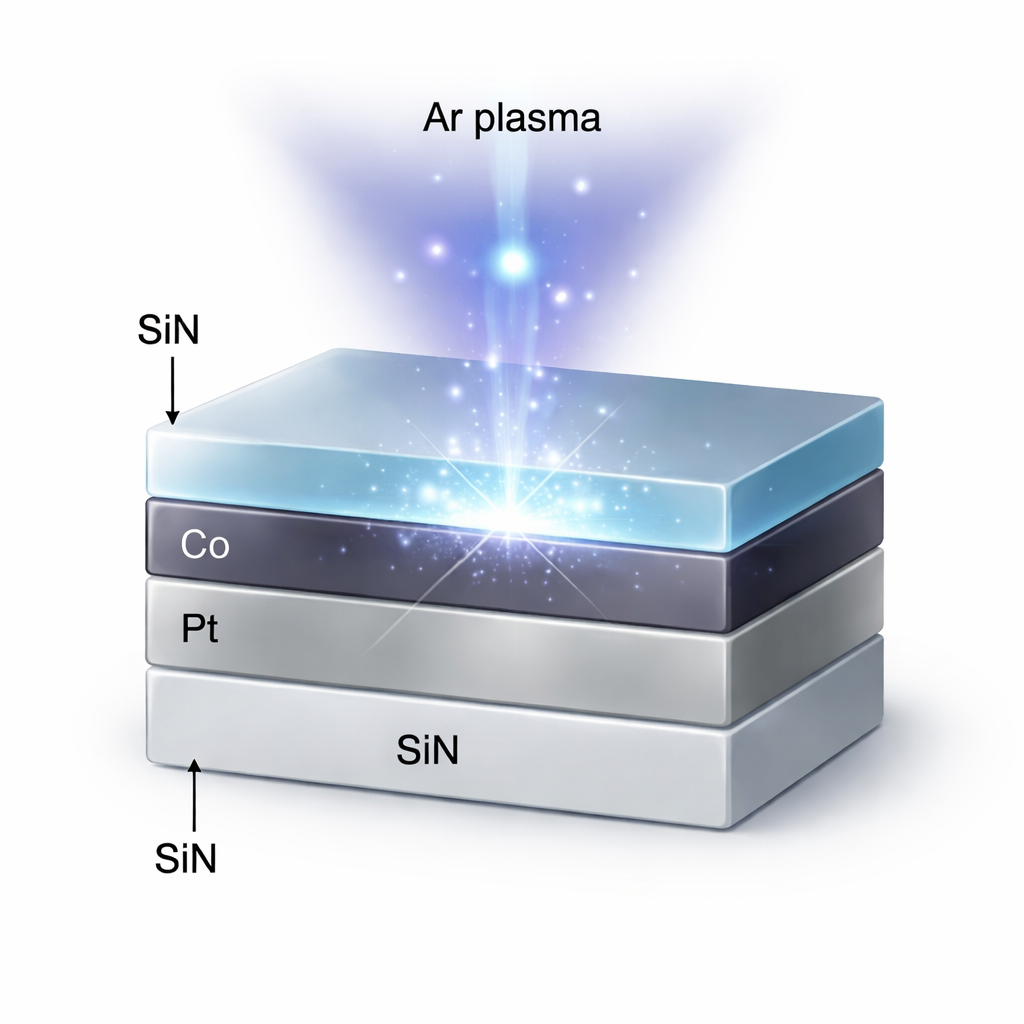
Why Spin Matters in Future Electronics
Conventional electronics move electrical charge around. Spintronics adds another ingredient: the “spin” of electrons, which behaves like a microscopic bar magnet. In many proposed memory and logic chips, a heavy metal such as platinum (Pt) is stacked with a very thin magnetic layer such as cobalt (Co). When an electric current flows through Pt, it can generate a flow of spin that pushes on the magnet in Co, a process known as spin‑orbit torque. This torque can flip the magnet’s direction and thus write a digital 0 or 1, potentially much faster and with less energy than today’s technologies.
The Hidden Importance of an Invisible Boundary
Most efforts to improve these devices have focused on the bulk properties of the heavy metal, trying to boost how efficiently it converts ordinary current into spin. But the authors emphasize something subtler: the interface, the atomically thin boundary where Pt touches Co. Even if Pt makes plenty of spin, that spin must cross the interface into the magnet. If the boundary is rough or disordered, much of the spin signal is lost, weakening the torque. Earlier attempts to tune this interface added extra layers or used ion beams, but these methods can damage the structure or complicate manufacturing.
A Gentle Plasma “Polish” for Better Performance
In this work, the researchers use a simple argon (Ar) plasma treatment directly on the Pt surface before depositing the Co layer. Plasma is a gas in which atoms are partially ionized; in chip fabrication it is routinely used for cleaning and surface preparation. Here, the team made a series of SiN/Pt/Co/SiN stacks and exposed the Pt layer to Ar plasma for different times, from zero up to 16 seconds, without adding any new materials. They then measured how easily the films’ magnetization could be switched by current and how strongly the magnets preferred to point out of the film plane, a property crucial for stable information storage. 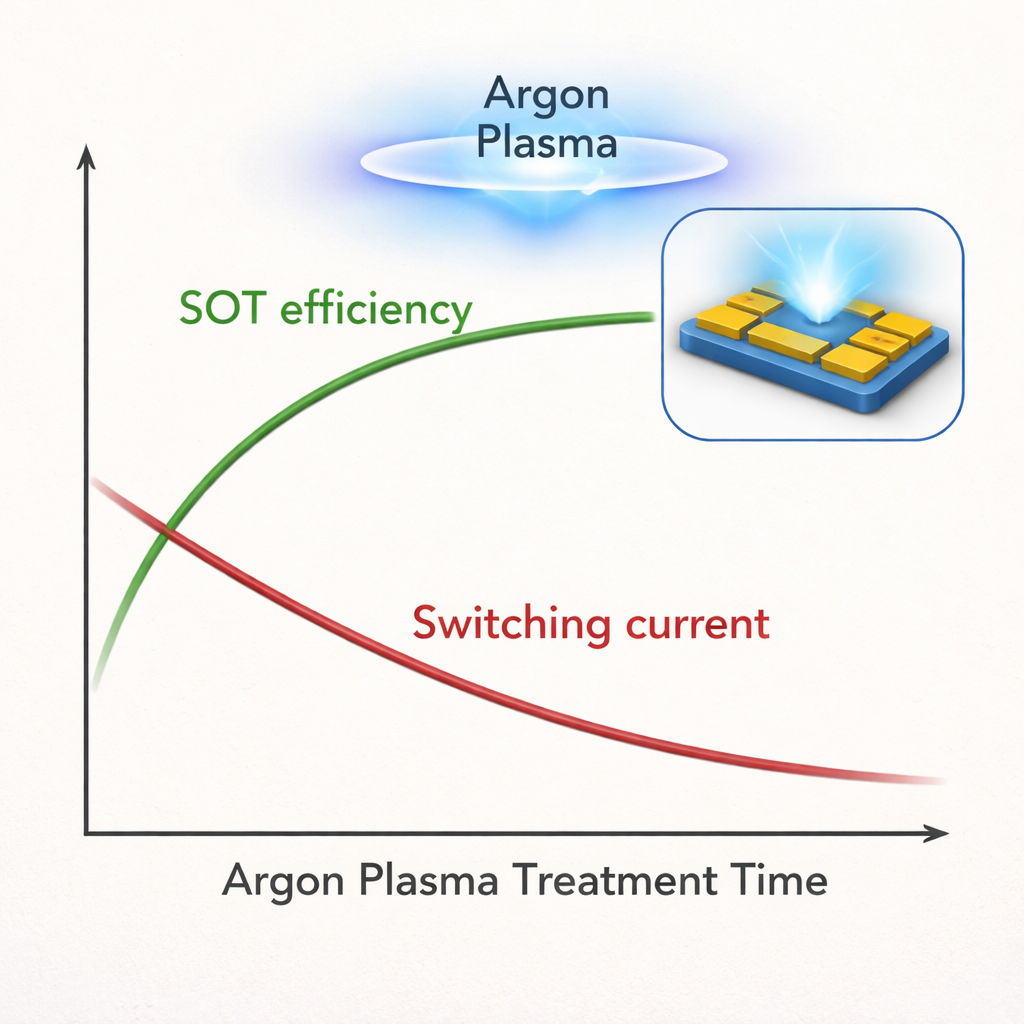
Stronger Spin Push, Lower Write Current
Using sensitive electrical tests called harmonic Hall measurements, the authors quantified the efficiency of spin‑orbit torque, essentially how much magnetic “push” they get for a given current. They found that a modest plasma exposure dramatically boosts this efficiency by up to about 60 percent, peaking around 10 seconds of treatment. Importantly, other basic properties, such as the overall resistance of the Pt layer and the strength of the Co magnet, remain nearly unchanged. This points to a cleaner, more transparent interface rather than a bulk change in the materials. When they performed actual switching experiments—flipping the magnetization with current pulses—they observed that the critical current density needed for switching dropped significantly in all plasma‑treated samples, meaning the bits could be written using less power. The quality of the switching, measured through how completely the resistance changed between magnetic states, was only slightly affected.
What This Means for Everyday Devices
For a non‑specialist, the key message is that a quick, gentle surface treatment can substantially improve how efficiently future magnetic memory cells operate. By subtly smoothing and cleaning the boundary between two nanoscale metal layers, the researchers allow more of the useful spin signal to get through, so the magnets flip with less effort. Because argon plasma treatment is already common in chip manufacturing and does not alter the overall layer stack, this approach is practical for large‑scale devices. If adopted in industrial processes, it could help pave the way toward faster, more reliable, and lower‑power spintronic memories and logic circuits that underpin the next generations of computing hardware.
Citation: Li, R., Zeng, G., Zhang, J. et al. Tuning of spin-orbit torque efficiency by the interface modification in perpendicularly magnetized Pt-Co heterojunction. npj Spintronics 4, 12 (2026). https://doi.org/10.1038/s44306-026-00131-5
Keywords: spintronics, magnetic memory, spin orbit torque, plasma treatment, Pt Co interface