Clear Sky Science · en
Effects of interlayer Dzyaloshinskii-Moriya interaction on the shape and dynamics of magnetic twin-skyrmions
Little Magnetic Whirls as Future Information Carriers
As our hunger for data grows, engineers are hunting for new ways to store and move information that are faster, smaller, and more energy-efficient than today’s electronics. One promising route uses tiny whirlpool-like patterns in magnets, called skyrmions, as information bits. This paper explores how a special kind of magnetic coupling between two ultra-thin layers can reshape these whirls and steer how they move, potentially giving chip designers much finer control over future skyrmion-based devices.
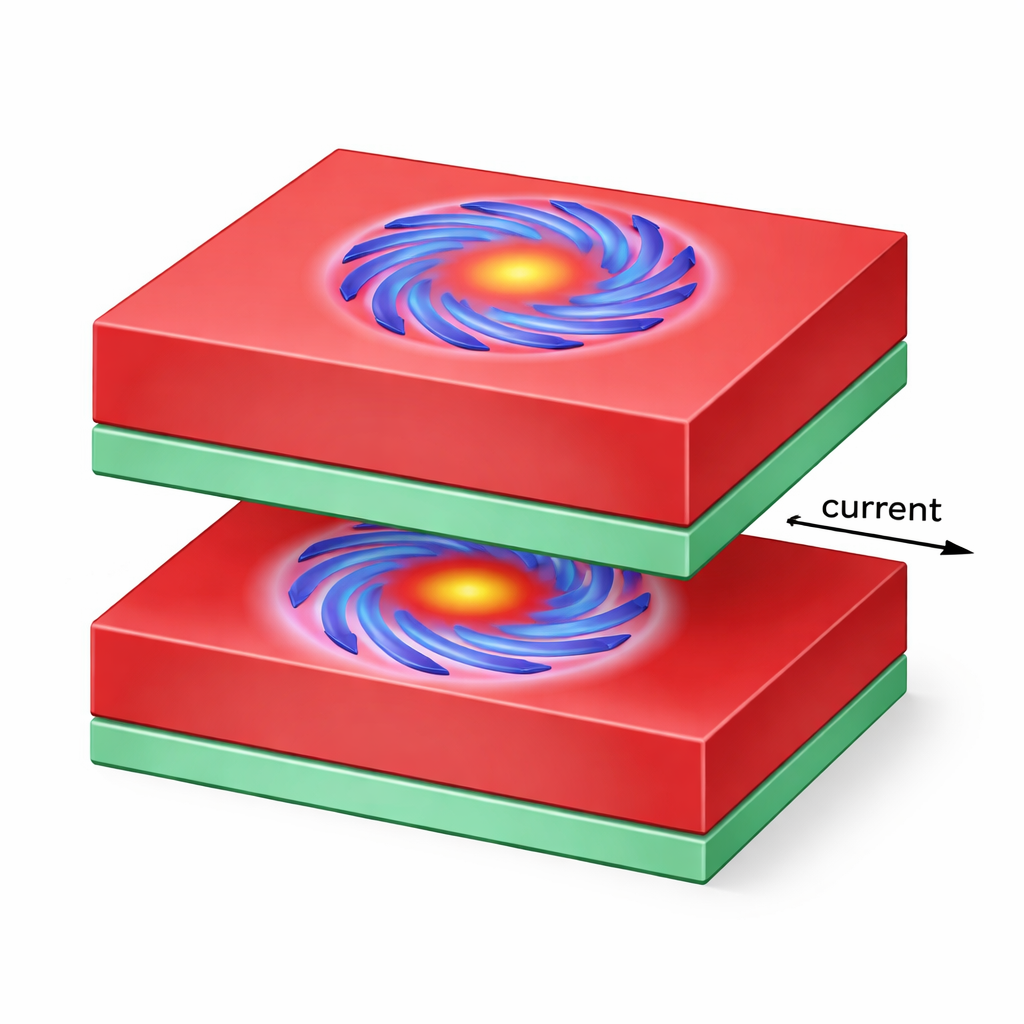
Twisting Spins in Stacked Magnetic Films
The authors study a sandwich of two magnetic layers separated by a thin non-magnetic spacer. In each magnetic sheet, the atomic magnets (spins) can arrange into a skyrmion: a nanoscale swirl where spins at the center point up, those far away point down, and those in between rotate smoothly in the plane. When two such layers are stacked and coupled in a particular way, skyrmions form in both layers, but with opposite spin directions, creating a three-dimensional pair the authors call a “twin-skyrmion.” The work focuses on how an interaction known as interlayer Dzyaloshinskii–Moriya interaction (IL-DMI) changes the shape and internal twist of this paired structure.
How a Hidden Coupling Stretches and Twists the Whirls
Using detailed computer simulations based on a standard model of magnetism, the team varies the strength and direction of IL-DMI and watches how the twin-skyrmion responds. When this coupling lies in the plane of the layers, it nudges the spins in the two films to tilt in opposite directions. To lower its energy, the twin-skyrmion stretches into an oval, elongating roughly along or across the direction of the coupling, depending on how the spins rotate inside the swirl. If this in-plane coupling becomes strong enough, the oval becomes unstable and tends to open into stripe-like patterns, showing that the interlayer interaction can fundamentally reshape magnetic textures.
Changing the Inner Twist Without Breaking the Shape
When the IL-DMI instead points out of the plane, the overall skyrmion stays round, but its internal twist changes differently in the two layers. In one film, the swirl rotates slightly clockwise; in the other, slightly counterclockwise. As the out-of-plane coupling grows, this difference in twist increases roughly in proportion, and the twin-skyrmion also grows larger in radius. The authors confirm these trends both with atom-by-atom simulations and with simplified continuum equations, showing that the effect is robust and could be tuned by material choice or external controls such as electric fields.
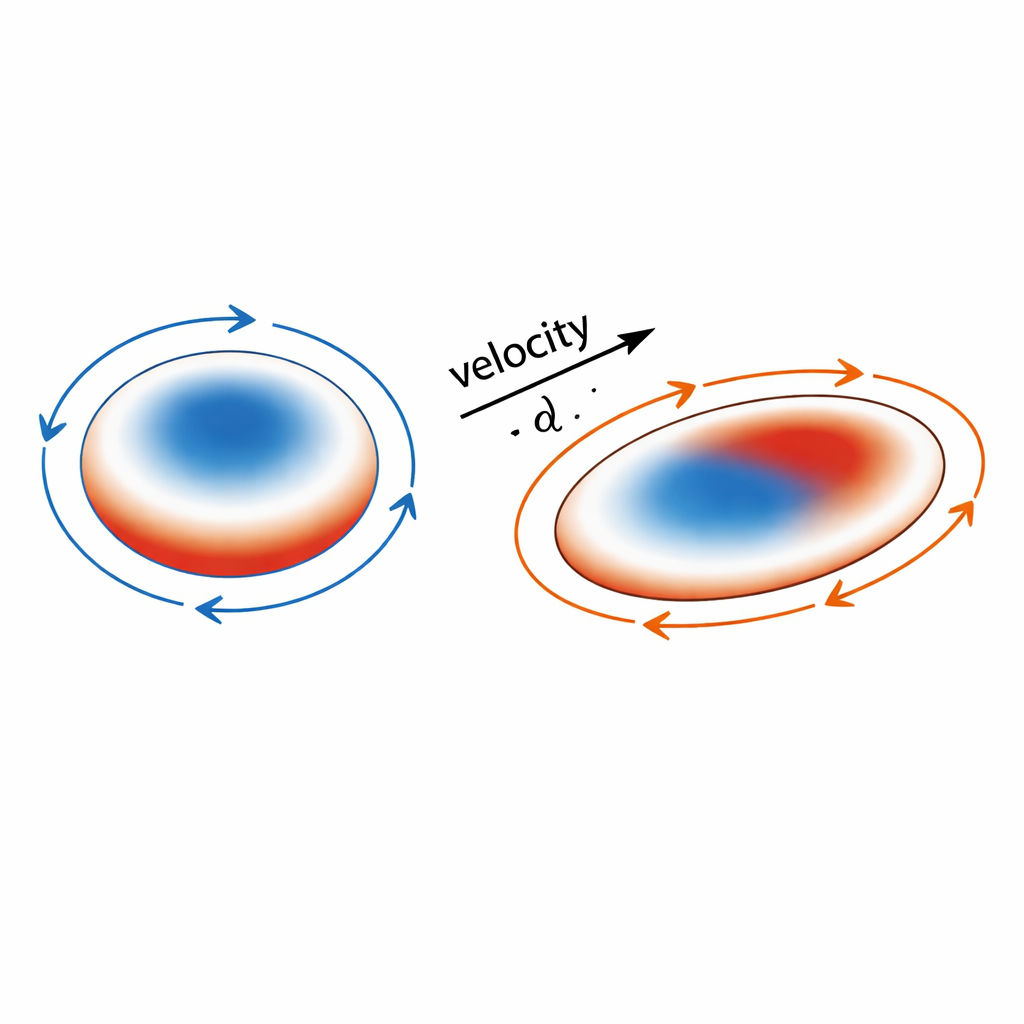
Guiding Skyrmion Motion with Current
Beyond static shapes, the study examines how twin-skyrmions move when driven by an electric current flowing beneath the stack, which generates a spin-torque pushing the whirls through the material. In this “current-perpendicular-to-plane” setup, the IL-DMI strongly affects both the speed and the direction of motion. With in-plane coupling, a stretched twin-skyrmion tends to move faster along its long axis; when the preferred motion from the current is misaligned with this axis, the speed drops and the path bends back toward that of an uncoupled system. By carefully choosing the coupling direction, one can either boost speed or adjust the sideways deflection angle—the so‑called skyrmion Hall angle—largely independently.
Why These Twinned Whirls Matter
For non-specialists, the key message is that a subtle interlayer interaction acts like a steering wheel and shape-control knob for skyrmions in stacked magnetic films. It can stretch these magnetic whirls, twist their internal pattern differently in each layer, and tune how quickly and in what direction they move under current. Because this coupling can itself be adjusted, for example by electrical means, twin-skyrmions offer a flexible platform for future memory and logic technologies that exploit three-dimensional magnetic structures to encode and process information with low energy cost.
Citation: Matthies, T., Rózsa, L., Wiesendanger, R. et al. Effects of interlayer Dzyaloshinskii-Moriya interaction on the shape and dynamics of magnetic twin-skyrmions. npj Spintronics 4, 8 (2026). https://doi.org/10.1038/s44306-026-00129-z
Keywords: magnetic skyrmions, spintronics, magnetic multilayers, topological magnetism, skyrmion dynamics