Clear Sky Science · en
Curvilinear magnetic effects in helicoid nanotubes
Twisting Tiny Magnets into New Shapes
Modern memory chips and magnetic sensors are mostly flat, built like tiny city blocks on a two-dimensional wafer. This study asks what happens if we leave the flat world behind and twist magnetic materials into a three-dimensional spiral, like a miniature curly ribbon. The authors show that this unusual shape does not just look different – its curves and twists fundamentally change how magnetism behaves, opening up new ways to store and move information at the nanoscale.
Why Shape Matters for Magnetism
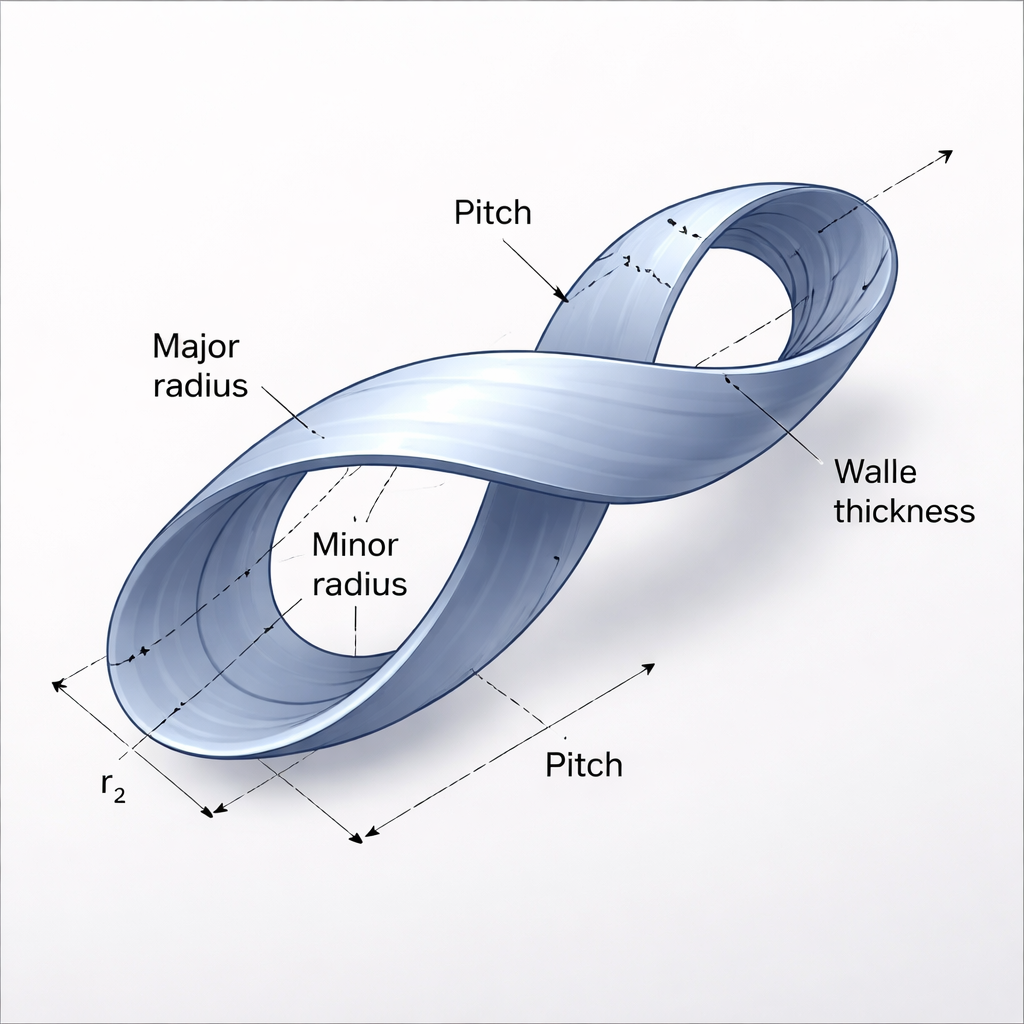
At small scales, the way a magnetic material bends and curves can alter the basic forces that govern how its tiny magnetic moments line up. The researchers focus on "helicoid nanotubes" – hollow magnetic structures shaped like a twisted ribbon wrapped into a tube. By changing how tightly the ribbon is twisted (its pitch) and how stretched its cross-section is (its major and minor radii), they can tune the surface curvature from almost flat to strongly saddle-shaped. These changes in curvature are not cosmetic: theory predicts that they can create new effective interactions, favor certain swirling magnetic patterns, and even push magnetic boundaries, known as domain walls, to move.
Building Three-Dimensional Magnetic Ribbons
To study these effects in real materials, the team first "3D-prints" delicate, non-magnetic scaffolds using a focused electron beam to draw a platinum–carbon helicoid directly onto a transmission electron microscopy grid. They can precisely control the pitch of each structure, down to a few hundred nanometers. Next, they coat these scaffolds with a thin shell of Permalloy, a common nickel–iron magnetic alloy, using magnetron sputtering from opposite sides to form a closed nanotube. Electron diffraction and elemental mapping confirm that the result is a clean core–shell structure: an amorphous Pt:C core wrapped in a continuous, polycrystalline magnetic shell with uniform thickness around the twisted surface.
Imaging Hidden Magnetic Patterns
The authors then use electron holography, a technique that turns an electron microscope into a phase-sensitive camera, to visualize the magnetic field inside and around a single helicoid nanotube. In an as-prepared tube with uniform pitch, they find a simple state where the magnetization mostly points along the tube’s length, but with a subtle twist that follows the geometry. Simulations reveal that the spins acquire a vortex-like rotation due to the curved surface, so the magnetic "handedness" mirrors the physical handedness of the helicoid. When they apply a strong sideways magnetic field, a more complex structure appears: a vortex–anti-vortex domain wall, a pair of swirling magnetic textures that prefers to sit in regions where the tube is less tightly twisted and therefore less curved. This confirms that the local curvature landscape guides where these magnetic features can form and remain stable.
Chirality as a Magnetic Traffic Light
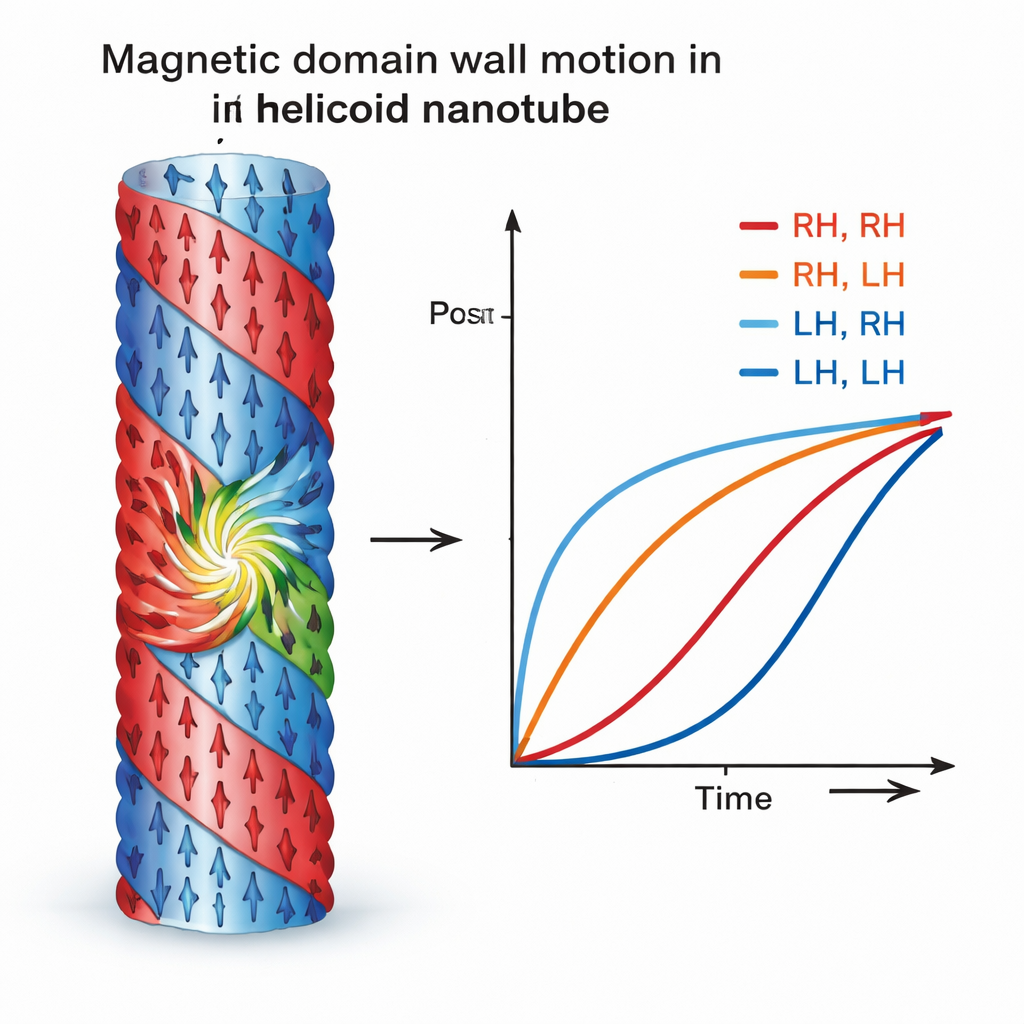
Beyond static patterns, the study explores how domain walls move along the twisted tube under an applied magnetic field. Using detailed micromagnetic simulations, the authors analyze a simpler, energetically favored vortex domain wall and track its motion for different combinations of magnetic chirality (the sense in which the spins swirl and the field points) and geometric chirality (whether the helicoid itself is right- or left-handed). They find that when both chiralities are right-handed, the domain wall travels quickly and smoothly along the tube. If the magnetic and geometric chiralities work against each other, the wall slows down, jitters, or even stops after a short distance. Tighter twists (smaller pitch) raise the energy cost of hosting a domain wall and reduce its speed, amplifying these chirality-based effects.
New Knobs for Future Spintronic Devices
For a non-specialist, the key message is that magnetism in these nanoscale spirals can be steered not only by material choice or external fields, but also by the three-dimensional shape itself. By carefully designing the twist and handedness of helicoid nanotubes, engineers could create magnetic tracks where information-carrying domain walls naturally form in specific regions and move quickly or are deliberately slowed or stopped elsewhere. This added "geometric control" points toward a new generation of three-dimensional spintronic devices, where curves and spirals become active design tools for routing and processing information in ultracompact magnetic circuits.
Citation: Fullerton, J., Phatak, C. Curvilinear magnetic effects in helicoid nanotubes. npj Spintronics 4, 10 (2026). https://doi.org/10.1038/s44306-026-00128-0
Keywords: curved magnetism, helicoid nanotubes, spintronics, domain wall motion, magnetic chirality